Annapurna Sanctuary
annapurna base camp trek
Annapurna Ranges

Annapurna Base Camp Trek - 11 days

314 reviews in TripAdvisor
27 reviews in Google Reviews
Recommended by 99% of travelers
Duration11 Days
Trip GradeModerate
Maximum Altitude4130m/13550 ft
ActivitiesTrekking
Group Size1-30
StartsPokhara
EndsPokhara
Best TimeMarch-May, Sep-Nov

The Annapurna Base Camp Trek in Nepal provides you a front row ticket to stand in the shadow of the world's 10th-highest mountain, Mt. Annapurna I (8091 m), with a face-to-face panorama of  Annapurna and the Dhaulagiri range, and also visits the vantage point of Poon Hill (3210 m), and allows you to relish in the hot spring water at Jhinu Danda in the western himalayas.

Detailed Overview

Our Annapurna Base Camp Trek stands out as it includes visits to Poon Hill and the Annapurna massif foothill, all wrapped into one exceptional journey. Along the trekking route, other than just natural diversity, the trekking trail also describes the Tibetan-influenced communities, with small temples, mani walls, chortens, prayer wheels, and colourful prayer flags, promising to transport one into the ancient era, whereas, relishing at Jhinu Danda, with the surrounding hills, feels no lesser than a jacuzzi, after such a tiring adventure.

This trail offers a perfect blend of ecosystem, rich Himalayan flora and fauna, with many dense forested sections dotted with blooming rhododendrons, in the shade of pink and red, along with a cross over of several suspension bridges, river streams, cascading waterfalls, and hot springs, showing the untamed beauty of the Annapurna Conservation Area.

Throughout the journey, you will be accompanied by numerous gigantic mountains, including Gangapurna (7456 m), Macchapuchare - Fishtail (6994 m), Himalchuli (7894 m), and the almighty Annapurna massif itself, with six other distinct peaks over 7000 meters, along with the panorama of Annapurna I (8091 m) itself with it's distinct view from the beginning till the very end.

Being known as an all-around trek, despite being a mountainous adventure, this adventure can be successfully commenced by anyone, without demanding any age or prior experience, with our fine customised itinerary, which is why it is also considered one of the classic family treks here in Nepal.

However, it is highly suggested to visit the legendary Annapurna Sanctuary during peak seasons, Spring and Autumn, especially if you are a beginner, or venturing out with kids, or senior citizens, for a safe, comfortable, and easy journey with unhindered views of landscapes and mountains at the same time. Meanwhile, adventure seekers having a long duration time can consider combining with the Annapurna Circuit for a comprehensive, thrilling experience, within the Annapurna region.

In the first half, this trip covers the trail to Poon Hill, known as the best panoramic viewpoint that shows 19 notable peaks, including Annapurna and the Dhaulagiri massif. Afterwards, lets you pass through culturally rich settlements such as Ghandruk, Tadapani, Upper Sinuwa, Deurali, and Macchapuchare Base Camp, finally leading to the ABC and descends to Bamboo, Jhinu Danda - with a relish to natural hot water pool - an impeccable way to conclude this 11-day trek before returning to Kathmandu.

While we may think that the sanctuary journey is all about eye-catching experiences. The hospitality of distinct communities like Gurung, Magar, and Thakalis rewards us with their heart-wrenching culture and tradition. Their greetings with smiley faces while welcoming us to their small villages and lodges provide a comforting relief to our tiring hike. Don’t miss out on strolling around these tiny settlements in the lap of the Himalayas. 

In short, it is a roller coaster ride in the Himalayas that shows the unique side of the earth that leaves an indelible mark on us forever. For someone who loves to experience something new and is trending with the feel of a mini mountaineering experience in Nepal, this trip is perfect for you.

Highlights

  • Enjoy the marvellous transition of the landscapes, from the bustling city of Kathmandu, to green hills, along with the roaring scenic view of the rivers and Nepal's countryside, to the wetland city of Lake Pokhara
  • Spend a day in the thriving city, enjoying a sightseeing tour to some of the heritage sites, temples, or gaze at Phew Lake (Lakeside), with the backdrop view of Mt. Macchapuchare, for more thrill, engage in boating, kayaking, etc. 
  • Attain the iconic Poon Hill viewpoint - 3210 meters, and relish in the sunrise view over the Annapurna and Dhaulagiri range
  • Take an insight into the diverse indigenous communities, such as Magar, Gurung, Rai, immersing in the warm hospitality of locals and their mountain lifestyle
  • Unveil the unique culture of the Gurung communities en route, enjoying their local delicacies such as Dhido, Gundruk, Tibetan bread, ghee items, and the ultimate Dal Bhat
  • Traverse along the diverse ecosystem of flora and fauna in the Annapurna Conservation Area from the start
  • Soak in the unparalleled views of the heavenly iconic mountains such as Annapurna I (8091 m), Gangapurna, Machhapuchare, stretching over the Dhaulagiri range 
  • Visit the naturally formed Hinku Cave while making the way to the Macchapuchare Base Camp (MBC)
  • Reach the highest viewpoint of this trekking trail - the lap of the world's tenth-highest peak, Mount Annapurna

Annapurna Base Camp Trekking Route

Starting with a drive to Pokhara from Kathmandu on the very first day, and the drive continues to Hile via private vehicle on the next day.

The walking trail begins from Hile toward Ulleri, bypassing several settlements, and reaches Ghorepani the next day. The village is solely covered with the rhododendron forest with similar hamlets and decorated hamlets of locals, of the Gurung and Magar communities - a lifetime opportunity to immerse in the rich hospitality of these ethnic groups.

One of the most highlighted sections of this Annapurna Base Camp trail is the “Poon Hill”- which stands out as the viewpoint offering the prominent views of 19 countable peaks. Waking up early at 4 AM, just before the sunrise dawn through stone staircase section, and attaining to the Poon Hill view point is an achievement itself, as it rewards us with a panoramic view of the Annapurna range stretching to Dhaulagiri, Annapurna South, Nilgiri, Machapuchare, and many other iconic peaks - a surreal moment to keep within us forever and ever!

On this day, the trek leads us to Tadapani, Chhomrong, and finally to Upper Sinuwa, entering the gateway that takes us to the heart of Annapurna Sanctuary, and then to Deurali on the next day.

Bypassing through several popular villages along with the Modi Khola Valley, finally the trek leads us to  Machhapuchhre Base Camp and then to Annapurna Base Camp- 4130 meters, surrounded by a 360-degree panorama of Annapurna and Dhaulagiri Range. The following days, traverses by Bamboo, Deurali, Dovan, Himalaya, and take us to Jhinu Danda - a natural hot spring amid the Himalayas within the heart of the Annapurna region.

This route follows the same pathway, but stops by different famous stopping points, letting you get an in-depth and unique perspective of this odyssey of 11 days. The Annapurna Base Camp concludes with a downhill walk to Siwai and then finally drives back to Pokhara following Nayapul (New Bridge) and returns to Kathmandu, from where the journey started.

Note down that every itinerary of ours is easily customizable to your preference, that suits your timeframe, and routes. We’ll have a short discussion to tailor your packages to your choice, where our team will guide you thoroughly and explain each detail.

What makes the Annapurna Sanctuary Trek worth it?

Amongst all, the trail to ABC simply stands out as the no.1 trek located in the land of the Himalayas, as it takes you straight to the lap of one of the eight thousanders, surrounding you with a panorama of almighty peaks. This itinerary of 11 days from Kathmandu is genuinely crafted, ensuring that this odyssey takes you to every highlighted corner of this legendary trailhead without missing anything within the Annapurna region, letting you pass through the vibrant woodland of thriving rhododendron forest and several notable villages, finally to the alpine meadows of the iconic peak. 

Sparkling Panorama Mountain Views to Gaze at

This adventure to Annapurna Base Camp is equally an eye-appealing trek, filled with stunning views of snow-capped peaks. From the beginning, the journey rewards us with the Annapurna and Dhaulagiri ranges on our left side. While we climb up in the following days, we get to catch a stunning glimpse of several mountains rising gloriously, along with the Annapurna South, Annapurna I itself, the eighth-highest peak in the world.

From the very start, the breathtaking beauty of mountains like Mt. Machapuchare is in the shape of fishtails alike, and reaching the base camp of Mt. Annapurna showcases the panoramic views of glorious mountains shining in the crystal clear sky. Just imagining this feels like a magical world. But, this is not the end! The vistas of other peaks like Gangapurna and Himalchuli rising high in the clear sky just add a feel of serenity to this strenuous trek.

Annapurna Conservation Area: Where Nature Thrives with Elusive Wildlife

This trail meanders along the Annapurna Conservation Area, right from the very beginning, where the untamed beauty of the pristine flora and rare wildlife thrives. During the spring, we get to unravel the blooming rhododendrons, pines, oaks, dotted in the red and pink shade, whereas the autumn shows the marvellous transition of the colourful flora into more crusted leaves and brown landscapes, making the trailhead truly captivating.

Meanwhile, travelling in the wintertime demonstrates the snowy flakes covering the alpine valleys, with the clear vista of the mountains, in the fish lens view, where we get to feel the serenity, in a peaceful terrain. With the chirping sound of the Himalayan birds, which echoes in the forest area, and the surprising encounters with the rare fauna, such as langur monkeys, Himalayan tahr, elusive red panda, and even snow leopards at higher elevations, if luck is on your side, it is a win-win situation to hike along such a pristine area, no matter what day, what season, or how long you venture out.

Iconic Side Trip to Poon Hill: Sunrise Golden Views above 19 Notable Himalayan Peaks

This odyssey also reaches to one of the most loved vantage points - Poon Hill or you can say the heart of Annapurna Trail, that demonstrate the 19 iconic peaks including the Annapurna and Dhaulagiri massif, stretching to the most prominent view of Machapuchare, Nilgiri, Annapurna South, and many others undering the golden hues and pink shade painting the tip of the highest mountains. Imagine sipping a cup of hot tea and being amused by the paradise mountain views. That's what makes our early morning 4 AM hike to Poon Hill viewpoint, and get rewarded with the panorama, without any technical climbing section, well! That's what defines this top point at 3210 meters.

Get Awed by the Heartfelt Hospitality: Magar and Gurung Communities

Apart from offering magical views of several snowy mountains and landscapes, this adventure stands out to soak in the rich cultural diversity of locals with distinct ethnic communities. The route is filled with Gurung, Magar, Tamang, and Sherpa people and their hamlets. From the very beginning to the end, we get to live their lifestyle and indulge in their local foods. All the lodges that we’ll be staying at throughout the trek are run by these kind-hearted people. Here, we get to see, experience, and get to live in the present moment with them.

Relish in the Natural Hot Spring at Jhinu Dada

As we travel through this region, we can see many small natural hot springs. Jhinu Dada stands out as the major highlight of this odyssey. This hot natural spring lies just in the lap of the mountains, where trekkers can cleanse their bodies and souls and have some relaxation time. On top of that, local people think that it has some healing power that heals the tiring body and aches. 

Well-Structured Itinerary with Balanced Pace

With all those enchanting views and cultural immersion, you are simply going to be rewarded with the only thing that might think, whether it is a beginner-friendly short trek or safe enough to commence. Well! If that’s the case, then do not settle back, as this Annapurna Base Camp Trek itinerary is tailored with a gradual ascent without rushing the pace, ensuring that any pace of hikers can easily venture out on this journey with us, making it one of the most loved beginner and family-friendly treks in Nepal. It simply allows you to hike with ease through well-facilitated accommodations, feasible transportation, and covers every corner, hence try something different this year in 2025 and 2026 to the mountains with your loved ones with a hassle-free adventure.

How does the trip get started and end?

Soon after you arrive in Nepal, please let us know your arrival date and time in advance, so we can come to pick you up at the airport, welcome you, and safely escort you to the hotel via private vehicle. In the evening, or whenever your time fits, we will have a brief regarding the expedition and how it goes, and also get you to introduce yourself to the guide who will assist you throughout the journey. If you haven't sorted out the gears and other essentials, then our expert teams will lead you to buy and rent gears in Thamel, Kathmandu. On top of that, we also provide several gear items as a complimentary, like a t-shirt, cap, and a sleeping bag (must be returned after the trip), a basic first aid kit, which will be distributed before the trek.

The guide will come to pick you up at the hotel where you are staying, and the trip begins soon from Kathmandu via tourist bus to Pokhara, and the journey starts right from Pokhara on the very second day, toward Hile - the starting hiking point of the journey, then the hike proceeds on.

The hiking trail concludes at Siwai via Jhinu Danda (Hot Spring), and the overall journey ends after taking a drive to Pokhara and finally at Kathmandu on the following 2 days. On your departure day back home, one of our DHT airport representatives will guide you to the airport to drop you off via private vehicle.

Airport pickup → Kathmandu hotel → Bus to Pokhara → Hike from Hile → End Siwai → Pokhara → Kathmandu → Airport drop

ABC Weather by Season

Even though the weather conditions at Annapurna Sanctuary are not predictable, with the possibility of dropping quickly, to cold temperatures anytime soon, with heavy snow, winds and avalanche hazards, it is essential to forecast correctly and be prepared accordingly. The major factor that highly influences the climate situations stands out to be the season in which you are proceeding on the hike. 

During the spring starting from mid March to late May and autumn (September to November), which are considered the peak seasons, the weather remains stable, with the temperature ranging from 16°C to 20°C, and falls to only 5 °C to 9°C, offering sunny days, to explore the lap of the almighty Mount Annapurna, and settle in at night, in a cosy dining area, mingling with other hikers and interact with locals. Due to the unchanging weather conditions and no expected heavy precipitation, the panoramic views can be best experienced during peak seasons. 

In the winter season, the temperature takes a gradual drop to -15 °C to -22 °C, at night, demanding a sleeping bag and warm layer clothing to avoid the cold altitude, mainly in December, January, to mid February.

On the other hand, the monsoon time experiences unpredictable weather and climate conditions, where heavy snow and rain fall with high winds and precipitation are expected throughout the trail, especially from July to August. The humidity remains high, with the temperature ranging from 18 °C to 22 °C in low terrains, and around 25 °C at the highest at the base camp itself.

ABC Trek Difficulty: Beginner-Friendly Moderate

ABC rates moderate adventure that can be easily completed if the preparation is done well. If you have a basic level of physical fitness and are medically okay, then you can complete this trip smoothly.

Keeping these things aside, the only thing that could lead to a major problem is altitude sickness. As this base camp odyssey takes you to an altitude of 4130 meters, you need to avoid any alcoholic beverages and drink plenty of water and hot soups in such high altitudes. This itinerary is comprised of a week to make you gradually adapt to these drastically changing altitudes. There’s nothing to worry about commencing this voyage; our expert guides will make sure that you are acclimatised properly before ascending.

Moreover, it is an easy-track adventure where different groups of people, whether solo, family, or friends, are welcomed, and this wonderful journey can be completed by people of any age, having a positive perspective and a clear mindset. It is not necessarily important to be an experienced trekker, but you’ll require a professional trekking agency that provides amazing guidance along with a porter and guide.

Note to take all the basic first aid requirements for emergencies, and hire a professional guide to make your trek easy and successful. To know more in a detailed way, you can check out our recently updated blog by pro experts entitled: ABC Trail Difficulty level with guided tips.

Annapurna Base Camp Trek Cost for 2026 and 2027

The cost for the Annapurna Base Camp package highly depends on how your itinerary has been set, the route that you are taking, the comfort level regarding transportation, and most importantly, the number of hikers in your group. The cost also basically depends on season variation, while the cost basically remains the same at peak seasonal time, whereas it might cost more in the off-season, considering the challenging aspects at the trailhead.

Meanwhile, our ABC cost starts from USD 545 to USD 865 per head, which covers all the requirements of the trip, such as an experienced licensed guide, transportation accessibility to reach the starting point, required trekking permits, standard meals, and accommodations, whatever is required for the trek. Whereas the cost gets minimised, with the increasing number of hikers in your group, this pricing is crafted to ensure a cost-effective journey. Also, the itinerary supports the gradual ascent as well. However, if your estimated budget and time period don't match your preference and choice, then it can be customised, as per your essentials.

Here is the costing crafted for the years 2026 and 2027, on a group basis:

No. of Hikers Price/Person
1-1 USD 749
2-3 USD 649
4-5 USD 599
6-8 USD 579
9-12 USD 549

Why Trek with Destination Himalaya Treks and Expedition?

With experience of serving more than a hundred trekkers across the globe, Destination Himalaya Treks is proud to craft your trek with a gradual pace, covering every trail of the Annapurna region. Besides, our trekking guides are highly experienced and carry a great expertise to make your trip safe, meaningful, and fruitful at the same time. Having said that, no one can let you or showcase you the best of the Himalayas, unless they haven't ventured out themselves.

Our DHT Team, every season, every year, goes by the route and looks forward to crafting packages just like that. We've crafted this 11-day ABC sanctuary plan from Kathmandu - the capital city, ensuring the feasibility soon after your landing in Nepal.

Besides, our costs are transparent; whatever you see, you get it, and we never charge hidden charges. We offer other benefits for the booking of the trip for 2026 and 2027. So your trip becomes even more enjoyable. The Destination Himalaya Treks team will organise customised treks for you depending on your limitations, available time, and budget. We make custom plans for you when our standard schedules do not match your needs. Please reach us at info@destinationhimalayatreks.com for additional information, or reach out via +977 9851016814 through WhatsApp or Viber, or contact us by phone.

Benefits of Booking with Us

  • Free Airport Pickup and Drop off via private vehicle (Airport Shuttle)
  • 1-2 staycation at one of our hotel industry - Hotel Bihani, before and after the trek
  • Customising itineraries as per budget, cost, and route that you like to explore, and for better exploration, opt for our combined trek
  • Complimentary Farewell Dinner at Nepalese Restaurant with cultural program
  • Private elusive trip (must be over 2) and other complimentary for family (must be over 4)
  • Destination Himalaya Cap, T-shirt, Trip Map, Duffle Bag, Jacket, and Sleeping Bags (upon request)
  • Free Excess Luggage storage before and after the trek
  • Online Briefing before the booking and in-person briefing upon arrival
Itinerary

Want to customize your trip to the Annapurna Base Camp? Our itinerary is easily customizable and takes only 5 minutes. Speak to our experts and tailor your packages that suit your timeframe and costs. 

Trip PlanExpand all

One of our trekking staff will come to your designated hotel, to pick you up to catch the luxury tourist bus toward Pokhara. Our journey from Kathmandu Valley changes from downtown bustle to peaceful, open rural landscapes. Passing through the Prithvi Highway you can experience both the middle hill landscapes with the Trisuli River by their side. During our journey across Dhading to Chitwan and Tanahun we see numerous rural villages and terraced fields and green hills behind them.

At around 3:00 PM, we will arrive in Pokhara in the late afternoon for hotel check-in. Pokhara presents breathtaking vistas of Phewa Lake which show both Machhapuchhre Peak and the nearby mountain ranges including the Annapurna (8091 m), Manaslu, Dhaulagiri and many others. We have sufficient time available to walk along Lakeside while visiting the necessary supply shops. The day offers a prime chance to unwind before beginning our trek. 

Note: Please, take a note that, upon your arrival day here, in Nepal, we do offer airport pickup and drop off facility to pick you up from the TIA (Tribhuvan International Airport) and drop you off to the hotel via private vehicle. Let us know the arrival date and scheduled flight time. 


Max Altitude: 830 meters Meals: BreakfastAccommodation: 4 star ResortDuration: 7-8hrsDistance: 200km

We start our day by watching Phewa Lake during breakfast before taking a private vehicle to Hile- 1025 meters, which serves as our trek starting point. The drive takes us through the countryside with terraced farms, hills and small villages. We continue to Nayapul and stop at Birethanti by the Modi Khola River to show our permits at the checkpoint. Soon, we reach Hile from where we will officially start our trek to Annapurna Base Camp.

Moving into subtropical forested areas until we reach the fields of rice and millet. Looking over the beautiful landscape, we pass Sonari and reach Tikhedhunga, where we will enjoy our lunch at one of the local teahouses. The most challenging segment of today's hike is the famous 3300 steps to get to Ulleri, which is a test for our endurance. However, our day trek finishes at a peaceful setting among breathtaking vistas of both the Annapurna Range and Hiunchuli.


Max Altitude: 2030 meters Meals: Breakfast, Lunch and DinnerAccommodation: Guest houseDuration: 6 hoursDistance: 8 km

Our Ghorepani hike begins at the start of day, where we traverse through farming lands and bamboo forested areas and rhododendron and oak woodlands while distant mountains keep us company. We reach Bhanthanti for a break, then move forward to reach Nangethani along the Bhurungdi River. 

The final ascent to Ghorepani becomes demanding through the steep mountain trail but the panoramic mountain vistas become noticeably clear. We reach Ghorepani, which means “Horse water,” as in the past it was used as a rest stop for traders and their horses travelling between Nepal and Tibet. Residents in Ghorepani include Magar and Gurung communities who inhabit stone-built homes facing the magnificent sights of the Machhapuchhre, Dhaulagiri, Hiunchuli and Annapurna South with other Annapurna mountain ranges. Enjoying the local culture and peaceful ambience, we rest our heads in a local teahouse.


Max Altitude: 2840 meters Meals: Breakfast, Lunch and DinnerAccommodation: Guest houseDuration: 4-5 hoursDistance: 11 km

An enchanting day awaits us, to gaze over the breathtaking sunrise view of Dhaulagiri and Annapurna massif, from every possible side, YES! As we’ll finally ascend to the vantage point of Poon Hill.

Today, we will start our journey to Poon Hill right at dawn around 4 AM by walking 1.5 kilometers for an hour through stone staircase steep ascents following the rhododendron forest . Finally, we will the Poon Hill viewpoint just in time for golden sunrise. It is a captivating highlight of this trek because we get to see the most stunning wide-angle view of Annapurna and Dhaulagiri ranges that includes the picturesque snow peaks Annapurna I, Annapurna South, Annapurna III, Tukuche Peak, Nilgiri South, Hiunchuli, Lamjung Himal, Mardi Himal, Dhampus Peak, Tilicho Peak totaling 19 prominent mountains. Poon Hill is one of the most captivating points of the Annapurna Sanctuary, that demonstrates the view of almighty peaks with the golden shade of sunlight touching the peaks - an impeccable spot to immerse!

After relishing here for some time, We’ll return to Ghorepani village, for lunch before continuing our journey ahead.  After departing Ghorepani we trek to Tadapani while traveling through Deurali Pass and Banthanti. Within 6 hours, we will cross dense forests containing oak trees and rhododendrons and small mountain streams.  Traversing along the case fields to reach the Burundi River, we take a steep ascend for 30 minutes before reaching Tadapani, a small Gurung village which is a gateway to many famous destinations in the Annapurna Region. Enjoying the peaceful village setting and mountain vistas, we rest in a local teahouse.


Max Altitude: 3210 meters Meals: Breakfast, Lunch and DinnerAccommodation: Guest houseDuration: 5-6 hoursDistance: 12 km

We start our day by viewing the magnificent sunrise that reveals Hiunchuli together with the Annapurna range while we descend toward Sinuwa - our destination for today. Our journey leads us through thick rhododendron, oak and pine forests before reaching various villages including Chuile, Ghurjung and Top Danda, until we arrive at the Kimrong River where we will cross an aged suspension bridge. Soon, we will reach Gurjung village, which is a small Gurung village with a beautiful rural vibe. 

After walking down numerous stone stairs, we reach Chomrong Khola and cross a suspension bridge for a final ascent. We’ll reach Chormrong, which is a major village of Gurung people with lodges, bakeries, and a checkpoint for our permits. It is a gateway to Annapurna Sanctuary and Base Camp as well with some stunning views of Annapurna South. Spending some time here, we will ascend to Sinuwa gazing over the views of Annapurna range on the right hand side.


Max Altitude: 2630 meters Meals: Breakfast, Lunch and DinnerAccommodation: Guest houseDuration: 6-7 hoursDistance: 12 km

Today, the trail goes through the forest of bamboo and rhododendrons with the backdrop view of heavenly mountains. Today, we navigate by passing several settlements of tea houses or lodges like Dovan and Himalayas where many trekkers stay before reaching the Annapurna Base camp. The path gets a little windy as we pass by the lap of the Annapurna sanctuary. However, the winds become quite rewarding rather than strenuous as we can feel the soothing air coming out from the Himalayas. 

After crossing a small bridge and glacier, we reach the Deurali. Upon reaching here, we can witness the transition of lush forests to the snowy alpine meadows as the signs of vegetation disappear. This is the last settlement of the village before reaching the Machhapuchhre Base Camp. Make sure to drink hot soups and nutrient food as tomorrow we head off to our ultimate destination of this Annapurna Base Camp Trek.


Max Altitude: 3230 meters Meals: Breakfast, Lunch and DinnerAccommodation: Guest houseDuration: 7 hoursDistance: 12 km

Today, the magical journey awaits us! After having our delightful breakfast, we set off on the journey to Annapurna Base Camp. As we begin to ascend, The tall trees begin to disappear, with huge waterfalls and cliffs surrounding us. We visit the Hinku Cave on our way before reaching Deurali, which is the last checkpoint. Here, the air feels thinner and the temperature gets colder with clearer view of Machhapuchhre.

The route leads us steadily to the Machhapuchhre Base Camp (MBC 3700m) where we get a direct view of Machhapuchhre mountain with its characteristic fishtail shape. After sharing a pleasurable moment here with our team, we climb up to the Annapurna Sanctuary, the base camp of Annapurna. Reaching the ABC the panoramic view of Annapurna ranges rewards us with its fascinating beauty that feels like a fascinating dream.

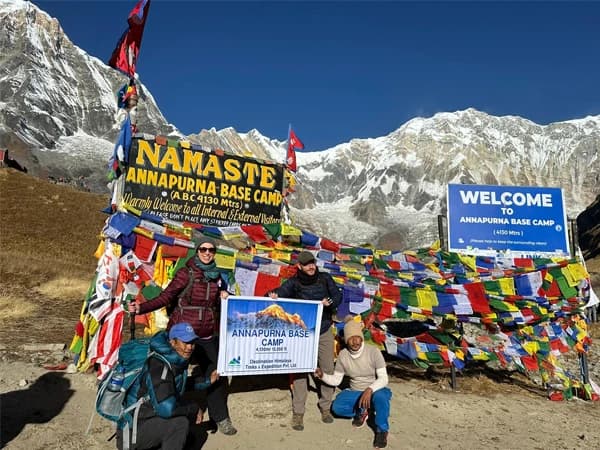
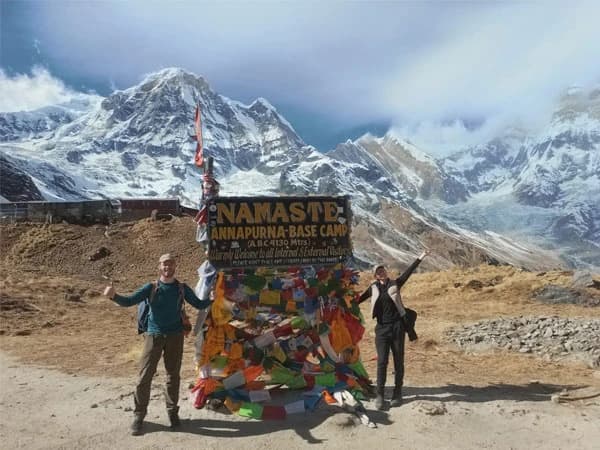
Further along the trail, we find the majestic Annapurna Sanctuary situated between snow-capped mountains. We reach the most significant stop on our journey, Annapurna Base Camp (ABC), after spending one hour trekking. 

The Annapurna ranges can be seen beautifully from the ABC, together with prominent views of Annapurna I and Annapurna South and Tent Peak, along with Gangapurna, Hiunchuli, Glacier Dome, and Singu Chuli.

While overnight at the Annapurna Base Camp (4130m), make the best of it. Catch the twinkling stars at night just right up off the peaks and the glacier beautifully melting off the mountains. In your leisure time, spend this time indulging in the insights of the heavenly Himalayas. 


Max Altitude: 4130 meters Meals: Breakfast, Lunch and DinnerAccommodation: Guest houseDuration: 5-6 hoursDistance: 13 km

After showering us with mesmerizing views of Annapurna Sanctuary, it’s our time to bid bye to the ABC and descend downhill to the bamboo by passing the same route Dovan, Deurali, and Himalayas. Today, the hike is quite easy as the path is well-trodden. As we walk through this lush forest of blooming wildflowers, enjoy the serene moment of the surroundings where the chirping birds add a peaceful vibe to your trek. After a short hike, we reach the village of Bamboo. Overnight stay in Bamboo


Max Altitude: 2310 meters Meals: Breakfast, Lunch and DinnerAccommodation: Guest HouseDuration: 6-7 hoursDistance: 12 km

Leaving Bamboo behind, we descend to the Jhinu Dada through agricultural land and lush forests. As we trail we can see the farming fields of the locals. After navigating through stone stairs and crossing Chhomrong Khola, we reach the village, Jhinu Dada after 5 hours of hiking.

Jhinu Dada serves as a perfect place to relax our body and soul as we hiked for 5 days straight. Imagine immersing yourself in the natural hot spring at just the foot of the massive Annapurna. This place promises to provide an unforgettable experience. It is also believed that showering here removes all the body pain and aches. So, make the best out of this! Staying here makes you forget all those hectic hikes. Overnight stay at Jhinu Dada.


Max Altitude: 1780 meters Meals: Breakfast, Lunch and DinnerAccommodation: Guest HouseDuration: 5 hoursDistance: 9 km

Today, it's our time to bid goodbye to the Annapurna region with a heavy heart. After crossing a long suspension bridge of Samrung Khola, we will reach Siwai. We catch a local jeep to reach Pokhara for a straight 4 hours. Along the way, we can see many tiny settlements, rivers, and bridges with a view of some mountains. Upon reaching Pokhara, we have leisure time to explore this amazing city of lakes. If the time fits, then don’t miss out on boating here. After this memorable 11 day trek, our trip to Annapurna Base Camp ends.


Max Altitude: 830 meters Meals: Breakfast, Lunch and DinnerAccommodation: 4 star resort

Our day begins with breakfast before we board a tourist bus from Pokhara to Kathmandu as we watch the diverse landscape retracing the same pathway. We’ll reach Kathmandu in 6-7 hours and get you transfered to the hotel. We will check in and take a quick rest before gathering for a farewell dinner in the evening. We will also host a trip completion certificate event and celebrate our successful adventure. 

Note: If you want a flight transportation facility from Pokhara-Kathmandu, we can arrange it adding additional cost.


Max Altitude: 1360 meters Meals: Breakfast, Lunch and DinnerDuration: 6-7 hours
Route Map
annapurna base camp trek 11 days route map
Altitude Chart
annapurna base camp trek elevation chart
Cost Details
Includes
  • Airport pickup and drop off by private vehicle
  • All 3 full course meals throughout the trek
  • All Accommodation during the trek
  • Transportation trip from Kathmandu-Pokhara-Kathmandu by tourist standard deluxe bus
  • All land transportation throughout the trek
  • Free safe luggage storage at Destination Himalaya Trek and Expedition office
  • One professional English fluency guide, and assistant guide (for a group of more than 12 trekkers)
  • Seasonal fruits along the trip
  • Guide expenses including meals, salary, equipment, transportation
  • Emergency evacuation service if needed (funded by your travel insurance)
  • Successful trek completion certificate from our office
  • Farewell dinner with all team members at Kathmandu
Excludes
  • International flight tickets
  •  All the Beverage bills and personal expenses (Hot water, Hot shower, Wifi charge, battery recharge, bottled water,
  • Laundry charge, etc)
  • Lunch and Dinner in Kathmandu and Pokhara
  • Personal trekking gear and equipment
  • Porter costs USD 200
Add-ons & Options

Venture out on an unforgettable journey with Destination Himalaya Treks and Expedition, bringing over 15 years of expertise to prioritise your comfort and safety. Our team of highly experienced hikers ensures an exceptional trekking experience, and to make your Annapurna Base Camp Trek truly special, we offer exclusive add-ons that elevate your adventure from Kathmandu to the majestic highlands of the Himalayas.

  • Porter Service at USD 22 per day: Let your backpack be carried by a strong porter, so you can hike with ease, smoothly enjoying the Himalayan scenery, without draining yourself out. Each porter can carry up to 24 kgs that can be shared between 2 hikers.
  • Private Jeep Service at USD 120: Upgrade your shared jeep accessibility to reach the trip starting point and ending point, to a private jeep ride in just USD 120, where the cost can be shared if you are 5 hikers in 1 group, as one jeep can fit up to 6 passengers, including driver, for a round trip.
  •  Kathmandu to Pokhara Flight Ticket at USD 100: Enjoy the short aerial flight accessibility to get to Pokhara from Kathmandu, avoiding the long 8-9 hours of driving roadway navigation.
  • Pokhara to Kathmandu Flight Ticket at USD 110: Conclude your trip with an elusive, comfortable flight back to Kathmandu, a perfect way to end the adventure, after a long journey.

With these well-thought-out, well thoughtfully curated add-ons, well-crafted add-ons, it promises to enhance your journey, making it more comfortable, with less hassle and luxury service, elevating your adventure, making it a lifetime memorable odyssey.

Dates & Availability
Select your preferred date
Feb 2026
Mar 2026
Apr 2026
May 2026
Jun 2026
Jul 2026
Aug 2026
Sep 2026
Oct 2026
Nov 2026
Dec 2026
Jan 2027
Feb 2027
Mar 2027
Date and Days
Price
Status
Date & Days
Feb 23, 2026 - Mar 05, 202611 Days
Price
US$549US$879
Save US$330
Status
Guaranteed
Essential Information

Best Seasons for Annapurna Base Camp Trek

The trek to Annapurna Base Camp (ABC) stands out as an all-around adventure, where you can undertake this journey any time of the year; however, during the seasonal time, it plays a huge role in the trail conditions, weather patterns, and visibility.

Thus, considering these factors, the ideal seasons are Spring, starting from March till the end of May, and Autumn, from mid-September to November, with the stable climatic situations, moderate mild temperature and less likely chance of heavy precipitation.

During spring, the route gets exhilaratingly adorned with the blooming red and pink rhododendrons, lush green valleys, and the panoramic views of the himalayan peaks on the crystal clear skies, with minimal chance of rain or snowfall. As the season comes after the conclusion of winter, the snowy trail gets washed away, and remains dry and smooth to traverse throughout, without any possible hurdles of landslides, avalanches, or weather disrupting the navigation to the sanctuary.

On the other hand, the autumn, is considered as most peak time, where the hikers come acrooss the globe, due to holiday weekend time, and locals, fill the trail more, as the main festivals, of the himalayas; Dashain and Tihar, falls, in between this season, showcasing another perspective of the himalayas, than, just reaching the destination. After the monsoon, this seasonal time arrives, offering zero chances of precipitation, offering the great insights of the mountains and landscapes, throughout and from the vantage point, with brown hills, fall seasonal perks, and a chance to experience the cultures of the locals, more lively.

The trail can be commenced during the off-season time of winter and monsoon as well (December to February) and June to August, but the genuine question is, are you ready for the slippery terrains, muddy steep sections, and have a prior hiking experience, as the trail gets 2x more challenging than the actual hike during the off-season time. But, can surely undertake with proper preparation, planning and packing gears and essentials accordingly.

Get to know more about the ideal seasons for annapurna sanctuary on our recently updated article.

Elevation and Distance

Annapurna Base Camp sits at an elevation of 4130 meters above sea level and offers a panorama of the Annapurna Range from every stride, making the ABC one of the remote expeditions in the land of the Himalayas- Nepal. To reach such a high elevation, you must start the journey and pass through several settlements in between, depending on the route that you undertake.

Due to the rapid changes in the altitude gain, you can feel the thin air at such heights; hence, proper acclimatisation days are required to avoid certain challenges that happen in mountain areas. That is why we've set this itinerary accordingly, so you can hike in a free mind without any mentally frustrating situations and leg-trembling conditions. 

The distance and length of the Annapurna Sanctuary simply depends on the route that you undertake, as there are many routes to reach the legendary ABC, whereas starting from Pokhara- Birethati with a drive, it covers approximately 97 km of hiking trail, bypassing many stopping points such as Ulleri, Ghorepani, Poon Hill, Upper Sinuwa, Tadapani, Chhomrong, Ghandruk, Deurali, Machhapuchare Base Camp (MBC), to finally reach the base camp of Mount Annapurna I (8091 m) and descend back to Bamboo, Jhinu Danda, Ghandruk, retracing the same pathway in 11 days.

The journey till we reach here is only accessible through several sections, step by step, so you can finally immerse yourself in the breathtaking panorama of the Annapurna range and unveil the unique insight of majestic peaks. To learn more in detail and prepare accordingly, you can explore our blog post, ABC elevation guide. 

Risk of Altitude Sickness and Prevention

There's no doubt, when heading to the mountain areas, there is always a certain risk, circulating 24 hours, unlike city areas, the environment there is unusual, from what we experience with the basic, limited rescue amenities as well. The most crucial thing to highly consider during the trek is the risk of AMS (Acute Mountain Sickness), as in every high altitude adventure, it is quite expected, no matter whether you are a beginner or an experienced hiker.

Meanwhile, if you are panicking, whether you could get one, do not settle back, as this itinerary is set with a gradual ascent without going over the board with 500 meters maximum elevation gain of the rising meters, ensuring the possibility of AMS remains low. 

However, apart from that, one must follow several preventive guidelines to minimise the risk or avoid the risk of altitude sickness. Here are 5 useful tips that we highly suggest from past experiences:

  1. Make sure that you stay hydrated throughout the journey, with 4-5 litres of water per day. If that sounds too much, then follow the substitutional process, like having soupy items, fruits, or noodles, which avoids the dryness of the mouth.
  2. While taking a higher ascent, do not rush yourself out, and take a slow uphill walk. Sometimes, what happens is that hikers get overexcited or nervous, speeding their climb. Walk slowly and breathe slowly, don't try to speed up your pace.
  3.  Avoid consuming hard drinks, caffeine, or smoking cigarettes, as they can make you out of breath and also make the body dehydrated, leading to severe altitude sickness.
  4. If you aren’t allergic to ginger items, then remember to carry dry ginger (available in every mart) and consume ginger soups in the evening. It helps to warm the body and energise the muscles.

Can I do ABC as a beginner?

Soaring at the highest elevation of 4130 meters, the overall ABC Trekking demands almost 5 to 6 hours of daily hiking with a coverage of 9 to 12 kilometres per day, so there is no doubt that this trip falls into moderately challenging treks in Nepal. That is why beginners who are willing to opt for this journey should engage in physical training and follow some preventive guidelines to avoid unfortunate conditions that might arise along the way without enough preparation. Even though this trek does ascend to such high terrains, with a complex, confusing route, walking with the assistance of a guide, this trek is safe and free from any danger to undertake, and can be easily done by beginners as well. 

Just on June 3rd, 2025, the marathon in the Annapurna Base Camp Trail was hosted, where many individuals across the globe participated, even the beginners, who looked forward to pushing the limits, and mark new heights and introduce themselves in the world of the Himalayas. Thus, it clears the doubt, and the questionnaire on whether the trail can be ventured out by beginners or not. On top of that, the trail is well-maintained and easy enough to pass through, even though there are several steep uphill walks from Ulleri and downhill descents to Sinuwa. With some training, one can smoothly complete the expedition, but with a positive, enthusiastic mindset and a slow yet effective approach to the trek. 

If you are a beginner and willing to conquer the height of 4130 meters with ease, then take a brief overview of our new blog: Beginner's Guide to Annapurna Base Camp, which provides thoughtful tips to tackle challenges, especially for newbies to the mountains.

How to be prepared for the trek to Annapurna Base Camp?

Even though this trek is not so strenuous to navigate, it is always best to prepare yourself fully just to make the trip go more smoothly. Especially if you are a beginner, you must take some considerations beforehand so that while making your way for 5-6 hours to the next destination stop, you don't feel any kind of challenges during the Annapurna Base Camp Hike.

There are 3 major factors to keep in mind while prepping: Physical, Mental, and Medical Considerations.

Physical Fitness

First things first, you have to have proper physical fitness since the journey is long and there are some physically challenging sections on the trail. Start training your body 2-3 months before the trip. Cardio is king. Your cardio needs daily sessions of 30-40 minutes at least four times weekly through swimming, hiking, running, and walking, which provides additional health benefits. Your legs, back, and core require major support, so they need dedicated strength training. You should begin hiking while carrying a backpack on weekend days, starting from short distances to longer distances.

Positive Mindset

While we always tend to give 100% to strengthen our bodies and be fully geared up, we often tend to overlook the mindset aspect. YES! It is your mind that keeps you going when your body tries to give up. Use positive thinking and remind yourself why you chose this expedition during times of diminished motivation. Meditation and yoga help to keep your mind focused so you can enjoy the beauty of the journey, not the difficulties. Make your mindset filled with positivity and have that extra glow of enthusiasm. Do some research beforehand, so on the trail, you don't feel any sort of confusing shock, which becomes completely different from expectations.

Medical Consideration

Even though the route doesn't pass by the remote terrains like any other isolated treks in Nepal, it is always better to go through medical procedures and do a whole body check-up just to know how your body is currently working. It is highly recommended to do a checkup regarding health conditions 1 week before and carry the medication accordingly. As the emergency access to a serious health line is just a helicopter evacuation, to avoid such situations, make sure to follow the preventive guidelines accordingly. Also, to know more in-depth, check our recent blog entitled: How to prepare for ABC?, which has a comprehensive guideline from starting to be fully prepared for the trek to Annapurna Base Camp.

A Typical Day in the Annapurna Base Camp Trekking Trail

Every day on the trek to Annapurna Base Camp can be a little different from yesterday's due to weather conditions, changes in landscapes, and your overall mood and physical fitness. All breakfast meals are served at 7 am in the teahouses or lodges where you spend the night. The breakfast options will typically include porridge, along with eggs, bread, and tea or coffee.

Once you hand your bags to the porter, he quickly goes ahead before the rest of your group follows. During our trail hike, we stop at a teahouse to eat noodles or Dal Bhat as our main lunch meal. It is essential to eat proper meals and stay hydrated for well-being throughout the ABC Trekking route.

The trek duration spans between 5 and 7 hours daily. The trek requires a decent fitness level to make walking more comfortable, but it can be done by everyone with patience. The guide will point out important sights and give you cultural insights while you enjoy the surroundings. Please inform your guide if you experience any health problems so he can assist you. Most important of all, take time to admire the breathtaking mountain peaks that tower above you. 

We will reach our lodge to enjoy hot or cold drinks before proceeding to dinner. Bedtime is early, and we suggest limiting your alcohol consumption throughout the adventure. Also, before taking a nap, do not miss out on playing UNO, playing Nepalese instruments such as the Madal and Flute (Basunri), and singing songs while mingling with locals and fellow hikers.

Guides and Porters 

Even though the trek to Annapurna Base Camp can be done without a guide, legally, as there are no such restrictions about solo trekking not being allowed at the trailhead, we highly suggest you hike with an experienced registered guide. If you are wondering why, then these two reasons make your navigation with a licensed guide a must-do adventure. Firstly, having such an experienced partner, who will assist you throughout the journey, ensures that you are hiking via the safest route, covering every highlighted aspect of the Annapurna region. Secondly, they are medically trained as well, which means they follow emergency protocols intelligently and take immediate action if any unfortunate situations arise en route. 

Our Annapurna Base Camp Trekking package covers an experienced licensed English-speaking guide, and all his expenses throughout the journey; hence, there is no additional cost required to hire guides, excluding the tipping factor, which is expected as a respect to their hardships. They are highly experienced with more than 10+ years and locals, being medically equipped as well, hence your safety and comfort are highly taken care of. Meanwhile, if you want a porter, then you can hire one by adding a cost of USD 20 to USD 25 per day; one porter can be shared between 2 hikers, where 22 kgs of backpack can be carried by him, which means 1 porter can be shared between 2 hikers.

Safety and Emergency Procedures during ABC Trekking

The Annapurna Sanctuary adventure is basically a high altitude odyssey that passes through varied kinds of terrains every single day, where you can expect the unexpected situations, where the navigation along such thinning air and lower oxygen is a big challenge in itself.

The trailhead basically follows, the unmarked routes, traversing via forested trail, on the very first half, untill Deurali or Chhomrong, whereas, as you go higher, the route transforms into steep, rugged and remote narrow trails, with landslide prone areas, as well, especially, in between Deurali and Macchapuchare Base Camp, thus, it is mandatory to have a local knowledge, and an experienced support factor, for quick daily response, for safe navigation and ideal decision making in case of emergency.

That is why the assistance of the expert teams, and a local experienced licensed guide is mandatory, who knows your pace level, itinerary, trail conditions, and changing weather patterns, to avoid any unfortunate conditions, like getting lost in trail, stuck in a landslide or in avalanche-prone areas. Besides, the guides are medically trained and equipped as well, so they know how to medically respond in case of an emergency, knowing early AMS (Acute Mountain Sickness), monitoring your pulse rate via oximeter at each stopping point, hence, they become your buddy throughout. 

Before opting for this adventure, on the very first hand, we advise you to let us know your experiences, health and pace level, so that the itinerary can be crafted accordingly, matching your fitness, so that you ascend adjusting to the rapid altitude growth, rather than blindly following just the itinerary or group. Throughout the journey, make sure to follow the navigation of the guide, and stay with him/her, without being influenced by others easily, and rooting another shortcut routes instead. 

If any symptoms of AMS, illnesses, or injuries occur, inform the guide immediately and get a quick medical checkup, as the trail is remote and has no hospitals or health posts, so getting travel insurance is a must for the emergency evacuation process, if things get out of hand. While getting your travel insurance, make sure to comprehensively review what is included, and ensure that medical expenses, hospital bills, heli evacuation upto 5000 meters, theft, trip delay/cancellation are included in the policies, to save extra cost, and hassle free journey.

Accommodation 

The Annapurna Base Camp route is a popular trailhead for trekkers, as hundreds of visitors pass by the track each day. There are many tea houses and lodges available, so you don’t need to worry about lodging.

The lodging in this area is simple and includes sharing or attached bathroom, comfortable mattresses, cushions, and pillows, but extra charges are added regarding Hot water buckets, wifi, laundry, and charging. Although the tea houses are not so fancy as all are operated by the locals here, you'll get a comfortable stay. In lower areas, single rooms are readily available in Kathmandu, Pokhara, and the trekking regions, but finding them becomes difficult at higher altitudes as lodges are limited throughout the trailhead.

Your comfort and stay throughout the trip are guaranteed by the organisation, whereas you don’t need to worry about pre-booking and safety at lodges. We'll accommodate you in the best lodges in the region and try to manage a single room for every stay. But do not expect this in the higher regions, as there are only a few lodges available.

For deeper insights on specific lodges and seasonal availability, explore our detailed guide: Accommodation Along the ABC Trail.

Meals and Drinking Water

Our Annapurna Base Camp Trekking package covers 3 standard meals throughout the expedition, with a cup of tea or coffee. Along the trailhead, you can find a wide range of foods from traditional foods to international cuisines like Indian, Chinese, and Tibetan that cater to the taste of every visitor.

On the breakfast menu, a wide range of food options are available, like Tibetan bread served with veg curry and boiled eggs, Roti (Indian Chapati), Fresh toast with butter, jam, and omelettes, Oatmeal items, and hot porridge. On top of that, here you’ll also get hot chocolate, espresso, and an Americano, which just gives a perfect kick to heat the body before starting the hike.  

For Lunch and Dinner, you get a variety of traditional Nepalese cuisines and Tibetan local cuisines like Thukpa (made of noodles and vegetables), non-veg momo, or Spanish Momo, that you surely don’t want to miss out! Other options like Ramen, Spaghetti, Fried rice, non-veg and veg curry, dry meats, Thenduk, momo, Pizza, Burgers, and Spaghetti are served. Sounds appetising, right?

While having dinner, take advantage of the dining area seating. Here you can enjoy the heater made out of clay (a traditional heater of the Himalayas), providing warmth to such cold altitudes. So, make the best out of this. We recommend you have dal bhat before the trek, as it is a nutritious food that allows you to continue the trek with a happy tummy.

Throughout the trail head, the natural water sources are available; however, as the foreign hikers, or beginners, might not be used to the himalayan natural untreated water, it might not be safe, with the high possibility of allergic reaction. So, to avoid such conditions, you can consider drinking hot boiled water from the tea houses, on a kettle basis, with small fare, and use a water purification tablet to purify the water as well.

We do not suggest buying bottles, promoting sustainability and the protection of the Annapurna Conservation Area, so it is best if you drink hot boiled water, which is clean, hygenic, and safe to drink as well.

WIFI, Network and Communication on the ABC Trail

Every tea house has the accessibility of WIFI, which you can connect to at the dining area (higher section), or even rooms, upto Chhomrong; however, the WIFI coverage works great, while covering the Ghorepani poon hill route, as it is on the lower elevation side, and stands out to be more facilitated. At the peak season time, due to huge traffic and only limited coverage, the wifi might not be stable in the rooms; however, it connects well to call back home, and use social media. For the wi-fi as well, an extra cost is charged between USD 2 and USD 4 at the upper trails, due to limited availability.

On the other hand, for the mobile network coverage, the signals are not consistent at the higher altitudes, as you go deeper into the sanctuary; meanwhile, it runs smoothly in the lower terrains, in fact, on a 4 G / 3 G basis. Just make sure to purchase an NTC (Nepal Telecom) SIM CARD if you do not have any Nepali SIM cards, as it performs effectively, compared to others. 

Besides, the lodges also have a telephone call booth, or satellite phones, for emergency cases, so do not worry! Either way, you will not find any communication issues throughout the journey, as there are always alternative options.

Electricity and Charging Facilities 

As the trekking route is quite remote and a high altitude tea house, it has limited facilities for electricity and charging, so do not expect a quick and exceptional service when it comes to charging sockets and electricity, as it is run by solar energy.

While at the lower trail, the charging plug is attached in the room itself, as you ascend higher, above 3000 meters (Chhomrong), it is only available at the dining area, where you have to wait in a queue to get your gadgets charged, paying an extra fare of USD 3 to USD 5, depending on the lodge.

Even though every, lodges, do include such rechargeable accessibility, waiting in line might be frustrating for some, so it is advisable to bring a powerbank (20,000 mAh), to get your batteries, mobiles, cameras, etc., charged in an emergency.

Whereas, as for the electricity, as the weather changes drastically, at the high points, the power availability sometimes might get affected, due to inconsistency of the sunlight, and all the lodges largely depend on the solar panels, so it is better to carry a powerbank, one extra as well, for such emergency cases.

Transportation 

For the transportation facilities, you will be provided with all the in and out services soon after you land here in Nepal. Even though this trip doesn't include your arrival date, it's your own choice, when you want to arrive here and explore the Kathmandu valley beforehand, you will be received at the airport via private vehicle, and dropped off at the hotel directly and same remains during your date to returning to home, where you will trasnfered to the hotel with the assistance of the airport representative. This airport pick-up and drop-off is not included in the cost; hence, we provide it as a complimentary service for your ease and comfort.

Meanwhile, to reach Pokhara for the Annapurna Base Camp Trekking, a comfortable sofa-seated tourist bus with AC will be provided, from Kathmandu to Pokhara, whereas, from Pokhara (PKR), to reach Ulleri, a private jeep is used, rewarding hikers with a 2-hour scenic view. The modes of transportation remain the same to return via private jeep from Siwai to Pokhara and a comfy sofa tourist bus from Pokhara to Kathmandu.

Note: You can upgrade transportation to a flight mode of transportation as well, at an additional cost of USD 100 to USD 130 per head. We can arrange the air transportation happily, or any other private mode of transit, as per your request.

Permits required for Annapurna Base Camp Trek

To trek to the Annapurna Base Camp, one of the most crucial aspects that every trekker must consider is obtaining the required permits for this adventure trail.

To trail along this protected area, there are basically two permits required: firstly, the Annapurna Conservation Area Permit (ACAP), and secondly, the TIMS Card (Trekkers Information Management System Card), which can be obtained from either Kathmandu or Pokhara, as well, depending on the starting point of the trip.

While, as of now, as per the 2026 update, the TIMS Card is not required, which used to cost approximately $ 18 for foreign nationals, and only $ 3 per head for the SAARC nationals. However, the requirement of the TIMs varies, every month, or on a seasonal basis, so it's best if you check the recent update for the information.

At present, the only required permit is the ACAP, NPR 3,000 (approximately $27) for foreigners. NPR 1000 (approximately $9) for SAARC countries. The permit fee goes directly to the protection of the wildlife, boosts the local economy and projects, and goes into the upgrade of the trail, and also keeps track of the inflow and outflow of the hikers, ensuring safety on the very first hand, along with sustainability.

After your booking is confirmed with us, we at Destination Himalaya Treks and Expedition arrange both essential permits and paperwork. Just make sure to send us your valid passport photo, and recent photography, and while being at the trailhead, these permits must be with you throughout the trail.

Essential Packing List for ABC Trek

To make your trip a complete success, packing gear and essentials play a crucial role, which can either make or break your expedition, so make sure that proper planning is made regarding what to carry, include, and what to exclude and ignore, and make sure to pack smartly for the 11 days ABC Hike, as it helps you to tackle challenges and at the same time, saves personal spending as well. Here are some of the recommendations that we highly suggest include in your packing checklist:

Clothing: What to wear?

  • Dry Fit T-shirts: at least 2 to 3 that are quick to dry and absorb sweat easily
  • Breathable hiking pants or shorts
  • Down Jacket or Puffer Jacket: whatever is suitable for you
  • Full Sleeves T-shirts: to protect from the sun's heat 
  • Inner Thermal Wear: warm enough to wear at the tea house, and for a high-altitude hike
  • Wind cheater: useful during sunny days and even low precipitation
  • Light gloves and woollen gloves

Footwear: Hike with ease

  • Flip flops or sandals to wear at the tea house
  • Short cotton socks and Long woolen socks - if possible, bring 6-7 pairs
  • Hiking boots - have a nice grip and don't slip
  • Comfortable sports shoes - useful as an alternative

Gears and Hiking Backpack

  • Bagpack: 25 L to 35 Litres
  • Waist bag: to quickly fit in and use the gadgets and keep essential items like cash, passports so on.
  • Extra Batteries and Power Bank - due to limited amenities available at the trailhead.
  • Personal First Aid Kit - basic medicines with doctor's precautions
  • Crampons and sleeping bags - if it's winter, it's essential
  • Toiletary items and basic hygienic products
  • Trekking poles (2) and a water bottle

These essentials fit most adventurers, but gear needs shift by season or fitness. Check our seasonal breakdown: What to Pack for Annapurna Base Camp, to get better insights and recommendations on what to include and exclude, with tips on packing based on weather patterns.

Booking procedure

Do not wait any longer for the epic adventure of the Annapurna Base Camp Trip, and book a spot now! To make things easy, we provide everything you need for the trip, including food, lodging, transportation, permits, and expert guides (all of their permits, food, insurance, and so on).

You can email us at info(a)destinationhimalayatreks.com for the booking confirmation, or you can phone or message us on WhatsApp at +977 9851016814 with any questions. For the payment, you can directly pay through our website or simply transfer the advance payment. To manage everything, we just deduct 10% of the entire fee; the remaining sum may be paid after you get to Kathmandu. 

Last-minute booking

Destination Himalaya Treks and Expedition helps us to book your last-minute trek during peak season with ease. You must pay 100% to confirm the last-minute booking since we need to pay for a guide, along with porters, and accommodation in advance to ensure your trip. You can get more information through our WhatsApp or Viber at (+977 9851016814) and also email directly to us at info@destinationhimalayatreks.com.

Tips for the ABC Sanctuary Journey

  • Make sure to withdraw sufficient Nepali rupees from banks in Kathmandu or Pokhara ahead of your trek because ATMs are not available during the trek. The teahouses accept Nepalese cash only.
  • Get a local SIM card from Ncell or NTC in Kathmandu or Pokhara to use during emergencies, as these providers supply sufficient network coverage throughout the trek. You can connect with your friends and family, though coverage may be limited at high altitudes.
  • Make sure to keep drinking water throughout your trek to prevent dehydration. You can bring a reusable water bottle with a 2-3 litre capacity and refill it in teahouses and use filtration tablets to ensure the water is safe to drink.
  • You will need a portable high-capacity power bank or charger when planning to use your phone or camera. Remote areas often lack reliable charging facilities at teahouses, despite some locations providing power sources.
  • Even though there are several tea houses along the trail, the prices are very high. Buy quick snacks to grab on the trek, such as granola bars, protein chocolates, and instant noodles.
  • Carry only the necessary trekking equipment to keep your backpack lightweight. A fully necessary trekking kit should include layered clothes, proper boots, a sleeping bag, and essential products such as sunscreen, lip balm, moisturisers, and required medications. 
  • Make sure to carry an oximeter and check your pulse rate through the oximeter (given by us). If it goes lower than it should, then inform the guide immediately. 
FAQs

Yes, you can get the visa upon arrival at the airport in Nepal, soon after you land. If you prefer to apply online, you can get it before coming to Nepal, which reduces the hassle of dealing with it at the airport. No matter how you apply, your passport must have a validity of up to 6 months, and one passport-sized photo, to apply for it, whereas the cost, on the other hand, depends on your duration of stay, which can be either paid in cash (if you are in Nepal), or via online (if applied through online). The SAARC citizens, including Chinese and Indians, do not require a visa arrival fee.

Upon your arrival at the airport, one of the Destination Himalaya Treks representatives will come to pick you up, assist you to the hotel via private vehicle, and also help you to get checked in. Not only that, but you will be transferred to the airport during departure time as well, on your flight scheduled day and time

Yes, two permits are required while trekking to Annapurna Base Camp, which include the Annapurna Conservation Area Permit (ACAP) and the TIMS Card (Trekkers Information Management System Card), which will be managed by us, soon after your booking is confirmed.

Yes, if the published departure doesn't match your time being itinerary time, along with the group departures, then let us know, it will be customised, as per your preferred time and choices.

The highest altitude that this ABC Trekking leads you to stands out to be the Annapurna Base Camp itself, at an elevation of 4130 meters (13,550 feet), above sea level, unravelling the panoramic insights of the highly towering mountains such as Annapurna I, Fishtail, Hiunchuli, and many others.

The total length and distance coverage for the ABC Trek highly depend on how your itinerary has been set and on the starting point for the trip. If you are opting for this trek starting from Kathmandu, then it usually takes more than 10 days, with a gradual pace, following the standard itinerary, whereas if starting from Pokhara officially, then this trek can be completed within 7 days. However, following the Poon Hill route takes almost 14 days, because it covers two major destinations in 1 single journey. 

Daily, you must cover a hike of 5-6 hours, depending on the route, and sometimes, even only 4 hours, as the itinerary is a moderately level crafted, ensuring that beginners, as well as families hiking along with children, can get to the Annapurna Base Camp easily, without any possible risk of altitude sickness.

Yes, the ABC Trek Itinerary allows you to modify it based on your personal choices, spending limitations, and available time. The additional days allow you to extend your time while visiting different areas in the region. Similarly, you can shorten the trip to fit your time frame as well. 

Yes, staying at the base camp of the world's 10th highest peak - Mount Annapurna I (8091 meters), is possible, as there are many tea houses and lodges, even cafes to comfortably settle at and gaze at mountains, sipping a cup of tea and gazing at stars at night

Yes, with proper preparations, planning, a gradual ascent itinerary, and packing comprehensively, the trek to Annapurna Sanctuary can be attained even in the seasons of monsoon and winter. However, if you are considering these particular seasons, then one must ensure that while trekking in the monsoon, carrying insect protection cream, a raincover for the backpack, and a raincoat, to get covered up, and slow navigation and sturdy footwear remain crucial to navigate through slippery and muddy terrains. Besides, those hikes in the winter times must be prepared for challenging terrains, especially at the higher altitudes, demanding crampons, hiking boots, and even sleeping bags for the winter season.

The ideal seasons for this trip are marked to be two particular seasons, firstly, the Spring season, starting from March and lasting till the end of May, whereas the other tends to be Autumn, which begins from September, and lasts till the beginning of November. During these two particular seasons, you can expect the weather to remain clear and stable, the temperature only ranging from 5 to 12 degrees Celsius, and mild humidity, where one can venture out with ease and be comfortable, without draining physically or mentally.

The difficulty for any trek depends on the distance, duration, elevation gain, weather and temperature conditions, and route accessibility, for sure. Considering all the factors, Everest Base Camp is comparatively harder than Annapurna Base Camp, as EBC gains 5545 meters of elevation at its highest, and the accessibility is also hard and has a higher chance of delay of the Lukla Flight in peak season. Whereas the EBC is longer than ABC, taking more than 14 days, with a high possibility of the trek becoming delayed, due to the weather and temperature conditions causing flight cancellation, and is not suitable for beginners.

Yes, one can take a direct helicopter tour to ABC in a day, or consider returning by helicopter after attaining the base camp of Mt. Annapurna; both options remain possible

The accommodation, along the route, is based on a tea house and lodge basis, run by the locals themselves; however, getting basic, simple amenities (facilities), such as wifi, laundry services, communication, charging, and a warm bed and comfortable dining configuration, every essential is well equipped. However, private bathrooms aren't available at the higher terrains after ascending to Deurali, so please keep your expectations realistic and be prepared mentally, knowing that it is a remote trekking trail.

Yes, you will find every kind of meals variation, from vegan, to non vegeterian options, as even though, the route is remote and tea houses are basic, it ensures that it caters the taste of everyone, and also, keeping in mind, regarding their health diets, ensuring a safe and smooth adventure, where one do not have to compromise, their taste buds.

The transportation facilities to expect are 4X4 jeeps to get to Bikash Danda, which is the starting point of the Annapurna Base Camp Trek route.  Although the roads can get a bit rough, this is just another part of the adventure. You can also take a local jeep or a personally owned vehicle to get to Hile. You can also organise everything with our trekking guide, so you don't have to bother about it. 

Even though it is a high altitude adventure, even beginners can commence on this trek easily, due to the transparent accessibility to amenities, a moderate pace level of hike, which demands the hiking coverage from 5 to 6 hours only, and a gradual pace of hike. However, first-time trekkers might face challenges in covering the daily pace hike through varied kinds of terrains, where sometimes, you have to walk along forested trails, rugged and steep pathways, where the altitude gain increases daily. Also, at the trailhead, there are many misleading routes, and the possibility of landslides and avalanches, so one must pay caution while navigating through.

However, as our Annapurna Base Camp Trek itinerary includes a gradual ascent, of only 300-500 meters, not going beyond that, ensuring a safe ascent, without any effect of AMS (Acute Mountain Sickness), crafted for even beginners, new hikers can also venture out on this hike easily. Besides, our experienced licensed guide, being medically equipped, is available 24 hours there to assist, so that you traverse through the safest and highlighted terrains, and become your emergency assistance, if any unfortunate situation occurs by any means.

Yes, the Annapurna Base Camp Hike can be easily and safely done by females, even if they are trekking solo, as the route is well-maintained and doesn't have any high mountain passes or dangerous sections. However, one must consider and follow preventive guidelines to avoid the possibility of altitude sickness. As this trek leads you to the highest altitude or height of 4130 meters, the risk of altitude sickness is significantly higher

Physically able children above ten and active seniors can complete the Annapurna Base Camp Trail, provided they take it slow with additional days for acclimatisation. A private guide is recommended as he will adapt the pace to your needs and assist in emergencies. Several families together with active senior groups have achieved completion through extended itineraries spanning 10 to 12 days.

While ABC Trek does not demand travel insurance, it remains essential to have it because it functions as an all-important protective measure against unforeseen events. It covers medical expenses, emergency evacuation (helicopter), lost gear and trip cancellation costs so that your expenses remain under budget.

Unlike restricted area treks in the Himalayas, which require 1 hiking partner to travel along with, or a group, as the solo trek is prohibited, the Annapurna Base Camp route doesn't come under such restricted area, which doesn't include any specific rule regarding the number of hikers; hence, you can undertake this hike solo or privately as well. Solo Trekking allows you an opportunity to get yourself fully immersed in the enchanting beauty of the Himalayas, feeling the serenity, hiking at your own pace, and customisation of your itinerary, without having to get matched with others, letting you have a safe ascent, and also craft the package on your estimated budget as well.

No, you cannot undertake any treks in Nepal solo, independently, without any assistance from an experienced licensed guide, as the government and NTB (Nepal Tourism Board) have made it clear that hiking solo, alone, is prohibited, hence not allowed. This rule has significantly played a huge role in the safety of the trekkers, across the globe, to trek along the Himalayas, following safe navigation, avoiding the possible risk of injuries, losing track of the pathways, and also preserving the untamed protected territory of the Annapurna Conservation Area. At the same time, it has also been an impactful benefit to the locals and guides, for boosting their economy, who highly rely on tourism.

Our trekking agency employs government-licensed guides who have completed their required training sessions and passed their certification requirements. Guides with experience typically lead the route dozens of times and maintain strong English skills, exceptional knowledge about altitude sickness symptoms, and emergency protocols. They have basic first-aid knowledge to aid you in injuries.

You can best prevent altitude sickness by ascending steadily while gaining between 300-500 meters of elevation above 3000 meters. Your daily water consumption needs to reach 3-4 litres, while you should keep alcohol consumption low and decrease your caffeine usage. If you feel a headache and dizziness, report to the guide and descend immediately. Drink plenty of water and maintain a steady pace. You must obtain medical authorisation to take Diamox (acetazolamide)  to prevent symptoms.

Yes, additional personal expenses are required even though our trip package covers the standard meals - Breakfast, Lunch, and Dinner, accommodation (tea house/lodges), permit fee, and transportation, along with an experienced trekking guide and porter. However, you must require extra money for laundry, shower, wifi, and charging, which is estimated to be $5 to $10 per day.

Need Help? Talk to Expert!
min gurung
Min Gurung
+977 9851016814
Karma is a great guide!

We had Karma as a guide, he was professional, friendly, supportive, knowledgeable and a great guide. I always felt safe and had a wonderful trek on the ABC 7 day

c
cmK6123FB
December 08, 2025
Best of!

Perfect guides, very nice organized.
Highly recomended. I will try to be back again. Great memories excellent people

S
Stefanos S
November 15, 2025
Over Two Decades of Adventures: My Journey with Min Gurung and DHT

Soon I will be going to Nepal for the 8th time for a beautiful trek. All eight times, Min Gurung was involved. First as a guide and later as the...

read more +
M
M G
February 09, 2025
You May Also Like
annapurna base camp trek
Starting from
US$659US$1199
Thorong La Pass
Starting from
US$599US$1099
Trekker's Choice
mount everest base camp trek
Starting from
US$1199US$1599
Bestseller
Need Help? Call Us+977 9851016814