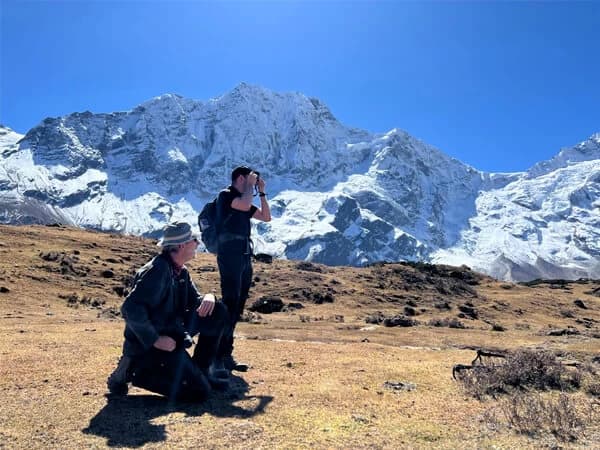
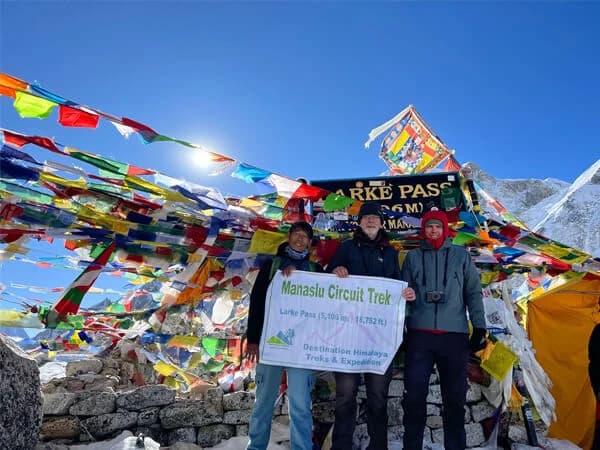
manaslu circuit tsum valley trek
manaslu base camp
rupina la pass

Manaslu Circuit Tsum Valley Trek - 18 days

295 reviews in TripAdvisor
27 reviews in Google Reviews
Recommended by 99% of travelers
Duration18 Days
Trip GradeModerate
Maximum Altitude5106 meters - Larkya La Pass
ActivitiesTrekking
Group SizeAny
StartsKathmandu
EndsKathmandu
Best TimeSpring (March-May) & Autumn (Sep-Nov)

The Manaslu Circuit Tsum Valley Trek is a combined, off-the-beaten-path Himalayan route that encircles Mt. Manaslu (8,163 m) and explores the sacred Tsum monasteries.

Often described as one of Nepal’s most rewarding treks, it passes through quiet mountain villages, hidden valleys, and diverse landscapes, with panoramic views of giant peaks and the cultures of Tibetan-influenced communities, culminating at the thrilling Larkya La Pass (5,106 m).

This classic tea-house odyssey takes you through rhododendron and pine forests, across suspension bridges, along river valleys, rocky sections, and alpine meadows, revealing the six climatic zones of the Manaslu region. Open to trekkers since 1992, the area requires a special restricted area permit, which limits visitor numbers and helps preserve the ancient Himalayan terrain and traditional lifestyles.

Overview

Discover a raw Himalayan journey through the Manaslu Circuit and Tsum Valley, weaving through isolated hamlets, remote Tibetan communities, and the sacred “Beyul Kyimolung,” Tsum’s enchanted “Valley of Happiness. This adventure fuses the wilderness thrill of crossing a high mountain pass with the chance to experience the centuries-old heritage of the Tsumbas, an indigenous Tibetan-Buddhist community known for its Nyingma practices, gompas, monks, nuns, the footprint of Milarepa, and the meditation cave of Guru Rinpoche (Padmasambhava).

With our finely crafted 18-day Manaslu Circuit and Tsum Valley Trek itinerary, you get to cover two of the most isolated and remote Himalayan treasures. With a gradual ascent of 300-400 meters each day, covering almost 4-8 hours of trailhead, with two acclimatization days included, at Nile (3362 m) and Samdo (3530 m), which features a side trip to Mu Gompa (3700 m), the wetland of turquoise Birendra Lake, Manaslu Base Camp, the foothill of the world's eighth tallest peak, and Rui La Pass (Tibetan Border) at 4998 meters.

The longest trekking trail, and the highest altitude that this trail takes you to, is the thrilling Larkya La Pass (5106 m, 16,751 feet), which reveals the majestic sunrise panorama views of several mountains, including Ganesh Himal, Buddha Himal, Shringi Himal, Cheo Himal, Himlung Himal, Kang Guru, Annapurna II, and Mount Manaslu, along with Larkya Peak itself. While the pass can be strenuous for beginners, trekkers with a basic level of fitness and proper preparation find the route moderate and manageable with our expertly tailored package.

The journey first follows the Tsum Valley trail through Lokpa, Chumling, Chhokangparo, and Nile, visiting ancient monasteries such as Mu Gompa, Rachen Gompa, and Piren Phu Gompa. Then, the route rejoins the classic Manaslu Circuit, from Deng, passing Namrung, Lho, Shyala, Sama Gaon, Samdo, and Dharamsala before reaching the high vantage point above 5,000 meters.

Over 18 days, you’ll experience the livelihoods, cultures, and traditions of Sherpa, Rai, Gurung, Bhotia, Nubri, and Tsumba communities along a Tibetan-influenced trail dotted with mani walls, chortens, shrines, and prayer flags, with snowy peaks accompanying you at every step.

We at Destination Himalaya Treks are all set to make your adventure a one-of-a-kind and hassle-free experience, with all your permits, logistics, and itinerary arranged by us, with the assistance of experienced, licensed, and trained trekking guides, ensuring smooth and safe navigation for 2026 and 2027 adventures!

Highlights

  • Cross over the legendary mountain pass of Larkya La, which soars at an elevation of 5106 meters
  • Unveil the natural wonders of the Manaslu Conservation Area through the thriving forests of rhododendrons and alongside the Budhi Gandaki River
  • Explore the new spiritual trekking path to Tsum Valley, visiting sacred monasteries: Mu Gompa, Rachen Gompa, and Piren Phu Cave
  • Walk through Tibetan-inspired Buddhist landmarks, mani walls, prayer wheels, chortens, red shrines, and nun-teaching schools (gompas)
  • Immerse in the ancient cultures, traditions, and the warm hospitality of the local Tibetan communities of Rai, Bhutias, Sherpa, Gurung, Nubri, and Tsumbas
  • Expansive insight into the Himalayan giants, including Ganesh Himal, Sringi Himal, Himlung Himal, Kang Guru, Annapurna II, Cheo Himal, Larke Peak, Ngadi Chuli, and several others
  • Reach the lap of Mount Manaslu (8163 m), the Manaslu Base Camp, and the glacier-fed turquoise Birendra Lake
  • Take a dip at the hot spring, Tatopani, a perfect time for such a long trailhead
  • Get a chance to spot Himalayan migratory birds and wildlife such as the Himalayan Tahr, the elusive red panda, and the snow leopard, as well as Himalayan yaks and blue sheep (chyangra), grazing in the terraced agricultural farms
  • Attain the Nepal-Tibet border at Rui La Pass, surrounded by mountains and Tibetan plateau landscapes

Manaslu Circuit and Tsum Valley Trek Route

The Manaslu adventure begins with 8 hours drive from the capital city, Kathmandu, to Maccha Khola (869 m), via Aarughat and Soti Khola on the first day, by local bus, covering the distance of 162 kilometres. The walking trail proceeds towards the village of Jagat at 1340 meters, passing by the natural hot spring, Tatopani, and Dovan. Then, we will join the trail of Tsum, as we make our way to Lokpa (2240 m), registering the permit and officially entering the Manaslu Conservation Area. Further, on the 4th day, the route takes us to Chumling (2386 meters), crossing several suspension bridges in between and a downhill walk to Siyar Khola Bridge along the Cantilever Bridge.

Afterwards, the altitude increases above 3000 meters for the next two consecutive days, as we will march to Chhokangparo (3031 m) and Nile (3361 meters), taking a glimpse of the Tibetan-influenced landscapes, Buddhist-influenced landmarks, local remote hamlets, and spectacular mountain views of Ganesh Himal I, II, III, IV, V, Himalchuli, Ngadi Chuli, just behind. Nile marks our 1st acclimatisation day of this odyssey, where we'll pay a visit to the spiritual monastery of Mu Gompa at 3710 meters, with sculptures, the footprint of Milarepa, Buddhist shrines of legendary spiritual teachers, and the meditation spot of Guru Rinpoche, and also ascend to some viewpoints, making the best of this acclimatisation side trip.

Leaving the settlement of Nile behind, the downhill walk leads us to Chumling, where we get to visit another sacred monastery, Rachen Gompa, and finally rejoin the route of the standard Manaslu Circuit, with a descent to Deng (1862 m) on the 9th day. On the following days, we will trek deeper into the villages of Namrung (2630 m), Lho village, Shyala (3500 m), and Sama Gaon (3521 meters), where we'll explore the famous Birendra Lake, Pungen Gompa, or Manaslu Base Camp, which you can choose between. If you seek to reach both side trips, then we can add 1 extra day here, as an acclimatisation day at Sama Gaun as well.

Then, the trek further continues to Samdo (3874 meters), which marks another acclimatisation day (2nd), that takes us to experience the arid Tibetan plateau and a distinct panorama of the Himalayan peaks, as we'll reach Rui La Pass at 4998 meters on this excursion rest day. On the 16th day, we will finally attain the pinnacle of the thrilling Larkya La Pass (5106 meters) from Dharamsala, which is the hardest and longest day, lasting for 9 to 10 hours, including the descent to Bhimtang (3590 meters) afterwards. Finally, this 18-day trip to Tsum Valley and Manaslu Trek concludes with a drive back to Kathmandu from Dharapani the next day, by a scenic private jeep drive that lasts for 5 to 6 hours.

Itinerary
Trip PlanExpand all

The journey begins on the very first day with a bus ride from Kathmandu to Machha Khola, along the Prithvi Highway, witnessing the diverse landscapes of the land of the Himalayas, Nepal, with many roaring rivers accompanying you, including the Trishuli River. The road trip showcases the transition of the surroundings, from bustling towns (bazaars) like Dhading, Malekhu, Dumre, and many others, to small hamlets, terraced farms, local shops, green rolling hills, and rugged, giant topography as well. In between, the bus also stops by several points for breakfast, coffee breaks, and lunches, as the driving is a long hour lasting for 7 hours approx, until reaching Aarughat.

From Aarughat, we'll take a shared jeep to Maccha Khola via Soti Khola, along the Budhi Gandaki River, following the bumpy road, with impeccable insights into the snow-capped peaks, including Mount Manaslu, Ganesh Himal, and the local settlements in between. Even though the ride lasts for another 1.5 to 2 hours, the unique perspective of the roadside of the Gorkha region keeps you truly intrigued, rather than feeling like a hectic ride or something. At around 4:00 PM, you will reach the tea house of the Macchakhola, the first overnight stay, where you can fully immerse yourself in the warm hospitality of the locals and engage in a short stroll nearby, along with the guide, to explore what this place has to offer.

Max Altitude: 862 m/2,854ft Meals: Breakfast, Lunch and DinnerAccommodation: Tea houseDuration: 158 kmDistance: 7-8 hours

The walking trekking trail starts on the second day, from Macha Khola to Jagat, entering the narrow, steep pathway, traversing through several villages, including Tharo Khola and Khola Besi, and after crossing a long suspension bridge, we will reach Tatopani, where there is a famous hot spring, as the Tato Pani itself denotes the meaning of "hot spring". Resting here for a bit, dipping our bodies, taking a bath, and feeling the serenity of the Himalayas marks a perfect beginning of this iconic adventure.

After spending some time here, we'll continue the trek, crossing another suspension bridge over the Budhi Gandaki River, with an uphill ascent, and the path leads us to Dovan. At Dovan, we will take a short break for lunch, as the first long-distance hike might be physically daunting, so resting and fueling our bodies is a must. Afterwards, continuing our hike, crossing the bridge over Yaru Khola and taking a steep uphill walk to Thado Bharyang, the quaint, terraced settlements of Jagat village, adorned with ancient stone houses, which welcome us amid the red rhododendron forests, which seem completely surreal. 

While staying here overnight at Jagat, we can enjoy the cosy tea houses run by the Gurung locals, interact with them, savour local meals, and gain insight into their lifestyle, making the best of the moment before ascending further on the following days.

Max Altitude: 1,342 m/4,396ft Meals: Breakfast, Lunch and DinnerAccommodation: Tea houseDuration: 5-6 hoursDistance: 14 km

Leaving Jagat behind, today we will take the route to the Tsum Valley. After registering our permits and officially entering the Manaslu Conservation Area, we'll navigate to Lokpa village. The trail begins, trailing across the challenging, rugged terrain. In the first half, we'll cross a riverbank of Salleri, and then, the long suspension bridge above the Budhi Gandaki River again, with a spellbindingly closer view of the Sringri Himal and Ganesh Himal, after taking an uphill walk to Phillim, then, Ekle Bhatti, we'll stop by here, for a lunch break, and have a good amount of rest time, enjoying the scenic view. After almost 6 to 7 hours of hiking through distinct terrain and surroundings, crossing many small hamlets and golden agricultural farms in between, we will arrive at Lokpa village, which marks our destination for today.

Max Altitude: 2,246 m/7,362ft Meals: Breakfast, Lunch and DinnerAccommodation: Tea houseDuration: 6-7 hoursDistance: 12.8 km

After having breakfast, with an intriguing sunrise view from the tea house itself, today we make our way into the forested area and gorges, with some steep uphill and downhill walking, via blooming pink and red rhododendrons and a fir woodland trail, crossing metal cantilever bridges. With a spectacular upfront view of the Himalayan peaks such as Ganesh Himal and Shringi Himal, passing through several small Gurung hamlets, including the sparse hamlet of Chisapani, we'll finally reach Chumling, the overnight stay for tonight, overlooking the Tibetan settlement alleys of mani walls, chortens, slatted-roof lodges, and Buddhist prayer flags. 

Max Altitude: 2,391m/7,841ft Meals: Breakfast, Lunch and DinnerAccommodation: Tea houseDuration: 5 hoursDistance: 7 km

Leaving the Chumling behind, today the route takes us on a more remote trail, with many rocky and steep sections, so ensure that you have a fulfilling, nutrient-rich breakfast to keep you engaged throughout, covering the long distance and varied terrain. Proceeding further, with a gentle walk from the twin villages of Chumling, crossing a suspension bridge over the Siyar Khola gorge, the trail becomes more thriving with the colourful, lush green forest of pine and rhododendron, and terraced fields, with locally grown crops and the 360-degree panoramic insight of the Ganesh Himal range, Himalchuli, and Baudha Himal. Traversing several Gurung settlements, some river streams, wooden bridges, and undertaking a downhill walk, we'll enter the upper valley of Tsum, Chhokangparo.

Max Altitude: 3,034 m/9,952ft Meals: Breakfast, Lunch and DinnerAccommodation: Tea houseDuration: 5-6 hoursDistance: 8.2 km

Persisting in the navigation ahead from Chhokangparo, the trail takes a descent through the forest of pines and birch woodland, following the barren terrain; then, after crossing a wooden suspension bridge over Siyar Khola, the route passes by Milarepa Piren Phu Cave. Known as Pigeon Cave, it is considered a sacred meditation place of Milarepa, which stands out as a spiritual spot for Tibetans, especially Tsumba locals, where, while visiting this serene gompa, we can gain insight into two small gompas, 1000 Avalokiteshwaras, Milarepa, Buddha statues, Tibetan mantras, antique pieces, and the main highlight marks to be Milarepa's footprint carved in the rock. After paying a visit to the cave, we will continue our journey, visiting the Tibetan valley, terraced barley lands, small river streams, and crossing one more bridge, which eventually takes us to Nile village.

Max Altitude: 3,364 m/11,028ft Meals: Breakfast, Lunch and DinnerAccommodation: Tea houseDuration: 5-6 hoursDistance: 9.2 km

Today marks the first acclimatisation day during the Manaslu Circuit Tsum Valley Trekking, which also tends to be one of the most culturally rooted exploration days, as we'll visit the sacred Mu Gompa and its captivating landscape. Following the Siyar Khola's east bank, the upper trail of the Nile passes through undulating terrain on a Tibetan-influenced route, through mani walls, whitewashed chortens, red shrines, and the fluttering of the prayer flags, with the swift wind in the alpine meadows. 

Then, we take an ascent to the Mu Gompa, perched at an elevation of 3700 meters, built in 1895 AD, near the Tibetan border, with the sweeping vista of the gigantic mountains of the Ganesh Himal range, Himalchuli, Ngadi, surrounded by Buddhist landmarks. This highest gompa of the Tsum area features 40 monks or nuns practising Tibetan Buddhism cultures, ancient architecture, scriptures, and Avalokiteshvara statues, with panoramic mountain views outside and the border glacier vista of Phosyo. After exploring the gompa and other viewpoints, including the base of Pika Himal, we will return to Nile and stay overnight here again.

Max Altitude: 3,700m/12,138ft Meals: Breakfast, Lunch and DinnerAccommodation: Tea houseDuration: 4-5 hoursDistance: 4 km

The trail proceeds further, toward Chumling from Nile. Leaving this village behind, we march downhill along the Siyar Khola, traversing through slatted-roof stone hamlets and mani walls, where the scenery changes from rugged, remote, dry landscapes to a greener side, as we walk to lower Tsum. Moving further, we attain to small Tibetan plateau where the Rachen Gompa sits at an altitude of 3240 meters. Known famously as Rachen Nunnery, a prominent Tibetan Buddhist nunnery, it was founded at 90's by Dukpa Rinpoche, who meditated here, and at present, it serves as a spiritual hub for monks, nuns, and Tsumba locals, preserving their ancient traditions near the Tibetan border and housing almost 50 nuns for gaining spiritual knowledge of Tibetan and Mahayana texts. 

Here, we can also gain insight into monks meditating, with prayers echoing throughout the valley, which creates a serene atmosphere, before we continue our hike toward Chumling, passing waterfalls, suspension bridges, and a mixed forested trail.


Max Altitude: 3,240 m/10,621ft Meals: Breakfast, Lunch and DinnerAccommodation: Tea houseDuration: 6-7 hoursDistance: 15.6 km

Finally, the day has come to bid goodbye to Tsum Valley and take the official route of the Manaslu Circuit, as the destination stands out to be Deng today, passing through varied terrain and offering a unique perspective of the Himalayan trailhead. Gazing over the upfront view of the massive Ganesh, Sringi Himal, and Mt. Manaslu itself, crossing several suspension bridges over rivers like Shair Khola and Budhi Gandaki River, we will take a continuous downhill walk to several Gurung and Tibetan hamlets.

Traversing through Salleri, Sirdibas, Ghatte Khola, Phillim, and Ekle Bhatti, where we'll have our short lunch break. The route today is more culturally focused on the locals, where we get to see the locals engaging in the terraced field with the himalayan yaks, blue sheep (chyangra), grazing in the farm, and we will enter the dense forested area of rhododendrons, bamboos, firs, and oaks, crossing the Deng Khola river, we will arrive at Deng, overnight stay in tea house.

Max Altitude: 1,862 m/6,102ft Meals: Breakfast, Lunch and DinnerAccommodation: Tea houseDuration: 6 hoursDistance: 14.8 km

Kicking off our trekking journey from Deng to Namrung, the pathway leads you to the deeper Manaslu region, a more remote and culturally rich village. The trail begins with an uphill walk, following the roaring Budhi Gandaki River alongside, crossing several suspension bridges in between, and passing through a thin forest area as well. Navigating the hike further, passing through several settlements in between, such as Bihi Phedi, Rana village, and a Tibetan-influenced alley with red shrines, prayer wheels, mani walls, and chortens, we gain insight into a unique perspective of the territory, gain a rich cultural exploration, and soon arrive at Ghap, where we will stop for lunch. Further, we'll pass through Ghapsya, Prok village, with a closer view of the Siring Himal; then, with a steep uphill walk, we'll reach Namrung and stay overnight.

Max Altitude: 2,630 m/8,628ft Meals: Breakfast, Lunch and DinnerAccommodation: Tea houseDuration: 6-7 hoursDistance: 14.2 km

The trip continues further towards Shyala village, with a gradual ascent starting through Nubri's Tibetan-influenced villages of Lihi and Lho, with the crystal-clear upfront view of Mt. Manaslu (8163 meters), Naike Peak, and Nadi Chuli. Then, entering the forested apple orchards and a downhill walk, crossing several suspension bridges over the Budhi Gandaki River, the trail becomes more transformed into Buddhist-influenced hamlets made with stones, unique patterns, yaks grazing, and the panorama of the northern face of Manaslu.

After that, the trail gets steeper, with open lateral moraines and open landscapes, with an impressive view of Ganesh Himal, crossing some waterfalls and streams, and finally, we will arrive at Shyala village, located just below the giant peak of Manaslu's glacier bowl, where the hamlet sits at an altitude of 3500 meters

Max Altitude: 3,500 m/11,482ft Meals: Breakfast, Lunch and DinnerAccommodation: Tea houseDuration: 6 hoursDistance: 10.2 km

The morning begins with a spectacular sunrise view over the mountains. After breakfast, with an insight into the panoramic vista of the peaks, we'll begin our hike towards Sama Gaon from Shyala, with a gentle descent alongside the Budhi Gandaki River. Navigating the juniper tree line thinning area, crossing streams, and passing by the herder huts, we will reach Samagaun, the largest Nubri settlement, under the icy ramparts of Manaslu. 

After having our lunch here at the tea house in the village, we will leave our belongings here and undertake a side trip to the Pungen Gompa at 3900 meters, an ancient site with murals, prayer wheels, chortens, and whitewashed mani walls, surrounded by several glaciers and Himalayan giants. Then, continue the hike to Birendra Lake, fed by the Manaslu Glacier, which is famously known as the turquoise lake that reflects the snow-draped mountains of Ngadi, Himalchuli, Ganesh Himal, and Baudha Himal, making our side hike truly worth it. The side trip lasts for 4-5 hours round-trip. In the evening, we will get back to Samagaon and stay overnight here.

Max Altitude: 3,521 m/11,547ft Meals: Breakfast, Lunch and DinnerAccommodation: Tea houseDuration: 4 hoursDistance: 14.8 km

The trailhead is completely an uphill walk today, passing through the Budhi Gandaki River and crossing over several suspension bridges, and a birch- and juniper-thinned forested area with opening alpine meadows, to Kermo Khola. With a gentle ascent, we will arrive at Samdo, nestled at the high elevation of 3874 meters.

Max Altitude: 3,874 m/12,712ft Meals: Breakfast, Lunch and DinnerAccommodation: Tea houseDuration: 3-4 hoursDistance: 9 km

Today marks another acclimatization day, where we will take a side trip to Rui La Pass (Tibetan Border) at 4998 meters, passing via Samdo glacier, the quaint off-beaten, serene terrains, leading us to the border of Nepal-Tibet. Attaining here, the panoramic 360-degree vista of Kang Guru,  Larkya Peak, Cheo Himal, and Mount Manaslu, blending with the Tibetan plateau landscape, this unique overview of the Himalayas makes the side trip one hundred percent worth undertaking. After detouring for some time, we will get back to the tea house and explore the Samdo village for the rest of the day.

This acclimatization day remains crucial to adapt to the rising elevation, minimizing the risk of altitude sickness, as we will cross an altitude of 4000 meters on the remaining days.

Max Altitude: 4998 m/16,402ft Meals: Breakfast, Lunch and DinnerAccommodation: Tea houseDuration: 7-8 hours

Today, we make our way toward Dharamsala, also known as Larke Phedi, the foothill, the last settlement of the Larke Pass route. The trek starts by crossing the long suspension bridge over the Budhi Gandaki River, right after, made of wood, and past a few streams. Passing the Larkya Glacier and alpine trail valley, we will reach Dharamsala and rest for the evening for the night.

Max Altitude: 4,461 m/14,628ft Meals: Breakfast, Lunch and DinnerAccommodation: Tea houseDuration: 4-5 hoursDistance: 7 km

Waking up early in the morning around 3:00 AM, we will continue our journey to our main destination and also the highest altitude of this adventure, the iconic Larkya La Pass, soaring at an altitude of 5106 meters. Navigating via the Larke Glacier, with a snowy trailhead, we will further reach the pinnacle of the Larke Pass, which unveils the 360-degree panoramic mountain views of the Annapurna Range, Kang Guru, Larke Peak, Cheo Himal, Himlung Himal, Mt. Manaslu, and many others. After spending some time here at the pinnacle, we will take a descent to Bhimtang, following the alpine terrain.

Max Altitude: 5,106 m/16,754ft Meals: Breakfast, Lunch and DinnerAccommodation: Tea houseDuration: 8-9 kmDistance: 12 km

Starting the trek today, we will take a downhill walk towards Dharapani, passing by the pine forest area to Yak Kharka, crossing several bridges and the hamlets of Goa and Tiliche, and crossing the bridges over Dudh Khola and Surkhi Khola. Then, crossing another bridge on the Marshyangdi River, we will arrive at Dharapani, also known as the starting point of the classic Annapurna Circuit.

Max Altitude: 1,960 m/6,426ft Meals: Breakfast, Lunch and DinnerAccommodation: Tea houseDuration: 6-7 hoursDistance: 11 km

This 18-day Manaslu Circuit Tsum Valley Trekking itinerary concludes at Dharapani, after getting a road drive back to Kathmandu of 4-5 hours, after having breakfast, following the Prithivi Highway. After getting back to Kathmandu, you will be transferred to the hotel by our trekking guide in the evening; on the other hand, we will have a farewell dinner (if your time permits), where your trip completion certificate will also be distributed.

Max Altitude: 1,310 meters Meals: Breakfast, Lunch and DinnerAccommodation: Standard HotelDuration: 8-9 hoursDistance: 210-215 km
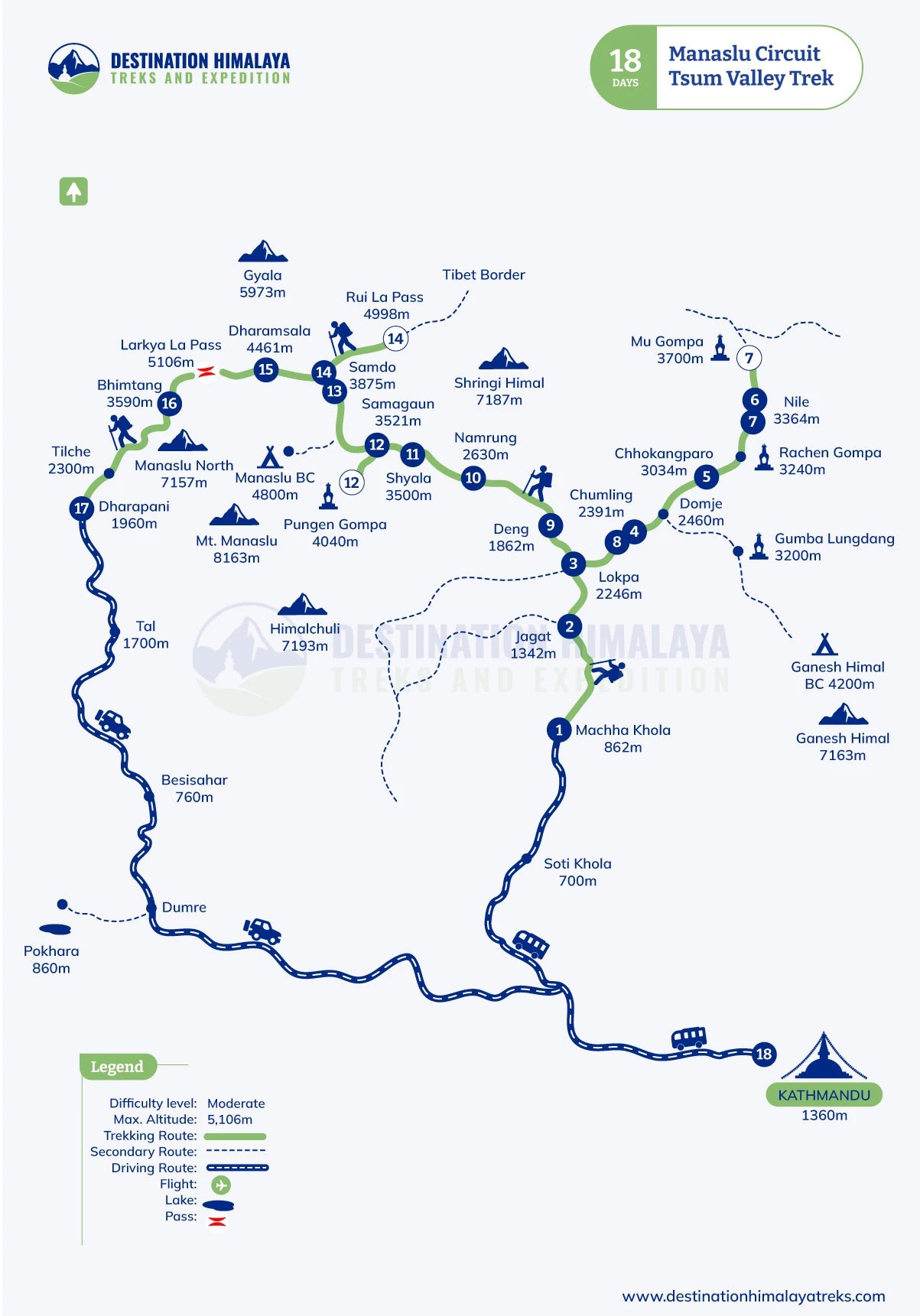
Route Map
manaslu circuit tsum valley trek route map
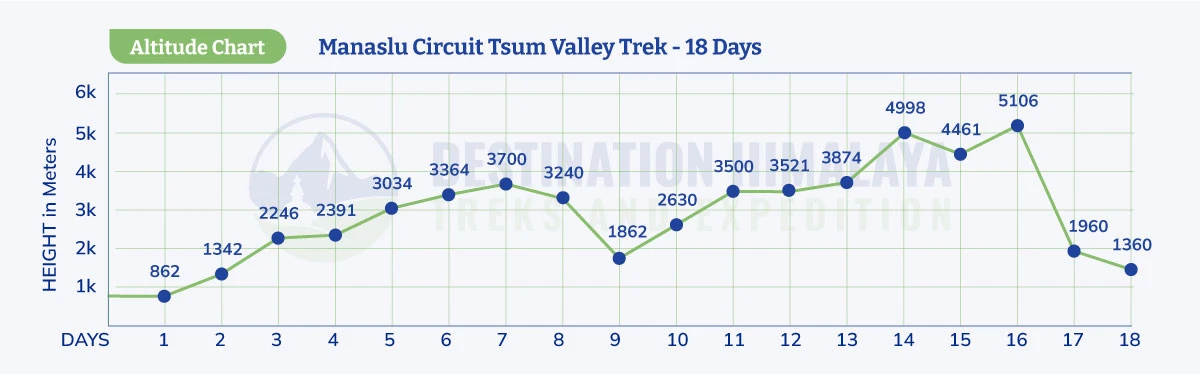
Altitude Chart
manaslu circuit tsum valley trek altitude map
Cost Details
Includes
  • Free Staycation at a standard hotel in Kathmandu (2 Nights), before and after the trip (complimentary offer)
  • Standard Meals (Breakfast, Lunch, and Dinner) throughout the trek
  • Accommodations during the trek 
  • Experienced Licensed Trekking Local Guide with English-speaking fluency and Local language speaking fluency, first aid trained, and equipped
  • Trekking Guide insurance, meals, equipment, transportation, accommodations, and expenses throughout
  • Transportation required: Kathmandu to Machha Khola by bus, Dharapani to Besisahar by local jeep, and Besisahar to Kathmandu by minibus van 
  • Required permits: Manaslu and Annapurna Conservation Area Permits, Tsum Valley permit, and Restricted Area Permit 
  • Duffle Bag and Sleeping Bag (if required and must be returned after trek)
  • Basic First Aid Kits: water purification tablets and an oximeter to check pulse rate
  • Official Expenses, VAT, and Government Tax
Excludes
  • Private Jeep Fare
  • All beverage bills and personal expenses (Hot water, Hot shower, Wifi charge, battery recharge, bottled water, Laundry charge )
  • Tips for the guide and porter 
  • Porter (Cost US $ 425 for one porter) 


Dates & Availability
Select your preferred date
Sep 2026
Oct 2026
Nov 2026
Dec 2026
Jan 2027
Feb 2027
Mar 2027
Apr 2027
May 2027
Date and Days
Price
Status
Date & Days
Sep 13, 2026 - Sep 30, 202618 Days
Price
US$1299US$1599
Save US$300
Status
Guaranteed
Date & Days
Sep 14, 2026 - Oct 01, 202618 Days
Price
US$1299US$1599
Save US$300
Status
Guaranteed
Date & Days
Sep 15, 2026 - Oct 02, 202618 Days
Price
US$1299US$1599
Save US$300
Status
Guaranteed
Date & Days
Sep 16, 2026 - Oct 03, 202618 Days
Price
US$1299US$1599
Save US$300
Status
Guaranteed
Date & Days
Sep 17, 2026 - Oct 04, 202618 Days
Price
US$1299US$1599
Save US$300
Status
Guaranteed
Date & Days
Sep 18, 2026 - Oct 05, 202618 Days
Price
US$1299US$1599
Save US$300
Status
Guaranteed
Date & Days
Sep 19, 2026 - Oct 06, 202618 Days
Price
US$1299US$1599
Save US$300
Status
Guaranteed
Date & Days
Sep 20, 2026 - Oct 07, 202618 Days
Price
US$1299US$1599
Save US$300
Status
Guaranteed
Date & Days
Sep 21, 2026 - Oct 08, 202618 Days
Price
US$1299US$1599
Save US$300
Status
Guaranteed
Date & Days
Sep 22, 2026 - Oct 09, 202618 Days
Price
US$1299US$1599
Save US$300
Status
Guaranteed
Date & Days
Sep 23, 2026 - Oct 10, 202618 Days
Price
US$1299US$1599
Save US$300
Status
Guaranteed
Date & Days
Sep 24, 2026 - Oct 11, 202618 Days
Price
US$1299US$1599
Save US$300
Status
Guaranteed
Date & Days
Sep 25, 2026 - Oct 12, 202618 Days
Price
US$1299US$1599
Save US$300
Status
Guaranteed
Date & Days
Sep 26, 2026 - Oct 13, 202618 Days
Price
US$1299US$1599
Save US$300
Status
Guaranteed
Date & Days
Sep 27, 2026 - Oct 14, 202618 Days
Price
US$1299US$1599
Save US$300
Status
Guaranteed
Date & Days
Sep 28, 2026 - Oct 15, 202618 Days
Price
US$1299US$1599
Save US$300
Status
Guaranteed
Date & Days
Sep 29, 2026 - Oct 16, 202618 Days
Price
US$1299US$1599
Save US$300
Status
Guaranteed
Date & Days
Sep 30, 2026 - Oct 17, 202618 Days
Price
US$1299US$1599
Save US$300
Status
Guaranteed
Essential Information

Best Time for Manaslu Circuit Tsum Valley Trek

The best seasons for the trek to Manaslu Circuit and Tsum Valley are Spring and Autumn, when the weather conditions remain stable, with a less likely possibility of rain and snowfall, showcasing crystal-clear mountain and landscape views. Due to the stability of the climate, the terrain (route) stays dry throughout, which offers a safe and easy trail to navigate and proceed through without having to face muddy, slippery, and icy trailheads, making it a moderate adventure with no risk of hazardous situations. 

During Spring, from March to May, the lush green valley is adorned with thriving blossoms of red and pink rhododendrons, white shades of oaks and pines, and a moderate temperature, ranging from 5 °C to 12 °C at lower altitudes and dropping to only 0 °C to -5 °C at higher altitudes, providing a mild humidity to trail along, without being drained out physically. Along with the flowers thriving all along, as this span of the year comes after the end of wintertime, the chances of precipitation are almost zero, with the winter snow navigation route washed off, ensuring an easy and smooth trail to cross the pass of Larkya La, with panoramic views of the snow-capped peaks throughout.

Whereas, during another peak season (mid-September to November), the region sees a heavy inflow of hikers across the globe, both locally and internationally, where hikers get to connect with keen-minded trekkers and also gain insight into the livelihood, cultures, and traditions of the mountain ethnic locals. The lush green forest and woodland side seems even more intriguing with the brown shades of leaves and golden millets, mustard, and other crops growing up in the terraced fields, being eye-catching all along.

As this idyllic year comes after the conclusion of the monsoon season, wet weather is less, offering a tension-free hike, and does not require much preparation, as the risk of downpour concludes, with the reveal of an unhindered vista of the gigantic mountain panorama. And nature's wonders. Besides, the major festivals of Nepal, Dashain and Tihar, fall in between this ideal time, where one gets to gain insight into how the himalayan tibetan local celebrate such an aura of the festive time, gathering and trying delicious festive meals, making it a peak cultural and best time to venture out for a long-hour hike.

Furthermore, if you are considering this adventurous journey to the Manaslu Circuit and Tsum Valley during the monsoon and winter time, then prior preparation, comprehensive planning, and packing gear and essentials accordingly are a must beforehand. These off-seasons offer heavy rain and snowfall, cloud bursts, with a high chance of natural hazards such as landslides in lower terrains and avalanche risk near the base camp and the pass itself.

Manaslu Circuit and Tsum Valley Trek Difficulty

The thrilling Manaslu and Tsum Valley adventure stands out as a moderately challenging trek, due to the long distance coverage, navigation along isolated and remote sections, daily altitude gain, and the different variations of terrain from forest to rugged, rocky, remote trails, consisting of several ascents and descents.

While many days, an insight into the local tea houses, cultures, and people makes the journey engaging, on the other hand, as you ascend higher, the trail becomes more plain and secluded, with no trace of lodges in between or other fellow hikers, which might be challenging for some who have never been on such restricted-area trekking trails.

Besides, the route is not well marked, with dense areas and steep sections in between, with no navigation signs, where the trekkers might lose the track and get lost in between, causing minor injuries as well, if not assisted well, or hiked independently. Daily, this trek demands at least 5-6 hours of daily hiking, covering 8 to 13 kilometers, which is moderate and not so rapid, whereas the longest trekking day is marked by 9 to 10 hours, while crossing over the Larkya La Pass, an uphill walk, and a downhill route to Bhimtang, demanding a strong physique for sure!

The most concerning factor of this Himalayan trail is the risk of altitude sickness, which is the most common hurdle at high altitude after crossing the altitude of 3000 meters and attaining the top of the pass at 5106 meters, with such massive elevation gain. Hence, you must follow the preventive measures for AMS and safety guidelines to reduce such risk, while letting your body adapt to the rising altitude as well. To minimise such risk, we've customised our 18-day Manaslu Circuit Tsum Valley itinerary with two acclimatization days at Nile (Tsum area) and Samdo on the circuit trail, with a daily altitude gain of only 400-500 meters, ensuring safe ascent.

Ensure your body is hydrated with 4-5 liters of water; avoid drinking alcoholic beverages and smoking cigarettes; instead, fuel your body with nutritious meals, check your body via an oximeter at each stopping point, and most importantly, navigate along with the experienced local trekking guide throughout for safe navigation and an enjoyable hike, without any hassle. Also, do not get influenced by others easily, and walk as per the itinerary that has been set. Lastly, engage in physical preparedness activities such as cardiovascular exercises, like running, walking, and steep climbs via treadmill, and weight training as well, to make your fitness level stronger, proceeding the trail with ease. 

Accommodation and Meals

The accommodation along the Manaslu Circuit Tsum Valley route is on a tea house basis, hosted by the locals themselves, offering warm, cozy hospitality and being well maintained hygienically. Even though the trail does not consist of any fancy lodging, you can expect standard amenities, with basic rooms accommodating hikers and cozily catering to the basic facilities required. The tea house is more on the remote side, with antique decorations in Tibetan patterns, and all lodges are in similar patterns, which makes the overall experience pretty intriguing and provides more Tibetan cultural exploration. 

Rooms are basic, with comfortable bedding, mattresses, cozy pillows, blankets, and warm enough for a night's stay, without having to require sleeping bags during peak times; however, it is still recommended to carry them above 4000 meters, as the temperature drops below 0 degrees Celsius. The rooms are available in a wide range of options: private, twin sharing, triple bedding, or group basis, which will be arranged according to your privacy and comfort level. Basic facilities such as WIFI, charging access in the dining area, shared washrooms, laundry, and hot showers are available throughout the trail, at an extra cost, depending on the lodges. Whereas, compared to the Manaslu standard trail, the rooms are simpler and more remote, and the tea houses are more Tibetan-style built while covering the Tsum area.

On the other hand, for the meals, every lodge/homestay has a wide variety of menu, catering to the taste of everyone, from Western American-style meals to asian to mexican to asian to local, keeping in mind the diet restrictions, and fulfilling meals for long-distance hikes. There are multiple dishes; for instance, for breakfast, Tibetan breads, Tibetan soups, paratha with curry, toasted breads served with peanut butter, jam, chocolate jam (Nutella), honey, any kind of hot beverages such as coffee, tea, milk, any kind of eggs (omelette, poached, boiled, fried, masala), etc.

Whereas, for the lunch and dinner options, a wide range, such as French fries, noodles with soup, chowmein, spaghetti, dumplings, pasta, pizza, even burgers, whole protein-filled bowls, etc., are available, which will be prepared soon after you order. Just take note: before ordering the meals, inform the guide or the locals (cook) about your dietary restrictions and ingredient choices, so that it can be cooked accordingly, keeping in mind your health and diet. 

We also suggest you try local meals, and the ultimate Dal Bhat, which includes all kinds of nutrients like fiber, carbs, protein, and can be refilled as much as you can, so that it fills your tummy and meets your nutrient goals to undertake a long-hour odyssey. Bring snacks: protein bars, dry fruits (almonds, cashews, nuts), chocolate bars (Snickers, Galaxy, filled with nuts), protein bars, to munch on in between the trail, giving you instant energy throughout. 

Guides and Porters

Throughout this combined iconic route to Manaslu and the Tsum trail, you will be accompanied by our experienced, licensed local trekking guide, with more than 15 years of expertise and a high level of proficiency in English and Tibetan. They unlock the hidden gems of the ancient monasteries like Mu Gompa, navigate through unmarked trailheads, dense forested areas, remote and isolated terrain, high-altitude sections where even GPS fails, and track, ensuring a safe journey and covering every highlighted corner without missing out on anything. 

Our medically trained guides serve as your emergency responders, carrying comprehensive first-aid kits and oxygen for altitude-related emergencies. In this remote region with no hospitals or health posts, they provide immediate care, stabilizing patients until helicopter evacuation if needed. Apart from that, from the very beginning till the end, they help you to follow the safety guidelines, check early symptoms of AMS, and also monitor your oxygen level via an oximeter. As the guides are experienced and locals of the Tsum area itself, they let you connect with the local communities of Tsumba, Nubri, and others by interacting and engaging in daily activities, being a part of the celebrations and cultures, enriching the trip more than just attaining the destination or a certain pinnacle.

The Sherpa porter, on the other hand, becomes your best help along such a high-altitude adventure, letting you trail along and ascend further with ease, as they take care of your heavy backpacks, up to 22 kgs, which can be shared between 2 hikers. As the porter is optional, we've not included it in our package cost, but you can hire one, adding an extra cost of USD 380 for 18 days. Having a porter is always a great option, which you can look further into for a smooth adventure to the mountain areas.

Can I do the Tsum Valley and Manaslu Trek without a guide, independently?

No, the Manaslu region is categorized as one of the most isolated restricted trekking trails in Nepal, limiting the footprint of trekkers for the conservation of the locals' cultures, traditions, and unchanged lifestyle, and maintaining the sustainability of the territory at the same time. The limitation of visitors has been highly effective in protecting the pristine nature and wildlife, without being influenced by modernization. The Government of Nepal has implemented certain rules for entering the Manaslu Restricted Area.

Firstly, this trek cannot be undertaken without the assistance of a local licensed trekking guide; secondly, the guide must be hired through a local travel agency in Nepal; and lastly, solo trekking is not allowed, where each group must include 2 hikers, excluding the guide and porter; thus, guided trekking is compulsory, and hiking without a guide is impossible. These rules have been followed for safe navigation along such isolated routes and high-altitude odysseys, where the weather changes frequently, with very possible chances of natural hazards such as landslides, avalanches, or getting lost along the trail. 

Solo or Group Join: Which one is better for the Manaslu Tsum Valley adventure?

We can arrange solo private, and group treks with Destination Himalaya Treks and Expedition, whatever you prefer, customizing the trip dates, itinerary, and cost accordingly. Just to let you know, the bigger the number of hikers your group has, the lower the price gets.

Group Joining

As government rules eliminate solo trekking, if you are a solo hiker and seeking a travel partner to hike along, then joining a group wins for experienced hikers, who can cope with any pace of hike, whether on a short or long hiking trail, with partners to trek with, sharing porter and guide costs. Every year, there are fixed departures for the Manaslu Trip, where other hikers await to join them and proceed on the journey, creating everlasting memories.

However, some travelers prefer more personalized experiences. Group packages follow fixed itineraries, scheduled dates, and group paces, which may not suit everyone. While 20% more affordable, matching others' hiking speed can feel rushed for those seeking:

  • Custom acclimatization (extra rest days)
  • Slower Larkya La ascent (beginners or seniors)
  • Flexible daily distances 
  • Private cultural immersion (Tsum monastery visits)

Private Group (Friends/Family)

If you do have a group/partner to trek with, then nothing is better than opting for a group trek to Manaslu and Tsum Valley, where we can handle any group size, more than 12+, as well as customizing itineraries as you prefer, without you having to compromise. Along with a great discount on the package, we offer extra complimentary add-on facilities, an assistant guide (for trekkers more than 6), and a porter for every two trekkers. Here are the pros (advantages) that you can expect while choosing the private group trek for such a thrilling journey:

  • Custom pace and acclimatization days
  • Better for senior citizens or beginners for the slow Larkya La ascent

Solo with Private Guide 

If you are someone who does not prefer joining a group and seeks to hike alone, enjoying your own company, and delving deep into nature, connecting with local lifestyle, cultures of the Tibetan communities, and craft itineraries, matching your choices, then it is the best option that you can root for, which is the most famous one as well. Trekking solo gives you full accountability for a deeper exploration of the region, and you thrive in the remote section of Tsum Valley. Many adventure seekers opt for a private solo trip, along with an experienced trekking guide, who lets you cover every highlighted spot without missing anything.

Here are the major pros to expect during a solo private trip:

  • Flexible schedule
  • Customization of itinerary (time/budget/route/acclimatization days)
  • Extra complimentary and early bird offer
  • Private assistance from the trekking guide (medical aid, licensed and trained)

Permits for Manaslu Circuit and Tsum Valley Trek

The trek requires four essential permits that must be arranged through a registered Nepali travel agency, as independent permit issuance is not allowed. We handle the entire paperwork once the booking is confirmed, and it is included in the package cost itself.

Manaslu Restricted Area Permit

First and foremost, the most essential permit is the Restricted Area Permit (RAP), giving you a full hand obligation to travel along the isolated restricted remote area, after fulfilling the requirement of two trekkers in each group, excluding the guide and porter, along with the trek being guided by a Nepalese company. The cost for this permit varies according to the seasonal basis, depending on which part of the year you undertake the hike.

  • Peak season (September–November): USD 100 for the first 7 days, plus USD 15 per day for every other additional day
  • Off‑peak season (December–August): USD 75 for the first 7 days, plus USD 10 per day for each additional day
  • Foreign nationals: NPR 3,000 (USD 23–30)
  • SAARC nationals: NPR 1,000
  • Nepali trekkers: NPR 100
  • Children under 10 years: free

Manaslu and Annapurna Conservation Area Permits

Second permit, marked as the Manaslu Conservation Area Permit (MCAP), costs approximately USD 28 (NPR 3000) per head for foreign nationals, and USD 8 (NPR 1000) for SAARC nationals, and only NPR 100 for Nepalese trekkers and free for children below 10 years old. As this trip also covers the Annapurna region as well, you must get a hands-on Annapurna Conservation Area Permit (ACAP), which costs a similar amount to the MCAP 

  • Foreign nationals: NPR 3,000 (USD 23–30)
  • SAARC nationals: NPR 1,000
  • Nepali trekkers: NPR 100
  • Children under 10 years: free

Tsum Valley Restricted Area Permit (Chumnubri Rural Municipality)

As the trail is extended to the sacred Tsum Valley, a separate Tsum Valley Restricted Area Permit is required, covering Lokpa, Chumling, many more, and the monasteries (Rachen and Mu Gompa).

  • Off-season (December-August): USD 30 for the first 1 week, plus USD 7 for every additional day
  • Peak season (September - November): USD 40 for the first week, and an extra USD 7 for every other day

All required permits and paperwork will be arranged by us once your booking is confirmed, with no additional cost beyond your package price.

Travel Insurance

For this trek to the Manaslu Circuit and Tsum Valley, it is one hundred percent crucial to obtain travel insurance that covers all the essentials, such as medical injuries, expenses, theft, trip delays, cancellation, and most importantly, evacuation above 3000 to 6000 meters.

Having travel insurance with you ensures that you're in safe hands in case of an emergency, natural hazards like landslides, weather changing situations, avalanches, etc., and acts as a quick medical response, as the trailhead does not have any hospitals for severe medical conditions. No matter how beginner, pro, or experienced you are, the possibility of AMS (Acute Mountain Sickness) is always there, ensuring a good policy becomes a great help if any uncertain situations occur, by any chance, saving extra medical costs, and arranging the helicopter evacuation immediately.

Booking Procedure

To book this trip, we only require 10% of the total trip cost for the arrangements of the necessary logistics, as you prefer. Booking with us at Destination Himalaya Treks and Expedition is one hundred percent safe and easy, as we've been operating as a locally based travel agency for more than 15+ years, being affiliated with TAAN (Trekkers Association Agency of Nepal) and NMA (Nepal Mountaineering Association); thus, you can trust us for your adventure for sure.

The payment can be made within a minute online via the website as an advance, and the remaining amount (fare) shall be paid after arriving in Kathmandu, the capital city of Nepal. After the payment is made, we will send you a booking confirmation receipt, mentioning your name and the amount received, via email and WhatsApp. Afterwards, please send us your original passport photo, recent photos, flight details, and travel insurance (if you have one).

Last Minute Booking

If you haven't booked the trip in advance, then we offer last-minute booking for this adventure, even up to 1-2 days; however, 100% of the total cost is required for last-minute booking, as we have to arrange all logistics immediately. If you have any further queries, then feel free to reach out to us through email at [email protected], or WhatsApp / direct call at +977 9851016814, anytime, as we are available 24/7 to assist you.
FAQs

The Manaslu Circuit with Tsum Valley Trek is known to be a moderately difficult to strenuous trek, stretching to more remote parts of the Manaslu region. It involves long walking days across varied terrain, with steep, rugged ascents and descents, and crossing the Larkya La Pass.

The trek lasts 18 days, including travel days to and from Kathmandu, acclimatization days, side trips, exploration of the Tsum area, and crossing the iconic pass.

The maximum altitude is Larkya La Pass, situated at 5106 m (16752 ft), one of Nepal's longest and highest Himalayan passes.

Yes, as the trek exceeds the height of 5000 meters, a risk of altitude sickness is the primary concern. We include two acclimatization days (Nile and Samdo), monitor SpO2 via oximeter, use first-aid-trained guides, and maintain a gradual pace that aids in minimizing the risk.

You should be able to comfortably hike 5-6 hours on the distinct terrain and continue it the very next day. Daily, the walking route changes frequently; sometimes, you'll encounter completely plain, easy trails, and other times, rugged, rocky, and steep uphill walk sections. Hence, you must have a reasonable fitness to handle different kinds of terrain.

Yes, the trek is achievable by fit seniors and first-time trekkers, with prior preparations for 6-8 weeks, engaging in cardio, weighted hikes, and focused packing essentials, and well-scheduled acclimatization plans. The private trips basically involve customary durations, rest days, and personal private guides, so if you are a beginner or a senior citizen, we highly recommend choosing private treks rather than a group join.

Yes, it is considered safe for well-prepared trekkers in 2026 when undertaken with a licensed trekking guide, a well-paced itinerary, and proper acclimatization. The main risks are unexpected weather changes in higher altitudes and on remote trails. However, the route and tea houses have operated continuously, and our itinerary follows conservative ascent profiles and oximeter checks; just make sure to consider travel insurance with helicopter evacuation.

Yes, while the recent flood happened on the 26th of August, 2026, it affected many parts of Nepal; however, the Manaslu Tsum area remains open and operating for trekkers, as the floods were localized to the Trishuli and Bhote Koshi corridors and did not impact the Gandaki River basin, where the trek is located. While on the trekking route and tea houses are completely unaffected and operating well, the driving route, Kathmandu - Maccha Khola, the starting point, requires using an alternative lower safe crossing through Benighat to bypass the damaged highway bridges; thus, you won't face any uncomfortable, bumpy road before the trek begins.

Only basic health posts are available in the lower altitude villages; there are no hospitals, as the trail is remote, but as our guides will carry basic first-aid kits and oxygen, if any, in uncertain situations occur, they will be your first safety access. For the serious cases, it is a must to coordinate helicopter evacuation; that is why comprehensive travel insurance is mandatory for this adventure.

Our guides assess the early symptoms of AMS, and if it seems serious (rare cases), then they will arrange an early exit to lower altitudes or helicopter evacuation if needed. Your insurance policy must cover medical costs and evacuation up to 5500-6000 meters.

Safety is our first and foremost priority. If any uncertainties, such as extreme weather conditions or unsafe trekking trail conditions, affect the Larkya La Pass crossing, then your guide will review the situation and may adjust the itinerary or wait for safer conditions.

You will find mobile coverage and Wi-Fi in some villages, especially in the lower part, but as you go higher, the connection gets limited and unreliable at higher altitudes. In remote sections, the only way to the internet is the wifi at the tea houses, paying an extra fee, as the mobile network connectivity is almost zero, but lodges do include wifi access, so there is nothing to worry about regarding communication.

No, there are no reliable ATM facilities; the last and only available ATM service is at Aarughat, before starting the walking trail. However, the machine may not work sometimes due to network failures and cash shortages, so you should carry enough Nepalese currency from Kathmandu for personal expenses, like charging, snacks, showers, laundry, and tips.

Group sizes completely vary as per the seasonal time. Our group-join trips typically run with 4-10 trekkers, while private trips can be tailored for couples, families, or solo travelers, with a dedicated guide.

Yes, the tea houses cater well to vegetarian, vegan, gluten-free, and other dietary needs that one requires, just make sure to inform the guide in advance, so he can take care of it.

Yes, the itinerary can be customized as per your availability, budget, and preferences, with extra side trips, rest days, and shorter walking days.

Need Help? Talk to Expert!
min gurung
Min Gurung
+977 9851016814
spectacularly trek, with incredible guides

I did the manaslu circuit trek. The trek itself was gorgeous, very peaceful and quiet, unlike some other treks.
My guide was Karma.
I trusted Karma with my...

read more +
W
Wanderer52553936923
April 08, 2026
Great Manaslu Experience

We hebben een top ervaring gehad met Destination Himalaya Treks & Expedition op de Manaslu Circruit Trek. Onze gids Bharat was erg zorgzaam en ervaren. Ik zou deze organisatie aanraden...

read more +
K
Keon W
April 07, 2026
Fantastische Manaslu Trek ervaring!!!

Mijn vriend en ik hebben de short Manaslu circuit trek (8 dagen) gedaan met Destination Himalaya Treks en het was echt fantastisch!! Alles was top geregeld en werden volledig ontzorgd....

read more +
M
Myrte V
April 07, 2026
You May Also Like
manaslu circuit annapurna circuit trek
Starting from
US$1299US$1799
Manaslu Circuit Trek
Starting from
US$999US$1299
Off beaten trails
manaslu circuit trek
Starting from
US$1049US$1399
Need Help? Call Us+977 9851016814