Best Time for Gokyo Valley Trek
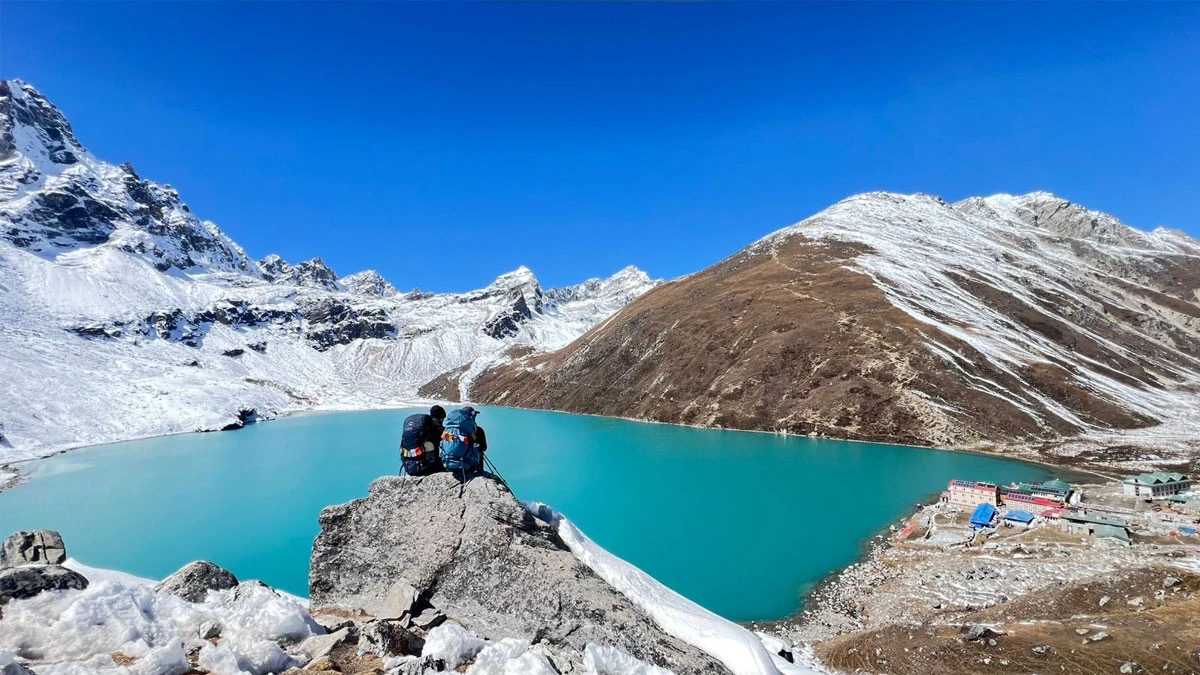
The ideal seasons for the Gokyo Valley and Gokyo Ri Trekking stand out to be the seasons of Spring, starting from March to the end of May, and Autumn (September to November). During this span of the year, the overall himalayan experience becomes magical, with the panoramic insights into himalayan peaks and landscapes due to the stable weather and climatic conditions.
The chances of precipitation (rain, snowfall) are relatively lower, as the seasons come after the conclusion of the monsoon and winter, when it faces a high level of cloud bursts. Due to this, the terrain remains dry and smooth, which can be easily traversed by any kind of trekkers, without having to face muddy, icy, and slippery trailheads, making it a perfect time to pass through.
During Spring, the sunlight day hour lasts for a longer time, where the trekkers get to explore the Khumbu region, and take a gradual pace and ascend, without speeding up the itinerary, just because of constantly worrying about dark evenings.
The temperatures usually range between 5 °C and 15 °C during the day, and don't go below -5 °C at night, offering a chill hike, and cozy nights, without draining or sweating you out and not freezing. The spectacular part about trailing at this time is that, while navigating through the forest area, you get to gaze at the thriving rhododendron forests and orchids with the picturesque backdrop. With the captivating surroundings, it keeps you engaging and energized throughout the day.
Autumn, on the other hand, marks another peak time to trail along, where the lush green woodland area turns into golden shade leaves, the roaring rivers, water falls, become more intriguing, as the monsoon concludes, with zero chance of rainfall. The humidity also tends to be moderate, not exceeding 18 °C, ranging somewhere between 4 °C and 18 °C during the day, and drops to only 0 to -2 °C at night.
This ideal time can be a go-to adventure for hikers who seek more interaction with other hikers and want to learn more about distinct cultures, not just Sherpas, as the route experiences a heavy number of domestic Nepalese trekkers, due to the holiday weekends of major festivals, Dashain and Tihar. It can be a great opportunity for individuals, celebrating the Nepalese cultures, traditions, and festivals, with the himalayan mountain people, gaining a unique perspective, insight into the himalayan trailhead.
How difficult is the Gokyo Valley Trek?
Compared to any other high altitude adventure or the isolated circuit treks, the trek to Gokyo Valley is considered a moderately challenging hike that can be commenced by any kind of trekkers. The terrains do not include any high mountain passes, technical sections, or rugged, patterned terrains, demanding no prior experience. However, at the higher elevation, it has some glacial pathways and a sloppy ascend; thus, one must have at least a basic level of physical fitness. The trail demands a daily pace hike of 5 to 7 hours, covering the daily trekking distance of 8 to 12 kms, through several uphill and downhill walks, so you must have a strong physique to bypass the trailhead with ease.
Basic fitness doesn't mean building muscles, abs, or anything like that; it just means engaging in some kind of physical activity, such as cardiovascular exercises, running, walking, swimming, or strength workouts, focusing on legs, and managing the frequent changing terrains. If you engage in some kind of training for a month, even as a beginner, you are all set to go.
Likewise, apart from the physical aspect, there are some challenges, such as frequent weather changes, remote and less trodden trailheads, and massive elevation gain, which make the overall trip, to be more difficult. Moreover, there are still some signboards, and the trails are well-maintained, with many tea houses in between. Also, while navigating with a licensed, experienced trekking guide, you won't find any challenges regarding the trailheads.
The only difficult factor that one may find en route is the daily altitude gain, with thinning air, and reaching the highest altitude at 5357 meters, Gokyo Ri summit point, as trailing along with unsimilar and not used to altitude is no joke. However, to ensure a gradual ascent, this 14-day Gokyo Valley Trek itinerary includes a slow altitude gain (300-500 meters) each day, with enough restful time to avoid the possible risk of altitude sickness.
Besides, the tea houses are also well-equipped, basic yet include all the services that the trekkers need, so you don't have to compromise on the services. Overall, this trek is a moderately challenging trip, demanding good fitness and a strong mindset. Any individual with basic fitness and good health can proceed on this adventure smoothly.
Altitude Sickness: Symptoms and Preventive Guidelines
Starting from an elevation of Kathmandu at 1360 m, with the walking trail starting from Lukla (2860 m), and reaching the highest at 5357 m, this trek to Gokyo Valley faces a massive elevation gain. Even though our itinerary is set, with a moderate climb not gaining beyond 500 meters, it is still crucial to follow the preventive guidelines throughout and be alert to the symptoms of altitude sickness.
Mild symptoms include a mild headache, stomachache, a bit of dizziness, and nausea, whereas severe ones are quite rare but still expected, such as losing control of walking, breathing problems, frequent nausea and vomiting, skin turning pale, and skin turning grey. If any of the symptoms occur, please inform the guide immediately, as our guides are medically trained, experienced, and equipped. Even though getting AMS (Acute Mountain Sickness) is rare with our expertly crafted itinerary, and the support of the best expert teams, following the safety measures, is necessary, which are mentioned below:
- Hydrate your body with 3-4 litres every day. Meanwhile, if it sounds too much, consider healthy, nutritious meals, such as ginger, tomato, or any soups.
- Avoid smoking cigarettes, vaping, or drinking alcoholic beverages, as they harshly affect your lungs and breathing at such an altitude.
- Always walk along the trekking guide, side by side, following his pace level and route. Do not be influenced by other fellow hikers and crush your itinerary, as everyone has their own experiences and pace level, so just follow the route that has already been set.
- At every stopping point, check your pulse rate via oximeter, and know how your body is coping well with the increasing elevation.
Training for Gokyo Valley Trekking
Even though the Gokyo Ri Trek is considered one of the moderate adventures, which can be easily undertaken by any kind of trekkers, from beginners to experienced ones, or families, or even senior citizens, one must consider proper preparedness and training. For this high altitude, one must consider physical preparedness, training the body for a strong physique and mental resilience, so that you get along with the rising altitude, long trekking hours, and a massive elevation gain. We highly recommend trekkers to engage in preparation for 1-2 months, if you are a beginner, or at least 2-3 weeks, if you are already running out of time.
Physical Training: Engage in Cardio and Strength Building
The best way that you can start training your body is by engaging in cardio workouts in the gym, such as walking, stair climb at the treadmill, cycling for 15 minutes, or doing jumping jacks or ropes. Then, as the day progresses, you can combine cardio workouts with strength training weight workouts, focusing more on the back, calves (legs), and core muscles, which greatly helps to cover 4-5 hours of walking pace, by strengthening your stamina level. Also, take note that cardio also helps to adapt to the rising altitude, does immensely best for the lungs, en route, training your body to cope with less oxygen and improve breathing.
Whereas, if you are not looking for joining gym, then you can also choose home workouts by watching YouTube videos, workout plans, including planks, lunges, jumping ropes, jumping jacks, squats, hence, just activating the muscles, for this adventure.
Engage in Short Hikes: Gain Some Altitude Experience
For those trekkers having no prior high altitude experience, the best preparation for the Gokyo Valley and Gokyo Ri adventure is by opting for short hikes nearby, gaining some elevation. Engaging in hiking helps your body adapt to the rising high altitudes, and minimizes the possibility of ams (acute mountain sickness), enabling your lungs to breathe at the trailheads.
What happens is that if you've never been to a higher elevation of 2000+ meters before, then going to the trail directly, and hitting the altitude, thin oxygen, and low temperature, can be too much for your body, especially for novice hikers. However, if you have gained some prior high altitude hikes, even if it is approx 2000 to 2500 meters, which only lasts for 4-6 hours, the lungs, heart, or the overall body get used to such rapid elevation gain, and proceeds a safe and smooth adventure.
Mental Resilience Training
Trekking along through such remote and isolated terrains demands a strong mental toughness, to keep you all persistent and engaged, to overcome fatigue, discomfort, or any sort of mental pressure, which usually happens if you are a beginner. Hence, training your mind to cope with consistency for the trip is crucial, which plays a more crucial role than physical fitness.
- Do some yoga and meditation practices, via videos, or read motivational books, listen to the adventures or climbers podcast - builds positivity.
- Practice the 4-7-8 breathing practice (4's inhale, 7's hold, and 8's exhale) - helps to breathe in higher altitude.
- Spend 5 to 10 minutes visualizing yourself on the terrain and at the summit of Gokyo Ri (5357 meters) to successfully create a positive, enthusiastic mindset.
- Create a journal book, writing your daily activities, daily mountain views, cultural exploration, and overall experience each day, while on the route - keeps you engaged.
Accommodations
The accommodations along the trail are on a tea house or lodging basis throughout the Everest Gokyo valley trek. The lodges are run by the locals themselves, so it is more on the simpler yet culturally rich side; it comes with limited services.
While in the lower terrains, Phakding, Namche Bazaar, the lodges are more facilitated, and come with luxury options, as well, with attached washrooms and private rooms. Whereas, as you move higher, it becomes simpler, with sharing a washroom and sharing basis twin based. If you are a solo trekker or want a single bedroom, then we can arrange that, as well. Just let us know beforehand. The availability of the variation gets quite limited at the peak times, but do not worry, as our team will book the accommodations in advance as you prefer.
Even though the rooms are simple, every required standard amenity, such as wifi, laundry services, charging accessibility, and hot showers, is available; however, you must pay extra for such services. The dining area is the most cozy and busiest area, where your meals will be served, and it is well-heated, so spend your evening time. Here, relax your muscles before heading to bed, which keeps you all warm. The rooms are well equipped, with bedrooms, mattresses, pillows, blankets, and well sanitized, and warm, where you might not require a sleeping bag. Despite that, if you want one, then we can arrange it throughout the trip. Inform us before the trip begins.
On the other hand, while being at Kathmandu, you will be accommodated at 3 star hotel, or a similar category hotel, for 2 nights, before and after the trip, with all the services included. If you have anything on mind, regarding the hotel choices, then we'll arrange it as well. Do not hesitate to reach out to us.
Meals
As the Everest region falls under one of the most popular trailheads, with a high number of visitors, across the globe, every tea house caters to the taste palette and dietary preferences. Our package includes three standard meals, Breakfast, Lunch and Dinner throughout the trip.
From western cuisines such as pizza, sandwiches, spaghetti, sizzlers, steak, rolls, burger to any kinds to asian/indian foods like roti (chapati), paratha, any kind of curries (veg or non-veg), to the Nepali typical meals, including momo, chowmein, thukpa, thenduk, every variations are available. You can also find a wide variety of breakfast options: mashed potatoes, peanut butter, jam, Nutella, butter spreadings with toasted or normal breads, any kind of eggs cooked (poached, omelette, boiled), granola, museli, Tibetan breads, served before the trek gets started in the morning, which keeps you engaged throughout the day.
Apart from that, there are an ample number of options for vegetarian, vegan, or gluten-free options; you just have to inform the cook or the guide beforehand, so that it gets prepared accordingly.
Besides, for the beverages, from hot drinks, americano, latte, green or milk, or black tea, capuchhino, hot lemon ginger tea or water, even hot chocolates, and famous Tibetan tea are available, to warm you up, including other cold and alcoholic beverages options as well. However, we recommend that you avoid such alcohol or cold beverages after crossing Namche Bazaar, typically above 3000 meters, and rather consider having hot soups, or ginger garlic soups, or tea, as an alternative, at such higher elevations.
How to get to Gokyo Valley and Gokyo Ri?
To reach the Everest Gokyo Ri summit point (5457 m), there are three means: either following the trekking route, via Lukla flight, or taking a jeep drive to Salleri, and following the walking trail, and rejoining the standard route from Phakding, or proceed a direct helicopter ride to the valley. Navigating through the trailhead on foot is the best option, which lets you explore more of the Khumbu region, Sherpa villages, cultures, and monasteries along the route. However, if you are short on time, then what you can do is follow the trekking route, on the one hand, after a flight to Lukla, and then return directly via helicopter to Kathmandu, cutting an extra 3-4 days.
Our 14-day Gokyo Valley Trek includes all the transportation fees and arrangements of the Lukla flight tickets included in the package, to and from Kathmandu. Lasting for 25 - 30 minutes, the airway showcases the impeccable panoramic view over the mountains, landscapes, and the easiest way to get to the starting point. If you want a helicopter option, a road drive option, or the heli return option, then we will arrange it accordingly.
Just to let you know, during the peak trekking season, the flight basically operates from Ramechhap, Manthali Airport, where we have to take a drive from Kathmandu to Ramechhap, and commence a flight from there, due to high air traffic congestion. To know more, check our detailed article, Lukla Flight Information, so that you get a proper overview.
Guide and Porter
To assist you on the Gokyo Lake and Gokyo Ri Trekking, you will be assisted by our experienced licensed guide, who is highly experienced, with more than 10+ years. Our guides are medically experienced, trained, and equipped as well, who know how to handle the emergency conditions, and also, act as a medical respodant if in case any unfortunate situations occur.
Besides, they have a really good personal connection with the locals, as well, so while on the route, you get to explore more of the cultural and daily life aspects, engaging in interaction or festivals, enriching the overall experience. As they have been serving the route for many trekkers for more than, decades, you will be safely navigated, covering all the highlighted corners, at the same time.
On the other hand, our package does not include a porter, as it is an optional choice; even so, if you are a beginner, then hiring a porter plays a huge role in making the trip easier and smoother. If you haven't had any high altitude experience, then we suggest you hire a porter, who will take care of your heavy backpack and make the ascent much easier. One porter can carry upto 22 kgs, which can be shared between two trekkers. If you want to know more about porters or guides, then we will have a detailed discussion while booking the trip.
Travel Insurance
Travel insurance is one hundred percent crucial for the trek to Gokyo Valley, where the route itself is isolated, remote, and most of all, the trail takes you higher and higher each day. While this trip is considered an easy-going odyssey, it still possesses many challenges, uncertain weather, frequent changes, unseen natural occurrences, and the risk of altitude sickness, due to which you must have a backup plan from the beginning. Besides, there are no such immediate medical facilities, health posts, or hospitals that handle serious cases, or even quick road access, as it is a completely high-altitude trek, so getting insurance that includes all the essentials must be prioritized while planning the trip.
Even though the kind of serious cases happen rarely, we still recommend you get the trip insurance, so if any of the situations occur, and getting back, or the quick medical response is the only option, then you will be immediately evacuated. Ensure that your policy includes medical coverage, bills, theft, trip delay, cancellation, and most importantly, helicopter evacuation upto 6000 meters, for this adventure.
What are the required permits for the trek to Gokyo Valley?
For the Everest Gokyo Valley Trekking, there are two essential permits: firstly, the Sagarmatha National Park Permit and secondly, the Khumbu Pasang Lhamu Rural Municipality Permit. Both these permits must be attained via a travel agency, and soon after your booking is confirmed with us, they will be arranged by us.
- Sagarmatha National Park Permit: It is essential to obtain a permit for any adventure within this territory, which can be obtained from the Nepal Tourism Board in Kathmandu, Thamel, or even at the entrance gate at Monjo. It costs approximately USD 13 (NPR 1500) for the SAARC nationals, whereas the cost is higher for the foreigners at NPR 3000 (USD 28), where the fee goes directly to the conservation and sustainability of the region.
- Khumbu Pasang Lhamu Rural Municipality Permit: The cost of this permit is somewhere around NRP 2000 (USD 18), which can be obtained at Lukla or Monjo, upon arrival at the starting or entry gate.
Booking Procedure
To book this adventure, we only require 20% of the total trip cost, which can be paid via the website (online), Western Union, or as an advance, whereas the remaining amount can be paid upon arrival. We at Destination Himalaya Treks and Expedition have been serving as an authorized, registered, and local agency, for more than 2 decades (more than 15 years), affiliated with NMA (Nepal Mountannering Association) and TAAN (Trekkers Association Agency of Nepal), thus, you can surely trust us, and booking with us, is one hundred percent safe and hassle free.
After the payment is done, we will send you a booking confirmation receipt, mentioning your name, amount received, via mail and WhatsApp. Afterwards, please send us your original passport photo, recent photos, flight details, and travel insurance (if you have one).
Tips for Everest Gokyo Valley Trekking
- Every lodge, at the trailhead, does not have attached charging sockets within the room, and only available in the dining area. As it is limited, you cannot find it in the room itself, and only accessible in the dining room, paying extra dollars for the service. So, we highly suggest that you carry a powerbank (20,000 mAh) and extra batteries, to avoid long queues, and get charged immediately.
- The ATM's services are available at Kathmandu and upto Namche Bazaar, so carry cash in Nepalese currency, for the extra personal expenses, and do not rely on Debit or Credit cards.
- No matter which seasons you hike in, ensure you carry packing essentials, considering other seasonal times as well. For instance, if you are trailing even at peak trekking time, Spring and Autumn, pack in down jackets, rain coat, a backpack cover, a sleeping bag, as the weather isn't stable, and changes frequently.
- The WIFi is accessible at every lodge but cannot be stable at the higher altitudes; thus, we recommend you buy an NTC or NCELL Sim Card for immediate calls, to use the internet connection, and use the internet especially along the route.
- Do not miss out on bringing personal toiletries items, such as biodegradable soaps, shampoos, sanitizers, towels, toilet rolls, to stay sanitized and hygenic, as hot showers cost approx. USD 3 to 5, and are quite limited.
Last Minute Booking
If you haven't booked the trip in advance, then we offer last-minute booking for this adventure, even up to 1-2 days; however, 100% total cost is required for last-minute booking, as we have to arrange all logistics immediately. If you have any further queries, then feel free to reach out to us through email at [email protected], or WhatsApp / direct call at +977 9851016814, anytime, as we are available 24/7 to assist you.