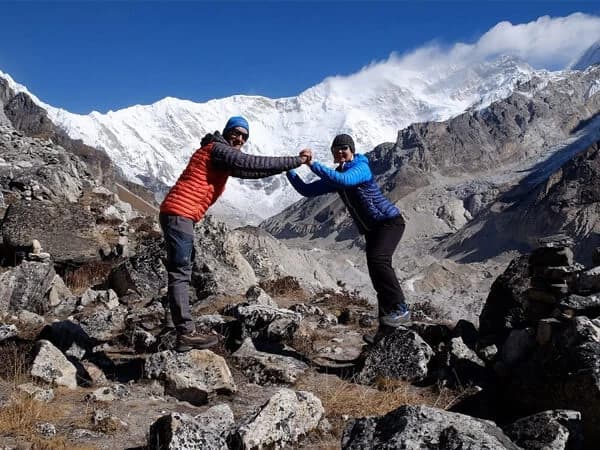
kanchenjunga
on the way to kanchenjunga circuit
kanchenjunga region trek

Kanchenjunga Base Camp Trek - 18 days

314 reviews in TripAdvisor
27 reviews in Google Reviews
Recommended by 99% of travelers
Duration18 Days
Trip GradeStrenuous
Maximum AltitudePang Pema - 5140 meters
ActivitiesTrekking
Group SizeMin. 2
StartsKathmandu
EndsKathmandu
Best TimeSpring and Autumn

A hidden gem that perfectly matches the synonym of heaven on earth, this Kanchenjunga Base Camp Trek is a 18 days adventure that visits both iconic north and south base camps of Mount Kanchenjunga (8586 meters), touching the route of The Great Himalaya Trail.”

The less crowded trail, the ancient monasteries where Tibetan flags flipper with the chanting of monks, and the rich ecosystem with a touch of off-beaten experience where the locals' smile and hospitality will fascinate you more than the mountains, where the mountains have more myths and culture compared to any other, and yes! the Himalayan range that connects India, Nepal, and Tibet. 

Kanchenjunga Base Camp Trekking Overview:

Located in far Eastern Nepal, Kanchenjunga is a secret wonder of the Himalayas that truly depicts what the earth would look like if it weren't influenced by the modern world. Kanchenjunga Base Camp Trek in Nepal allows you to take on a wilderness adventure here in Nepal, traversing the local villages, sparkling diamond-like lakes, unstoppable flowing rivers, and the dense forest of rich ecosystems, and lets you explore the north and south base camps together, showcasing the multi-angle views of the legendary peaks in one single journey.

Do you know that Kanchenjunga is also called " The Five Treasures of the Great Snow," which means 5 of its Himalayan ranges standing in a row exceeding the height of 8000 meters? During this trek to Kanchenjunga, you'll get to witness all of the Kanchenjunga West (8420 m.), Yalongkang (8504 m.), and Twin Peaks (8476 m.), and Kanchenjunga Main itself, with a height of 8586 meters, from unique vantage points and sides. Not only that, but it also circulates the whole mountain, which is why it is highly popular by the name "Kanchenjunga Circuit Trek"  worldwide. 

Although the  Kanchenjunga region has opened its doors to enthusiastic hikers since the year 1988, it remains unexplored due to its rugged trails, limited amenities, and, most importantly, a special permit is required to enter this conservation area, which keeps the trail a smaller footprint area. That is why it has its charm, authenticity, and unhindered beauty, where flora and fauna are still preserved in the Kanchenjunga conservation area, protecting the wildlife in its best pristine condition. In the year 2025, it is recorded to be home to more than 2000 plant species and 200 wild animals, with 20 snow leopards and more than 30 elusive red pandas. The national bird, the Himalayan monal (Danfe), can be seen along the trail dancing in its natural habitat, and the birds chirping in the forest make our long-hour trail truly a visually appealing and soothing journey. 

Have you ever heard of "Yeti-The Snowman," which was the hottest trending topic a few years back? There is a huge rumor that it is found here at a high altitude. Get ready to hear some of the fascinating stories and myths connected by the locals here, you will surely love every one of them, along the Kanchenjunga Base Camp Trekking route.

Even though the Kanchenjunga Trek is considered a strenuous and challenging expedition, as a trail by an unmaintained path, remote sections covering 5-7 hours of walking duration, and crossing the high pass of Sele La Pass 4200 m./13782 ft, it is a mentally and physically daunting task. As you ascend higher, the scenery shifts to the rugged beauty of Alpine tundra, leading you to the spectacular close-up views of several glaciers, including the famous Yalung Glacier and the Kanchenjunga massif, which highly resembles Gautam Buddha in a meditative pose from many sides, making every sweat, breath, and step one hundred percent worth it.

If you are someone who loves to push beyond limits and truly learn about the remote lifestyle in the Himalayas, where every corner of the region shows you the rich tapestry of culture at every turn, then do not wait any longer! Move one step closer to the voyage that leads you to a roller coaster wild adventure by unveiling the beauty of the north and South base camps of Mt. Kanchenjunga. An undiscovered treasure awaits you, and Destination Himalaya Treks and Expedition is all set to welcome you in the land of the Himalayas and become your travel partner like a shadow. 

Highlights 

  • Trail along the most trodden and isolated area of Nepal
  • Cross the daring Sele La Pass- 4200 and feel a sense of accomplishment 
  • Walk along the Kanchenjunga Conservation Area and get a chance to witness more than 200 species of flora and endangered species like the elusive red panda and snow leopard
  • Get a lively experience of Loba and the Tibetan community, and get to learn about their culture and tradition
  • Relish yourself in the ancient monasteries, gompas, and mani walls dated back hundreds of years, that transport you back to their ancient era
  • Visit both the base camp north and south of Mt. Kanchenjunga, in one single journey
  • Trek through terraced fields, greenery, meadows of pristine pine, and bamboo forests, lush grazing pastures, glacial lakes, and alpine meadows, and cross thrilling suspension bridges
  • Witness the panoramic 360-degree views of several iconic peaks under the golden sunlight, a unique sight of the Himalayas

What makes this trek to Kanchenjunga Base Camp worth it?

Well! There is no doubt that this expedition takes you to one of the most remote places that ever existed on earth, with a diversification of culture and tradition. Many people call it a treasure that sits in the Himalayas. However, it remains a hidden gem, making it the least explored place, and many campaigns here are run by the government to show its beauty to the world.

It is said that once you visit the remoteness of the Kanchenjunga area, then the perspective of life and the meaning of nature changes. Maybe that is why it was also declared a “Gift to the Earth” by the WWF Living Planet campaign in the year 1997. Hence, here are some of the highlighted corners and a meaningful insight expedition that makes it special, unique, and, of course! The top-notch destination in Nepal:

Experience the off-beaten adventure in Eastern Nepal

The true meaning of any trek is when we get to feel the true nature with peace of mind, away from the 9 to 5 busy life and crowded city. Throughout this trek to Kanchenjunga, you’ll feel the rugged version of the trails that surely promises to give you a nostalgic experience. Throughout the trip, you will traverse the less crowded paths, from dense forest, and small villages to alpine valleys with no fancy tea houses in between the trek, that’s when the wilderness amazingly surprises you. The cascading waterfalls, river streams, and pristine lakes, and crossing them with a barefoot dip in the water and walking past several ancient gompas, offer serenity and tranquility, showing a different insight into the world.

Unforgettable Mountain views with every step

A journey to the Kanchenjunga Base Camp Trek route means rewarding yourself with the majestic beauty of the great Himalayas at every step. From the start, staying at the Kanyam, the stunning tea garden with backdrop views of Mt. Makalu can be seen rising magnificently with a tone of light greenery shade. Moving to the Taplejung, the first glimpse of the Kumbhakarna Range, also known as Mt. Janu (7710 m.), tends to reward us. Moving from the dense forest to the upper section of the alpine valleys, we’ll catch an alluring vista of Kanchenjunga Himal and Tent Peak, along with several other mountains and glaciers, such as the iconic Yalung glacier.

Along the route, while passing the two high passes of Sele La (4290 m.) and Sinion La (4500 m.), it offers the panoramic views of some of the eight-thousanders such as Makalu (8485 m.), Mt Lhotse (8516 m.), and guess what? Even the world’s highest peak, Mt. Everest. Reaching both the base camps feels like a dreamy world where we can see the unique insight ofthe  Kanchenjunga massif, making our every footprint on the trail one hundred percent worth it. After all, who doesn't want to relish the mountain views with the feel of a "mini mountaineering experience in the Himalayas"?

Discover rare wildlife with pristine flora in the Kanchenjunga Conservation Area

Right from the start, you'll enter the section of the protected area, as mostly the entire region is covered by the Kanchenjunga Conservation Area- home to more than 200 unspoiled wildlife and 2000 plant species.  As it is highly preserved by the government, where a special permit is required to enter, you'll get to explore the rich diversity of flora and fauna still in their pristine condition. Beginning the trail with a lush forest, the blooming rhododendrons, pine, and oak tend to captivate you in the shade of red and pink, adding a vibrant tone to the brow,n crusty landscape. When reaching the high altitude section, some wildflowers such as the Himalayan blue poppy and the rare snow lotus cover the route breathtakingly, making the tiring hike filled with eye-catching beauty. 

Do you know that in the year 2024, 13 snow leopards and almost 50 red pandas were recorded within this conservation area? While walking by, if you are lucky enough, you might even get to catch a rare glimpse of those wild animals, such as the elusive red panda, Himalayan thar, and snow leopard, from a far distance for sure.  If not, then the Himalayan yaks and blue sheep (chyangra) grazing on the agricultural farm will truly captivate you. Besides, the playful langur monkeys in many stops tend to keep your route filled with laughable sites.

The vibrant culture of the Sherpa and the Spiritual practices of the Lepcha communities

Any expedition would go to waste if there were no meaningful cultural encounters! Having said that, "no authenticity of tradition and culture matches the Himalayas itself. Just like that, Kanchenjunga is a home where many distinct community resides, carrying their own identity and language with their traditional attire. Throughout the trek, you'll get a lively experience of many ethnic groups such as Thakali, Rai, Bhutia, and Sherpa. Ever heard of the daring Sherpa who is the shadow of every mountaineer across the world? Well, throughout the Kanchenjunga Base Camp Trek, you will hear some amazing, thrilling stories of them and get an insight into how they are living their life in such remoteness.

Navigating to the deeper section of the Kanchenjunga region, the Lepcha communities will surprise you in every good possible way. They wholeheartedly respect and worship the rivers, mountains, and landscapes as deities of the gods. It is also said that they communicate with nature and maintain shamanistic practices to get blessings. You will get to see locals performing songs and dances, showing the uniqueness of their territory and connecting with their roots that remain with us forever.

Why trek with Destination Himalaya Treks and Expedition? Additional Benefit with us?

With the experience of servicing enthusiastic trekkers across the globe, we are well-known for the safety procedures that tend to be the number 1 priority of every expedition in such remote trails. We are fully determined to assist you, whether it's before the trip by guiding you on what can be done at the trek or what Kanchenjunga Circuit Trek itinerary genuinely suits you, according to your time and budget. We take care of everything.

Not only that, but during the trek, we are committed to being the shadow in your every step on the trodden trails. Our sherpa guides are well-trained and medically equipped, helping you to overcome any emergency in case it occurs in the expedition. Every year, we successfully lead many trekkers to the Kanchenjunga region or you can say every corner of the Himalayas, ensuring "safety, security, and satisfaction.

On top of that, our cost is shown in the package itself: "whatever you see, you get it. There's nothing like hidden charges that can burn your pockets. We believe in 3 three things: your safety, your comfort, and your satisfaction, so that every penny you have spent on an expedition becomes worth it. If you have any further queries, you can email us at info@destinationhimalayatreks.com or WhatsApp us at +977 9851016814 or +977 9851146814. 

Benefits of Booking with Us

  • (Airport shuttle) Free airport pick up and drop off in a private transportation
  • If you are extending your holiday in Nepal, then we can offer you a 2-3 day staycation at our "Hotel Bihani" for free of cost
  • Customizing the itinerary as per the budget and time duration
  • 5% discount for family package (must be over 3)
  • Free excess luggage at our office during the trek
  • Free sightseeing 1-day tour in Kathmandu
  • Easy and safe payment system 
  • Online Trip Briefing for International clients before reservation, and an in-person briefing after arrival
  • Sleeping Bags, Jackets, Caps, Oximeters- to check oxygen level, Water purification tablets- to purify the water, Satellite phone to communicate, and Basic First Aid Kits

Is the Kanchenjunga Trek suitable for you?

The Kanchenjunga Trek Nepal is surely not an easy task, which stands out to be high altitude adventure demanding a long-distance coverage hike, a daily pace of hiking, a proper level of physical fitness, preparedness, and comprehensive planning. Considering these facts, several questions might arise among the trekkers regarding whether this trek suits them perfectly or not. Before you begin this trip, question yourself, before choosing the trail, of Kanchenjunga trail as your next bucket list.

Can you handle the long hour walking trails every single day? 

Please, take a note that, this trek, demands a long distance coverage for atleast 5-6 hours every single day, where you have to navigate through varied kind of trailheads, via forested area, rugged, remote, steep sections, and alpine valley, with several ascends and descends, demanding a high level of physical fitness and also, endurance level. If not, then, well, start your preparations, get trained, and build a comprehensive plan for a slow-paced hike that matches your stamina and experiences.

Do you have a high altitude experience or are you a first-time trekker?

Apart from being physically demanding, this adventure is mentally frustrating as navigating via such high altitude, isolated terrains, with a mere tea house, and logistics is not a joke. Before starting the hike, know that this trek is definitely not for beginners. Prior high altitude experience is a must, as every day the trail gains almost 300-400 meters of elevation gain, above sea level, leading to the possible risk of altitude sickness, even for those who have not even reached the height of 2500 meters. Hence, following preventive guidelines, measures, and setting the itinerary with a slow and moderate pace hike is a must.

Do you have enough time to spend here in Nepal or at the trailhead?

The trek tends to be one of the most lengthy trekking trails in the Himalayas, where you have to spend at least 20 days along the route, which supports the fact that it is a long journey and requires your time committment at the very first hand. Besides, the access to the starting point, marks to be via air navigation, where the possibility of delay of the flight for hours to hours, lasting till the day is high, so the real question is, do you have an extra 2-3 days of time frame to stay here in Nepal?

Considering these three major factors, you can determine whether the Kanchenjunga Trek suits you perfectly or not. If you are seeking remote trail navigation, untamed cultures, diverse wildlife, and mountain views, then this trip suits you impeccably. Apart from that, this trip can only be commenced by those who are physically fit, strong, and have a positive mindset, and can settle in the basic tea house setting, and do the comprehensive packing of gear and essentials.

How much does the Kanchenjunga Base Camp Trek cost in 2026 and 2027?

The trek to Kanchenjunga starts from $ 1425  to $ 1795, covering all the requirements for the trip. The price depends on how many trekkers each group holds. For instance, if you are solo to do this trek, then it can cost you $ 1795, and the price decreases with the increment of team members. However, if you are a family traveling with children, then let us know, and we can provide you with special family discounts.

This 18-day Kanchenjunga Trek package covers all your permit fees, meals, accommodation, some trekking equipment, guide, and porter (insurance, food, lodges, permits), and transportation facilities. In short, everything is required for the trip. However, for personal expenses such as hot showers, laundry facilities, and alcoholic beverages, you must cover them by estimating your daily extra expenses. 

Below are the costs based on the group size, allocated for the years 2026 and 2027:

No. of Hikers Standard Price
1 1899 USD per person
2-3 1699 USD per person
4-6 1649 USD per person
7-10 1599 USD per person

Is it possible to transform the trekking trail of Kanchenjunga into a short adventure?

Of course! There won’t be any problem with shortening up the trip to less than 18 days by visiting one of the two base camps, north or south. Meanwhile, If you are looking forward to covering the whole mountain by exploring both the base camps, then it cannot be customized for less than 18 days for safety purposes. Cutting off the acclimatization days generally increases the risk of altitude sickness, which we simply do not want. “Your safety and comfort are our topmost priority.”

So, you might be wondering what can be done to make the trip short without any hassle. Well! For that, you have two options to choose from. If you opt for the south base camp of Mount Kanchenjunga, then we can reach the base camp of the southern face of the peak (Oktang)  with a perfect, captivating vista of Yalung Glacier and the unique view of the third-highest mountain itself. 

Another option: However, if you want to do the excursion of Main Kanchenjunga, i.e., Pangpema, which is the highest amongst the Five peaks of the Kanchenjunga Himalayas. Then, you can choose our Kanchenjunga North Base Camp Trek, which starts and ends in Kathmandu with proper acclimatization days.

Whatever you decide to go for, it promises to surely offer you the best breathtaking views with great cultural immersion. The best part is! These two mentioned options of base camp treks get completed within just 14 days with a fixed departure date.

Itinerary
Trip PlanExpand all

Today, our journey begins, As we have to catch a flight to Bhadrapur as soon as possible in the peak season, in the early morning, our guide will come to pick us up. The flight lasts for approximately 45-50 minutes however, the stunning views of towering landscape and Himalayan peaks make our flight a soothing aircraft tour.

Upon landing, we will catch a jeep and drive towards Kanya,m passing by terraced fields where we can witness locals engaging in harvesting crops, dense forests, and small charming villages.

Kanyam is referred to as “The Queen of Eastern Nepal” and a popular destination for visitors to thrive on the backdrop of a stunning huge tea plantation surrounded by a lush greenery valley. It stands as a perfect spot to start our expedition to the Himalayas.

Max Altitude: 1,800m/5,997ft Meals: Breakfast, Lunch and DinnerAccommodation: Tea houseDuration: 3-4 hoursDistance: 621 km

Taking a jeep drive once again, traversing through some of the exciting routes with a bumpy road along the way, we will pass by several famous settlements of Pashupatinagar, Fikkal, Kutidada, and many others, we reach our destination for today, Taplejung.

En route, Do not miss out on catching the first glimpse of Kanchenjunga Hima,l which tends to welcome us in its territory shining brightly in the clear sky.

Overnight in Taplejung


Max Altitude: 1,800m/5,910ft Meals: Breakfast, Lunch and DinnerAccommodation: Tea houseDuration: 7-8 hoursDistance: 241 km

Leaving Taplejung behind, we will continue our trip by jeep to the village of Sekathum of approx. 5 hours of ride. Passing along the Tamur River, by several notable local settlements of Chirwa, Lelep, Mitlung, and Thapethok, we can glance at the villagers engaging in rice fields and animal husbandry processes. Crossing the river of Ghunsa Khola, we will finally reach Sekathum.

The permits will be checked along the way today at the Kanchenjunga National Park entry point, so make sure to carry it in a small bag or give it to a guide beforehand.

Max Altitude: 1,575m/5,150ft Meals: Breakfast, Lunch and DinnerAccommodation: Tea houseDuration: 30 kmDistance: 4-5 hours

After three days of continuous driving, the day is finally here when we start hiking toward Amjilosa. Stretch your leg muscles and make the boots all ready, as after having a drooling breakfast, we will navigate to the northeast side following the soothing Ghunsa Khola side by side. 

Crossing small suspension bridges, a lush forest of blooming rhododendrons and pine, and exploring the livelihood of Jonggim and Ghaiyabari villages, we will arrive at our destination for today, Amjilosa. It is a small settlement of Sherpa people amid the Himalayas where we can learn about their rich culture and tradition with a lively experience. So, don’t forget to get one-on-one interaction with them and hear some laughable jokes while dining up in the kitchen area.


Max Altitude: 2,308m/7578ft Meals: Breakfast, Lunch and DinnerAccommodation: Tea houseDuration: 5-6 hoursDistance: 9.2 km

Starting our hike with a dense forest of oak, rhododendrons, and bamboo, we navigate toward the Gyabala village. The trail is easy, and the best part is! We even get to witness the elusive Red Panda along the way. Although there are zero tea houses/ villages along the trail, the water streams, waterfall, and small suspension bridges amazingly make our trek a pur,e captivating expedition.

Dip your feet on this water while crossing the stones one by one it is truly a fun experience. After walking on a well-maintained path for almost 4 hours, the route will lead us to SakechungKhola from where we will reach Gyaba, where we will be staying tonight.

Max Altitude: 2,725m/8,945ft Meals: Breakfast, Lunch and DinnerAccommodation: Tea houseDuration: 4-5 hoursDistance: 8.6 km

Today, we will traverse through another enchanting forest, enjoying the pristine fauna and wildlife along the way that takes us to Phale village. Ever heard of Tibetans who have rushed down to Nepal to escape from China’s community regime? Well! We will stroll around here for a bit, exploring the handicraft items, wood carvings, and thangka paintings, and have our lunch in this tiny settlement.

The trek continues as we make our way towards Ghunsa, located within the Kanchenjunga Conservation Area. It is the largest village within this area or we can say human settlement, surrounded by brown mud houses, chortens, small mani walls, Buddhist monasteries, and many more.


Max Altitude: 3,475m/11,405ft Meals: Breakfast, Lunch and DinnerAccommodation: Tea houseDuration: 6 hoursDistance: 11 km

This day is set for an acclimatization day to take a gradual ascent and adopt the rising altitude. However, it doesn’t mean resting all day and feeling bored. We have two options to look forward to: one to the summit point (the hill point) of Lobsang La Pass, from where views of several mountains such as Ghunsa Peak, Selela La, and 12 other notable peaks can be witnessed from this vantage. 

Another option: We can take a climb to the ridge of the river just 500 meters above the village. From here, we can see several mountains along the glacier, shining beautifully in the hues of the sun.

If you just want to rest, then we can just stroll around the village exploring ancient monasteries residing here for hundreds of years and have some interaction with locals. That way, we can get some meaningful insights without any long hike up there and have an ample amount of time to rest.


Max Altitude: 3,475m/ 11,405ft Meals: Breakfast, Lunch and DinnerAccommodation: Tea house

Beginning our hike on the east side following the Ghunsa Khola (river) side by side, we will navigate by lush forests of blooming red rhododendrons and pine that lead us to Rampuk Kharka. On the way, we might even catch the sight of snow leopards from a distance if not, then the glance of blue sheep grazing on the ground will not disappoint us.

Pay a little caution while moving forward as it is a land-prone area, after passing by this challenging terrain, the spectacular views of Mount Jannu on the north side, also known as Kumbhakarna, will accompany us till we reach Khambachen. 

Max Altitude: 4,100m/13,454 Meals: Breakfast, Lunch and DinnerAccommodation: Tea houseDuration: 6 hoursDistance: 12 km

Today, the trail begins with an ascent to Khambachen Glacier, as we make our way toward the pristine wilderness, we may even get a chance to encounter Himalayan thar along the route. There are zero signs of tea houses/villages in between, but we can see some thick crowd trails of many trekkers returning from the Kanchenjunga North Base Camp. Upon reaching Lhonak, the spectacular views of Mount Kanchenjunga become clear, and the best part is we get to see Mera Peak as well as several other mountains.

Max Altitude: 4,790m/15,714ft Meals: Breakfast, Lunch and DinnerAccommodation: Tea houseDuration: 4-5 hoursDistance: 10.2 km

The day has finally arrived, which we all have been waiting for as we climb up to the north base camp of Mt. Kanchenjunga, also known as Pang Pema, navigating by the Kanchenjunga Glacier. As we slowly move forward, the prominent views of Taple Shikhar, Nepal Peak, Mt. Pathivara, Tent Peak, and many others motivate us to ascend feeling more energetic. After a while, we’ll reach Jorkin (5021 m.), which direct us to our destination.

Reaching the Kanchenjunga Base Camp, also known as North Base Camp, the breathtaking vista of Mt. Kanchenjunga and many other climbing peaks, such as Pyramid Peak and Yalung Kang Peak, surrounds us making our long tiring hike one hundred percent worth it.

Feel the serenity with a sense of accomplishment at its best, and make yourself immersed in the spiritual air where the prayer flags flagging on the wind provide a heavenly insight with the panoramic sight of Himalayan peaks. At the lap of the world’s third-highest mountain, make your best out of it and scream your heart out, feeling the amusement of achieving the destination goal. After this once-in-a-lifetime opportunity, we will return to Lhonak where we will be staying tonight.

Max Altitude: 5,143m/16,875ft Meals: Breakfast, Lunch and DinnerAccommodation: Tea houseDuration: 7 hours

Leaving the territory of the north section of Kanchenjunga Base Camp, we retrace back to the same route as before, walking downhill towards Ghunsa through Khambachen, giving us a nostalgic flashback of the forest.

Max Altitude: 3,475m/11,405ft Meals: Breakfast, Lunch and DinnerAccommodation: Tea houseDuration: 6-7 hoursDistance: 17 km

Today, we start climbing gradually, leaving Ghunsa behind. By passing through the trail of some narrow paths with rocky sections, we’ll get majestic insights of Mt. Manaslu and Mt. Kanchenjunga along some tiny villages. It is highly suggested to carry a bottle of water from the tea house of Ghunsa as there are only a few sections of the tea house along the way. Finally, after a long hours hiking in a well-trodden path, we reach Sele La Base Camp where we’ll be staying overnight.

Max Altitude: 4,290m/14,078ft Meals: Breakfast, Lunch and DinnerAccommodation: Tea houseDuration: 5-6 hoursDistance: 12 km

Crossing over high altitude passes of Sinion La, Mirgin La, that takes us toward Sinelapche Bhanjyang with an elevation of 4645 m. we will reach the village of Tseram. The hike today is quite strenuous, so make sure to have hot ginger soup in the breakfast that helps to strengthen and warm the body. 


Max Altitude: 3,870m/13,024ft Meals: Breakfast, Lunch and DinnerAccommodation: Tea houseDuration: 6-7 hoursDistance: 11 km

Today, another fascinating day awaits us as we head over to the vantage point of Yalung Base Camp, popularly known as Kanchenjunga South Base Camp, following the trail of Ramche. Reaching this settlement, we will have our short lunch and rest for 45 minutes as it is the only tea house we can get over here.

Continuing our hike with some steep sections, we’ll reach Kanchenjunga South Base Camp from where the 360-degree panoramic views of Kanchenjunga Himalayas with its three summits reward us with its surreal views. After witnessing this iconic moment, we’ll retrace our step toward Tseram via Ramche. 


Max Altitude: 4,160m/13,649ft Meals: Breakfast, Lunch and DinnerAccommodation: Tea houseDuration: 7-8 hoursDistance: 14 km

Continuing our journey by descending towards Khebang, where we will pass by a few manmade stone stairs and suspension bridges we enter the dense forest of rhododendron and pine. The transition of the path truly amazes us, from alpine meadows to lush green forests. Walking along the river of Simbuwa Khola side by side, we will reach Tortong-2994 meters and have a short lunch break.

Enjoy the serenity of the protected wildlife area at its best as it is our last stop within the Kanchenjunga Conservation Area, as from here we’ll be out of this territory. Walking downhill with a glimpse of small charming villages such as Yamphudin, we will finally reach our destination for today, Khebang

Max Altitude: 1,884m/6,176ft Meals: Breakfast, Lunch and DinnerAccommodation: Tea houseDuration: 6-7 hoursDistance: 18 km

Leaving the village of Khebang behind, we descend to Hamphu Khola with a view of a terraced field where locals are engaging in the vicinity of yards. Passing by the stream rivers, cascading waterfalls, and some wonderful small wood bridges, we finally reach the bridge of Hamphu Khola. Catching a private jeep from here, we drive towards Taplejung bidding goodbye to the Kanchenjunga region of Nepal.


Max Altitude: 1,800m/5,910ft Meals: Breakfast, Lunch and DinnerAccommodation: Tea houseDuration: 6-7 hoursDistance: 22 km

Today, we’ll drive to the city of Birtamode which lasts 4-5 hours. Appreciate the pathway relishing the glance at the agriculture farming of rice paddies, mustard, and corn along the several villages.

Birtamode is a village that is quite famous for its diversity here we can learn about cultural diversity, try local foods, explore the local markets, and also visit several temples such as Radha Krishna and many more. It is a totally unique insight into what we’ve seen throughout the Kanchenjunga Trek.


Max Altitude: 300m/1,017ft Meals: Breakfast, Lunch and DinnerAccommodation: Tea houseDuration: 4-5 hours

Our trek concludes by driving to the city of Bhadrapur early in the morning, from where we will take a flight back to Kathmandu. In the evening, we will have a dinner program with a Nepalese program where we will distribute your trip completion certificate. Let us know your departure date, we’ll assist you to the airport.


Max Altitude: 1,390 Meals: Breakfast, Lunch and Farewell DinnerAccommodation: Tea house
Route Map
Kanchenjunga Base Camp Trek Route Map
Altitude Chart
Kanchenjunga Base Camp Trek Altitude Chart
Cost Details
Includes
  • Free Airport Pick up and Drop off by private vehicle
  • All accommodations required for the trek
  • Boiled water and a normal water purification tablet to cleanse the water
  • All standard meals (Breakfast, Lunch, and Dinner) veg/non-veg options, and hot beverages such as tea, coffee, or anything as per your wish
  • Professional English fluency guide, assistant guide, (for above 6 team members), and porter ( 1 porter for 2 trekkers) 
  • All guide, porter, and their expenses including meals, salary, equipment, transportation, insurance
  • Flight from and to Kathmandu-Bhadrapur-Kathmandu 
  • Jeep transportation Bhadrapur-Kanyam-Taplejung-Hamphu Khola-Taplejung
  • All necessary trekking permits with taxes and extra charges
  • All the government charges, taxes, official charges
  • Sleeping bags, jackets, t-shirts, duffle bags, Trekking map
  • Emergency evacuation service if needed (funded by your travel insurance)
  • Destination Himalaya Treks and Expedition trip completion certificate
  • Farewell dinner with all team members at Kathmandu
Excludes
  • Nepal entry visa and international flight tickets
  • Tips for guide and porter (if given appreciated)
  • All the Beverage bills and personal expenses (Hot water, Hot shower, Wifi charge, battery recharge, bottled water,
  • Travel insurance (must have your own for emergency like helicopter evacuation)
Dates & Availability
Select your preferred date
Feb 2026
Mar 2026
Apr 2026
May 2026
Jun 2026
Jul 2026
Aug 2026
Sep 2026
Oct 2026
Nov 2026
Date and Days
Price
Status
Date & Days
Feb 17, 2026 - Mar 06, 202618 Days
Price
US$1599US$2199
Save US$600
Status
Guaranteed
Date & Days
Feb 19, 2026 - Mar 08, 202618 Days
Price
US$1599US$2199
Save US$600
Status
Guaranteed
Date & Days
Feb 22, 2026 - Mar 11, 202618 Days
Price
US$1599US$2199
Save US$600
Status
Guaranteed
Date & Days
Feb 25, 2026 - Mar 14, 202618 Days
Price
US$1599US$2199
Save US$600
Status
Guaranteed
Essential Information

How to reach Kanchenjunga Base Camp?

The trek to Kanchenjunga is marked as one of the challenging adventures in the Himalayas, and it can also be considered a long, demanding, strenuous journey, with navigation via an isolated section. There are two base camps that you can explore, either the southern one (Oktang View Point) or the northern one (Pang Pema), of the mountain range, where the total duration, difficulty, cost, and exploration highlights set themselves apart. Whereas one can reach both the base camps north and south, by opting for this trek, which is also known as the "Kanchenjunga Circuit Trek", it is essentially the same, whether you call it a circuit or a base camp hike.

There are two ways to trek to Kanchenjunga Base Camp in Nepal, south to north and north to south, where the starting walking trail point is marked at Taplejung, after a flight to Bhadrapur from Kathmandu, and then, a jeep drive to Birtamode, and then, finally, the air or road transportation ends after a bus ride to Taplejung

In contrast to the southern one, the North Base Camp is quite difficult to undertake, with 6-7 hours of daily pace hike, and covers more isolated, rugged, and remote trailheads, more focused on the mountain views, glaciers, and the thundering Kanchenjunga Range, attaining the highest elevation at Pang Pema (5140 meters), which is also, the highest point of the adventure. Whereas the Kanchenjunga South Base Camp Trek is more on the easier side, comparatively, it unveils the pure Nepalese and authentic Tibetan culture at Yamphuding and Mamangkhe, reaching the vantage point of Oktang View Point, followed by Cheram and Ramche.

Exploring both of the base camps is a one-of-a-kind opportunity to experience the untamed beauty of wildlife, culture, nature, and lifestyle of locals, with the majestic vista of himalayan peaks, glaciers, wetlands, and alpine valleys, without missing any highlighted attractions, which is why we offer this package, with gradual ascent, crafted by our pro expert teams.

What is the best time for the Kanchenjunga Base Camp Trekking?

Thinking about any expedition, the first and foremost thing one should look for is choosing the right season. Especially, to the wilderness and remote areas where the trek lasts for more than 2 weeks, yes! Kanchenjunga takes you through the conservation area to an altitude of more than 5000 meters. So, we must consider the best span of the year to avoid any kind of hassle that might come forward. Thus, to make it a successful voyage, the ideal seasons for the Kanchenjunga Base Camp Trek are Spring and Autumn, where the weather and climatic conditions are more stable, offering dry terrains, clear views of himalayan peaks, and moderate, humid temperatures to comfortably settle in, or proceed with the long-duration adventure

What to expect in Spring (March to May)?

There is no doubt that spring offers one of the finest seasons for any expedition, as it falls after the end of winter, we can trail along the Kanchenjunga circuit with perfect temperature, blending with good weather conditions. The path is covered with blooming rhododendrons, oaks, and other wildflowers, where landscapes are adorned by greenery offering a crisp, vibrant tone to the route. Due to the lower chance of heavy rain/snowfall, the views of mountains and glaciers can be seen clearly without any gloominess, making our journey one hundred per cent worth it.

What to expect in Autumn (September to November)?

Autumn is supposedly another best season to do the Kanchenjunga Trek, just like spring, it offers an impeccable climatic condition with long golden sunny hours of days. As it is a harvesting season, the lower trails of the Kanchenjunga region are covered with a lustrous shade in the terraced fields. Moving to a higher altitude, we can clearly witness the peaks covered with snow in the crystal clear sky.

Besides, the main festivals of Nepal, Dashain and Tihar, fall in between these months, and we can get to learn how they are celebrated in the remote areas in the authentic form, adding a meaningful touch to our expedition. If you are someone who loves to explore nature with the rich tapestry of celebrations in the Himalayas, then the hike in the Autumn season won’t disappoint you.

Is undertaking this trek during off seasons (monsoon and winter) doable?

Trekking in the Kanchenjunga region, during the off-seasonal time, is not suggested, due to the high cloud bursts, making the terrain slippery, the temperature dropping massively, and the snowy pathway to commence, making the hike more challenging than it actually is. Starting from June till the very last of August, the himalayas, experiences high level of precipitation (rainfall and snowfall), which makes the forested area muddy and treacherous, having a high possibility of natural hazards such as landslides, and even minor injuries, due to trail conditions.

Whereas, in the wintertime (December, January and February), the humidity takes a massive drop to sub-zero levels, and the routes are covered with snows upto 3 meters, due to which the route gets closed, delaying your adventure, for your safety, as it can get really wildly streneous, at these span of the year.

Hence, this trek is only suggested during the peak seasons of Spring and Autumn, due to the stability in weather, climate and a moderate temperature; however, experienced hikers can commence on the adventure in the winter season, as well, with proper prior preparations, planning and packing comprehensively. Meanwhile, the monsoon season is not highly recommended due to the heavy level of precipitation, even for those having experiences and high altitude knowledge.

What is the temperature and weather in the Kanchenjunga Area?

The Kanchenjunga region experiences a massive shift in the weather and climatic conditions at the highlands, changing at every season and elevation, with the genuine fact of remaining unstable, and transitioning every second. During the Spring season, the weather tends to be quite stable, with the daytime temperature ranging from 5 to 18 degrees Celsius, especially in the lower lands, such as Taplejung and Birtamode, at the start of the adventure. Whereas, at the mid-altitude, as the trek proceeds, the elevation ranges from 2 to 15 degrees Celsius, and falls to -5 to -12 degrees Celsius at night, near the base camp. The trail is blooming with rhododendrons, and the sunlight lasts longer, offering hikers a time to gradually ascend and enjoy the iconic vantage points and highlighted corners without speeding the walking trail.

Autumn, on the other hand, marks another ideal season, where the weather remains stable and has a very low chance of precipitation as well, as this season comes after the conclusion of the monsoon, offering clear visibility of the mountains and landscapes, with a dry route to commence, making the overall trip quite easy to navigate. The temperature is expected to range from 5 to 18 degrees Celsius, at lower elevation, and might reach upto 15 degrees Celsius at mid elevation, and drops to -5 to 0 degrees Celsius at nighttime, having moderate humid at day, and cosy warm nights to get settled in.

Meanwhile, the season of monsoon experiences a heavy level of precipitation, maximum level of cloud cover, and high humidity, exceeding 23 degrees Celsius, and 4 to 12 °C, making the route slippery, muddy, and full of leeches, hiding the views at the same time. That is why we suggest this season, which must be ignored. Whereas, in winter, the Kanchenjunga Circuit experiences, including all the himalayan trailheads, experience the coldest time of the year, with the temperature dropping to even -22 degrees Celsius, at higher altitudes above sea level, with snowy pathways, and freezing cold climate, which is suggested for only experienced hikers.

With such rapidly changing weather conditions, one must check the weather reports time to time, before starting the hike, every single day, which will be done by our experienced guides, assisted by you. All you have to do is follow the lead and pack the gear and essentials accordingly.

How hard is the Kanchenjunga Trek?

The trek to Kanchenjunga isn't a luxury trip filled with a standard level of facilities, such as strolling around the park, known as a wilderness journey in the Himalayas that traverses through every terrain that exists, such as land-prone areas, rocky pathways, snowy trails, and not to forget dense forest! A basic fitness level is required for this Kanchenjunga Circuit Trek as circulating the whole mountain by reaching both the north and south base camps, which isn’t an easy task.

One of the most concerning parts of this Kanchenjunga Trekking is AMS (Acute Mountain Sickness), as soon as we reach Ghunsa, the altitude reaches over 3000 meters. It is when you get to feel the effect of rising altitude due to the thinning air that some mild symptoms, such as losing appetite, sleep, vomiting, and a little difficulty in breathing, are quite expected. However, we’ve set this itinerary carefully with proper acclimatisation days that help to gradually adapt to the rising high altitude, which minimises the risk of altitude sickness, so do not panic! Worrying about AMS. Even if such conditions occur, make sure to inform our guide that they are medically equipped, experienced, and know how to handle such critical situations.

Besides, physical exhaustion is another factor that makes this trek strenuous is the minimal facilities. The tea houses are run by locals with basic amenities. Moving to the upper region, you can feel the remoteness of the trek having thin areas of tea houses in between. It might be frustrating for some if they haven’t done any remote hikes before and are unaware of what the Himalayas life is supposed to be like. But, as the day passes, the body and mind get used to the remoteness and isolated area, and that's when the charms of authenticity get all boasted up and make our trip truly fascinating.

Know more about the Kanchenjung Circuit Difficulty Level, where we've provided an overview of a complete guide, on the challenges, and preparation tips, for the hassle-free adventure.

What are the Training and Preparations required for trekking to Kanchenjunga?

Well! We all are aware of how tough this trek can get as spending in the wilderness area for 18 days is something where one must push their limits. As the journey is both physically demanding and mentally daunting, of course! There are certain things to consider beforehand before starting the KanchenjungaTrekking.

Gradual ascent with proper acclimatisation

Having said that, “it is always better to make a slow move rather than rushing and failing, just like that. Everyone has their own pace of walking, don’t we? Considering this thing in mind, we’ve set this itinerary to exceed 2 weeks with a moderate pace of walking, so that even the beginners can match up the hike without panicking and over-pushing themselves. Please remember that “Consistency is the key” Just take time to ascend along the guide without trembling your leg. 

If this sounds like a bit of fast track expedition, then you can consult with our experienced team and tailor the package to match your comfort and time duration. No one can estimate your fitness level except you; make sure to discuss beforehand and prepare accordingly.

Build your Core Strength and Endurance Level

Heading to the Himalayas is not a stroll around parks; it surely is full of roller coaster rides. No matter how pro a hiker you are, without any pre-preparation leveling up your stamina to at least 20% up is crucial. No one wants to feel tired and give up the expedition after spending thousands of dollars, do we? So, please make sure that you are engaged in some sort of physical strengthening activities such as running on the roadways or treadmill, cycling in the hills or gym, or even doing ups and downs by the staircase, and if possible, make sure to carry 8-9 kgs of backpack in the process. It surely helps us to navigate 5-6 hours per day through rugged terrains with a load of our wearing gear.

Focus on your 3 P’s (Persistence, Perseverance, and Patience)

While trekkers are always focusing on levelling up their stamina, being mentally prepared and strong is always being overlooked. During the Kanchenjunga Base Camp Trek, passing by a remote mountain area is a big deal, as we will by far exceed the height of 3000 meters. But let us tell you that the calmness the mountains bring after succeeding in the dream after long days/months of patience and discipline is the biggest achievement anyone could ever get. At the higher altitudes, especially while navigating to the base camp, we might just want to give up in between due to the windy air and cold temperature, it is where our persistence and perseverance level get tested. 

Just take one thing in mind before and during the expedition, " For now, this climb of Mount Kanchenjunga is the only ultimate goal, and keep your eyes on the peak like a hawk. Get some research and create a positive mindset that will surely make your trek easier than it is.

What kind of tea houses and foods are available during the Kanchenjunga Trekking?

As the tea houses are run by none other than the locals themselves, they are quite basic, with limited amenities. In the lower section, the rooms are facilitated by an attached washroom with many other facilities such as a hot water shower, laundry, wifi, and electric sockets within the bedroom area. Whereas moving to the upper trails, the facility gets limited, for instance, for the wifi and charging up the phone, you must go to the dining area by paying $2-3 dollars. 

In some sections of the Kanchenjunga Base Camp Trek route, there is no availability of network and electricity, as they are powered by natural solar energy, i.e., the usage of solar panels. So, please make sure to carry two power banks to charge the gadgets. For comfort, we’ll provide you with one sleeping bag (for each person) even though the lodges provide blankets and comfortable pillows. Just to ensure comfort and prevent the coldness of high altitudes, they will be given beforehand.

For the food, the menu will be provided by the tea houses, with a wide range of options available. You just have to choose it, and the meals will be prepared accordingly. For breakfast, from Tibetan bread and roti to French toast with hot chocolate and coffee are available. For lunch and dinner, please have some nutritious and fulfilling food such as “Dal Bhat”, which can be refilled and has a wide variety. If it doesn’t cater to your taste, then make sure to have ginger soup or carry dry ginger that will help you avoid altitude sickness and warm up the body at the same time. 

Washroom, Communication and Amenities Facilities at the trekking trail of Kangchenjunga

Located in the isolated and most remote section of the Himalayas, the route of the Kanchenjunga Circuit Trek has a mere standard of facilities, compared to any other popular trekking route in Nepal, which makes the hikers question even basic needs. However, as the route has been well maintained in recent days, it is much more well-facilitated, which is focused on catering for the needs and preferences of every hiker. The higher you hike, the more rapidly the amenities take a massive shift, due to the remoteness.

  • Washroom: On the lower trekking trail, the bathrooms are well maintained, more on the western side, with flush-style and even pan sitting styled available at the tea houses, with sharing toilets, due to limited lodges. Whereas, as you ascend higher, the toilets are more on the squat side, so we suggest you carry the toiletries items, such as wet wipes, toilet rolls, and hand sanitiser, to maintain hygiene throughout, as the availability of water is still scarce and cold at the bathrooms.
  • Communication: To communicate, the facilities of WIFI and telephones are available at the tea houses, in the dining area, where you have to pay a certain amount of money, $2-$6, charged by the lodges, as it is generated by solar energy. For more feasibility, consider carrying a SIM Card, for direct call, and even use datapack, at lower to mid altitude, to connect with home and us.
  • Amenities Accessibility: Even though the trail is considered an isolated region, other amenities at the accommodations, such as laundry services and hot showers, are available in buckets, where you have to pay, according to L (litres to litres). Whereas the charging sockets are only available in the dining area, and not attached to the room, consider carrying extra batteries and power banks for more flexibility.

Permits required

The permits will be checked at the Kanchenjunga National Park checkpoint, so it is impossible to take this journey without permits.  But, there is nothing to worry about as we arrange all the necessary permits in Kathmandu before your arrival.

The government has set 2 major rules: acquiring a Restricted Area Permit (RAP) and a Kanchenjunga Conservation Area Permit (KCAP) can only be possible if you are trekking through a registered trekking agency like Destination Himalaya Treks and Expedition must trek along with at least one other person, and that doesn’t include the guide and porter. 

There are only two permits required for the Kanchenjunga Base Camp trek mentioned below:

  • Kanchenjunga Restricted Area Permit: USD 20$, NPR 2000/- per person
  • Kanchenjunga Conservation Area Permit: USD 30$, NPR 3000/- per person

Solo or Group Joining

Trekking to the Kanchenjunga Base Camp solo/ alone is not allowed. It has been mandatory to trek along with at least two trekkers in a group, excluding the count of the guide and the porter. Required trekking permits are not granted by the government of Nepal if there’s no one along with you.

So, you might be a bit concerned about what can be done if you are alone and do not have a travel partner to trek with. We got you! You can join us on our fixed departure date for the years 2026 and 2027, where many solo trekkers have already signed up. That way, there won’t be any problem in attaining the permits, and also have a group of team members to hike along in the remote areas. 

There will be a maximum of 6 individuals in the group, with an experienced guide and assistant guide being fully medically equipped. If you want an alone trip, then we can arrange 1 travel partner for you. 1 porter can be shared between 2 hikers (max. 22 kg loads). For more queries, please WhatsApp or email us; we are available 24/7 to guide you. 

Willing to sign up with us? Booking Procedure?

Our unique and budget-friendly itinerary is a once-in-a-lifetime opportunity for you to visit the Kanchenjunga Base Camp. We know how crucial it is to sign up for the best expedition with proper planning and plotting. Destination Himalaya is always there for you. You can either WhatsApp/Call/ Viber us at +977 9851016814 or email us at info@destinationhimalayatreks.com for any queries. 

In addition, if you want to customise the package according to your timeframe and, of course, budget, feel free to talk with us. For the booking confirmation, you just need to deposit 10% of the total cost that has been mentioned above. Send us your passport photocopy, 2 photos, and you are 1 step closer to your journey of trekking in Nepal. Wait no longer! Our guides and porters are willing to befriend you and become your shadow at every step. For special group discounts, let us know anytime, or if you have any queries, you can talk to us 24/7.

FAQs

The world's third-highest peak, Mount Kanchenjunga, perched at an elevation of 8586 meters, is shared by both neighbouring countries, Nepal and India, where Nepal holds three of the five major peaks, which are marked as Main, Central, and West. Whereas India (Sikkim), on the other hand, holds the South and central sides, sharing spiritual beliefs in Tibetan Buddhism and Hinduism.

Mt. Kanchenjunga is also considered or named as the "Sleeping Budhha", due to its range (massif) containing multiple peaks, which highly resemble Gautam Buddha at sleeping position, from many angles, carrying a deep spiritual meaning, peace, protection, and also, worshipped as a god, by both countries Nepal and India, which you can witness, while visiting trekking trail, with the locals engaging in morning prayers, tibetan mantras, seeking blessing before climbing the peak and so on.

Yes, the Government of Nepal has permitted all hikers across the globe to trek to Kanchenjunga Base Camp, where you must obtain the restricted area permits to enter and navigate along the isolated restricted trekking trail, and must hire a licensed trekking guide via a local Nepal travel agency (company). There are two different routes that you can visit the base camp, either the northern one (Pang Pema) or the southern one (oktang view point), or visit both by opting for the Kanchenjunga circuit trek, which takes you to the lap of the world's 3rd highest peak, within a 17-20 day timeframe.

The starting point of the Kanchenjunga Trek stands out as Taplejung, whereas the walking trail starts from Sekathum (1575 meters), passes through many notable key points, Amjilosa, Gyabla, Ghunsa, Khambachen, Lhonak, and attains the northern base camp - Pang Pema. Then, the route continues towards Ghunsa, Sele La Base Camp, Tseram, Ramche, Sele La Base Camp, and then ascends to Oktang View Point (south base camp. Whereas, the ending walking trail point is marked to be Taplejung, where the journey ends with a drive to Birtamode, Bhadrapur, and with a fly back to Kathmandu.

The Kanchenjunga Trekking is considered one of the most strenuously challenging adventures in Nepal, which takes you to the most isolated and remote section, with limited amenities, lasting for almost 21-22 days, with higher altitude gain each single day. The remote area, scarcity of standard logistics, and not-so-well-marked pathways, a long trekking distance and walking hours, make this trip a difficult odyssey to commence, which is highly suggested for experienced hikers.

Located in the Taplejung district on the eastern side, protected by the Kanchenjunga Conservation Area, it can be reached via flight from Kathmandu to Bhadrapur, and then, a jeep or bus drive to Taplejung, whereas another route involves a direct flight to Suketar and navigating the trekking trail towards Taplejung and Suketar.

To explore both the base camps of Kanchenjunga, it takes almost 21-22 days to complete the full circuit, with a gradual ascent, and following the standard trekking trail, without going beyond the limitations, more on the safe and comfortable side. Meanwhile, many hikers seek a short route, as well, completing within 16-17 days; however, the question of safety arises, in terms of altitude sickness, injuries, sudden weather changes, delays of flight, and so on. Hence, with a safe and planned itinerary, the adventure takes almost 20 days.

The Kanchenjunga Base Camp Trekking involves a daily walking pace of 5-6 hours covering almost 10-18 days of timeframe, passing through varied kinds of terrains via woodlands (forested area), remote, rugged sections, alpine valleys, and demands a long hour coverage upto 18 kilometers (9 hours), while crossing Sele La Pass, and attaining to the base camps, of any of both.

Kanchenjunga Himal stands at an elevation of 8586 meters, which is almost 28,170 feet, marking itself as one of the top 3 highest mountains in the world, which comes after Everest and K2, which is one of the most dangerous peaks to ascend to the summit point.

The Kanchenjunga Base Camp Trek takes you to the highest elevation at Pang Pema (North Base Camp), perched at an elevation of 5143 meters, whereas, if you are opting just for the southern base camp, it ascends to the height of 4160 meters, at the highest altitude above sea level.

Well! As we are trekking to an altitude of over 3000 meters each day there is always the risk of AMS (Acute Mountain Sickness) circulating. Besides, we’ll be ascending to the high pass of Sele La Pass exceeding the altitude of 5000 meters which itself leads to altitude sickness if prevention isn’t done well. To prevent it, make sure to hydrate yourself with water or fluid food items like soup. Secondly, don’t overdo yourself such as maintaining your pace and leading to the hike as per your stamina. Thirdly, please note to acclimatize well in between, and don’t try to complete the Kanchenjunga Base Camp Trekking in a rush. 

To prevent the risk of altitude sickness, we have set proper acclimatization days even if you are a beginner AMS won’t be a problem in this trip. If you feel any uncomfortable ensure the guide immediately.


Located in the eastern part of the Taplejung district, Mt. Kanchenjunga resides on the border between Nepal and India (Sikkim), which is also a part of the Great Himalayan Range in Nepal.

This Kanchenjunga Base Camp Trek visits both camps of North and South, at PangPema (5240 meters) and Oktang View Point at 4760 meters, which is approximately 4 to 5 kilometres from the summit point, offering the most prominent 360-degree panoramic views of the Kanchenjunga range, mainly its northern face, glaciers, and a wide range. Apart from that, as this adventure also crosses the high passes of Sele La, Lhonak, above 4000 meters, expect to encounter other tallest mountains such as Makalu, Everest, and many others.

The trek to Kanchenjunga Base Camp is a high altitude adventure, which leads you to both the base camps of north and south, which is also known as the name "Kanchenjunga Circuit Trek", that encircles the full himalayan range of the mountain, attaining the highest view points of Pang Pema and Oktang. It is considered one of the most challenging remote treks in Nepal, taking you through six climatic zones, and varied terrains, unraveling the diverse topography, wildlife, tibetan villages and alpine valleys, which are protected by the Kanchenjunga Conservation Area.

Well! As we have already mentioned the trekking to the Kanchenjunga is full of remoteness and takes you to an altitude of over 5000 meters which is challenging. However, this itinerary is set with proper acclimatization/rest days with a gradual ascent. On top of that, the experienced guides are always there to assist you ensuring that you are comfortable and safe. 


If you are doing the trek with the proper guidance and a professional guide then you are good to go despite your age. Many people from 12 years old to 60+ old generations have done this adventure children with age less than 10 are free. our trek to this region without any challenges. A proper mental set and a basic level of fitness would be okay for this trek. But the only thing that needs to be taken care of is altitude sickness, and getting enough acclimatization properly. Besides that, the permit for the Kanchenjunga trek for children with age less than 10 is free.

No, as per the government rules, you must have someone to travel with along with the guide and porter which simply means that trekking to Mount Kanchenjunga solo is highly prohibited. However, if you are alone, and want someone to hike with, then we have many fixed departures set so, you can join them to attain the permits and make the trip a complete success.


During the Kanchenjunga Base Camp Trek, the network is quite poor moving to the upper areas. Make sure to buy a SIM Card that helps to communicate as the WIFI connectivity isn’t available at the upper section. We’ll also provide a satellite phone to the guide so, you can connect back to your home and convey messages to us. 


There are two permits required for this adventure, firstly, the Kanchenjunga Conservation Area Project Permit, which costs approximately NPR 2000 per person (USD 16), per person and another permit is the Kanchenjunga Restricted Area Permit, which costs approx. USD 20 (NPR 2200) per week. 

To obtain the required permits for the Kanchenjunga Base Camp Trek, one must follow the regulations of hiring a local trekking agency, via an experienced licensed trekking agency, with a minimum of two hikers in a group, where the permits can only be obtained via a local company, at the immigration department of Nepal, filling either omline form or an offline form

No, the trek to Kanchenjunga isn't possible without a guide, as the Government of Nepal has clearly stated the fact, that one must hire an experienced licensed trekking guide, that too, through a local trekking agency, as the trekking trail, falls under the isolated and restricted area of Nepal.

With an experience of more than 10 years, the guides you’ll get for this Kanchenjunga Base Camp Trek or any other trekking expedition are registered guides from NMA (Nepal Mountaineering Association) and TAAN. They are well-known about each route within the region and are medically equipped with the assurance of safety. For the porter, 1 strong porter will be given for 2 trekkers with a maximum capability of carrying 22 kgs.

As this trek crosses an altitude of over 4000 meters, it is compulsory to get travel insurance that covers your medical injuries, bills, thefts, and most importantly, helicopter evacuation. It helps us to arrange the helicopter evacuation (in case of emergency) as soon as possible.


Need Help? Talk to Expert!
min gurung
Min Gurung
+977 9851016814
Over Two Decades of Adventures: My Journey with Min Gurung and DHT

Soon I will be going to Nepal for the 8th time for a beautiful trek. All eight times, Min Gurung was involved. First as a guide and later as the...

read more +
M
M G
February 09, 2025
Kanchenjunga trek Nepal

Apr 2022 • Friends

We have been several times to Nepal, and done many trekking. Last time we chose Kanchenjunga Trek. This adventure trekking we liked very much. Its quite tough trekking...

read more +
M
Mike G
May 06, 2022
Great Experience to kanchenjunga

I did Kanchenjunga trekking in November 2019.
Before I visited Destination Himalaya, I went to many other agencies in Thamel, but many did not have trekking to Kanchenjunga, nor offered me a...

read more +
t
tim t
November 20, 2019
You May Also Like
Thorong La Pass
Starting from
US$599US$1099
Trekker's Choice
Kanchenjunga Circuit Trek
Starting from
US$1599US$2299
kids of upper dolpo
Starting from
US$3200US$4600
Need Help? Call Us+977 9851016814