Annapurna Base Camp Trek via Poon Hill – Overview
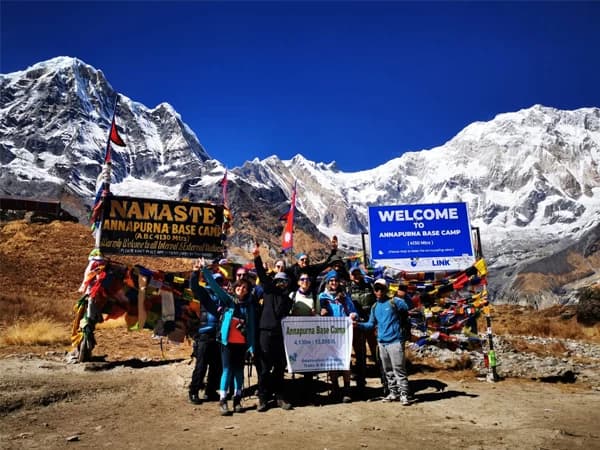
This ABC Trek via Poon Hill explores the region’s most iconic viewpoints: Poon Hill (3,210 m) and Annapurna Base Camp (4,130 m). Exploring the quaint mountain villages, rhododendron-dense forests, terraced farms, alpine valleys, and hot springs of Jhinu Danda rewards you with a breathtaking panorama of the Annapurna and Dhaulagiri massifs.
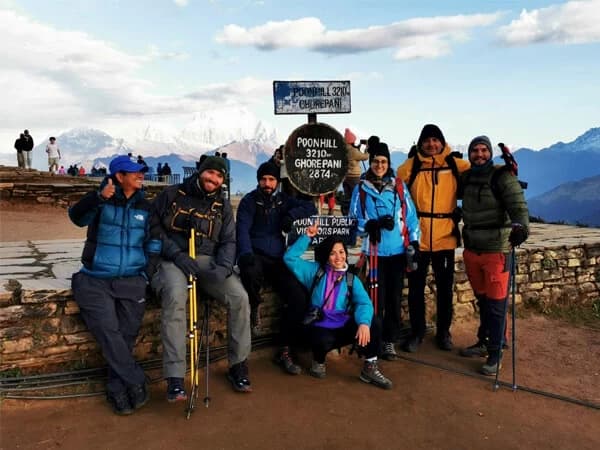
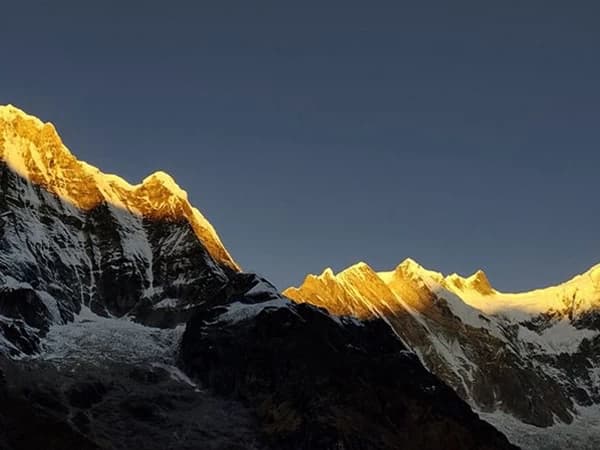
The trek begins with a scenic drive from Kathmandu to Pokhara, followed by a transfer to Birethanti, the starting point of the route. From there, the trail climbs through Ulleri and Ghorepani to Poon Hill at 3,210 m, where you can watch the sunrise over Annapurna I, Annapurna South, Machhapuchhre, Hiunchuli, and Dhaulagiri.
After Poon Hill, the route continues through Tadapani, Chhomrong, Bamboo, Dovan, and Machhapuchhre Base Camp before reaching Annapurna Base Camp. The return journey descends through Jhinu Danda, where you can relax in the natural hot springs, before driving back to Pokhara and finally returning to Kathmandu.
It follows a beginner-friendly walking approach that allows your body enough time to acclimatize before moving to higher altitudes, minimizing the risk of altitude sickness. Daily, it involves 4-5 hours of hiking at a pace that can be easily managed by beginners, seniors, and families. This Poon Hill Annapurna Base Camp Trek itinerary entirely focuses on being safe and gentle, and covers every highlighted section, from the majestic Annapurna and Dhaulagiri range, rich cultures, and a wander along the pristine Annapurna Conservation Area; the pristine Himalayan flora and fauna will leave you speechless.
Note: The recent flooding in Nepal in August 2026 has not affected the trekking trails or routes. You can reach Pokhara either by air or by road. If you are short on time, a 25-minute flight to Pokhara is available as an optional add-on. Alternatively, you can travel by a comfortable tourist bus with luxury sofa seating. Whichever option you choose, your journey to Pokhara will be smooth and comfortable.
Highlights
- A quick gateway to the Annapurna Sanctuary and Ghorepani Poon Hill
- Wander along the rhododendron forests, agricultural fields, and quaint villages
- Morning Sunrise panorama insights into the Annapurna and Dhaulagiri massifs
- Friendly locals and the company of rare species, including the elusive red panda, Himalayan tahr, or musk deer, if luck favours
- Six climatic zones, from open to rugged sections, to alpine meadows
- Natural hot spring relaxation at Jhinu Danda
- Front-row expansive view of Annapurna I (8091 m), in its glory
- An easy hike, moderate pace, no rush, that suits everyone
- Hassle-free logistical arrangements, from arrival to departure dates
- Relaxing Time at the lakeside city of Pokhara before starting the adventurous journey
Why the Poon Hill and Annapurna Base Camp Combination is the Best Route?
Combining the Annapurna Base Camp with Poon Hill offers one of the best Annapurna trail experiences in one single journey. You do not have to choose between these two viewpoints, as the route leads you to both, saving you money and time rather than taking them separately later in the future. Venturing on this trip not only gives you the thrill of a Himalayan excursion, but it is also less hectic, provides better acclimatization, a safer route, yet still stands out as a beginner- and family-friendly adventure too.
Two Iconic Himalayan Highlights in One Journey
The itinerary begins through charming Gurung and Magar villages, terraced farms, and rhododendron forests before climbing to Poon Hill at 3,210 m. From here, you can watch the sunrise over Annapurna I, Annapurna South, Machhapuchhre, Hiunchuli, and Dhaulagiri.
After Poon Hill, the trail continues through Chhomrong, Bamboo, Dovan, and Machhapuchhre Base Camp to reach Annapurna Base Camp at 4,130 m, where you are surrounded by the towering peaks of the Annapurna Sanctuary.
Better Acclimatization and a Safer Route
Rather than proceeding on a fast-paced, or rapid, walk, it takes a gradual altitude gain, making this combined route safer and more comfortable easy going than a direct ascent to the ABC. You will reach Poon Hill first, descend to a lower elevation, then climb toward the sanctuary, giving your body time to adjust to the increasing elevation.
Ideal for Beginners and Experienced Trekkers
Compared to other treks, you will find the trails and approach easier, fitting beginners, families, and experienced trekkers, with no hazardous passes or isolated pathways. The trails are well maintained, with great mountain views, culture, and comfortable tea houses for overnight stays, plus a relaxing stop at the hot springs of Jhinu Danda, making it one of the most wholesome itineraries in the Annapurna region.
Dhaulagiri and Annapurna Panoramas
Throughout the trek, the Annapurna and Dhaulagiri ranges remain a constant presence, rising above forested hills, terraced fields, and traditional mountain villages. During spring, blooming rhododendron forests add brilliant red and pink colors to the landscape, creating a beautiful contrast with the snow-covered peaks.
The early morning hike to Poon Hill at 3,210 m is one of the main highlights of the journey. From this famous viewpoint, you can watch the sunrise light up the Annapurna massif, Annapurna South, Machhapuchhre (Fishtail), Hiunchuli, and Dhaulagiri.
As you continue toward Annapurna Base Camp, the scenery gradually changes from lush green forests to rugged alpine terrain. The towering Annapurna wall and Machhapuchhre dominate the horizon, while the final approach reveals the full grandeur of the sanctuary.
At Annapurna Base Camp, 4,130 m, you are surrounded by a natural amphitheater of Himalayan peaks. The 360-degree panorama includes Annapurna I, Annapurna South, Gangapurna, Machhapuchhre, Hiunchuli, and several surrounding snow-capped mountains, offering one of the most spectacular mountain settings in Nepal.
Traditional Himalayan Lifestyle and Hospitality
Beyond the mountain scenery, the trek offers a meaningful insight into the culture and daily life of the Gurung and Magar communities. These ethnic groups have lived in the Annapurna region for generations, and their traditions, language, clothing, food, and hospitality add a special character to the journey.
The trail passes through welcoming villages such as Ghorepani, Tadapani, Chhomrong, and Ghandruk, where many families run teahouses and depend on farming and tourism. Walking through these settlements gives you a closer look at simple Himalayan life, from terraced farming and mule transport to warm local meals and traditional hospitality.
You will also notice Buddhist influences along the route, seen in mani walls, chortens, prayer flags, and small gompas. These spiritual landmarks reflect the deep-rooted beliefs of the local communities and make the trek culturally as rewarding as it is scenic.
Rhododendron Forests and Alpine Landscapes
The route lies within the Annapurna Conservation Area, one of Nepal’s most diverse protected regions. As you ascend, the landscape shifts through rhododendron forests, pine and oak woodland, bamboo groves, rivers, waterfalls, suspension bridges, and open alpine meadows.
The forests are home to a wide range of birds and wildlife. With a little luck, you may spot Himalayan tahr, langur monkeys, musk deer, or even the elusive red panda. The colorful Himalayan monal, Nepal’s national bird, is another memorable sight along the trail.
Between the villages, you will follow old stone paths, cross wooden bridges, and pass terraced farmland where locals grow crops and graze livestock. These everyday scenes, combined with the region’s rich flora and wildlife, make the journey feel complete and deeply connected to the Himalayan environment.
How much does the Annapurna Base Camp with Poon Hill Trek Cost?
The ABC Trek via Poon Hill package starts from USD 699 and goes up to USD 999, depending on the group size. The cost includes the return flight from Pokhara to Kathmandu. If you prefer to travel back by tourist bus instead of flying, the package price will be reduced by USD 100. The same adjustment applies to group pricing as well.
Our package covers all the essentials, such as required permits, transportation and accessibility for every road navigation that this route possibly proceeds through, an experienced licensed trekking guide, standard meals (breakfast, lunch, and dinner), and accommodations along the route and in Kathmandu and Pokhara. Whereas, if you are willing to opt for the optional add-on options that we've displayed, then the price increases accordingly. However, if you are hiking alone and choosing a private trip, then the standard cost stands at USD 999 per person.
Here are the costs displayed below, with the pricing on a group basis. If the cost doesn't match your estimated budget and timeframe, then it can be altered as per your demand as well.
| Group Size | Cost (USD) |
| 1 | 999 |
| 2-4 | 849 |
| 5-8 | 799 |
| 9-11 | 749 |
| 12-15 | 699 |
Benefits of Booking with us
- Airport shuttle) Free airport pick-up and drop-off in private transportation
- If you are staying for more days here in Kathmandu, then we can provide a 1-2 day stay at our own company, "Hotel Bihani," for free
- Luxury staycation at a 4-star hotel with a cultural program dinner in Kathmandu and Pokhara
- 5% extra special discount for family groups, but must be over 4
- Sleeping Bags, Jackets, Caps, Oximeters (to check oxygen level, Water purification tablets (to purify the water, SIM Card (must give your passport for registration), and Basic First Aid Kits
- Free excess luggage at our office (Destination Himalaya), ensuring the safety of your belongings
- Online Pre-Trip Booking and In-Person Booking after arrival
- Easy and safe payment system
- 24/7 communication at +977 9851016814 or email at info(a)destinationhimalayatreks.com