What is Kongma La Pass?
Kongma La Pass is a high mountain pass in Nepal's Khumbu-Everest region, perched at an altitude of 5535 meters (18,157 feet), and is part of the iconic Everest Three Passes Trek, which connects the trail to EBC and Gokyo at the same time. Compared to the other two passes, Cho La and Renjo La, it is the highest and most difficult one, which consists of rugged patterned terrains, rocky sections, steep ascents, and multiple uphill and downhill walks. No prior trekking experience or technical mountain skills are required to cross over the slippery glacier pathway; however, as it sits high, almost touching the elevation of Kala Patthar (5545 m), the highest point of the standard EBC or 3-pass trek, it falls under a challenging trek.
Major Facts
- Altitude: 5535 m (18,157 ft)
- Trek Duration: 19-21 Days (depending on the itinerary, covers EBC and the other two passes as well)
- Difficulty Level: Moderate to Challenging
- Starting - Ending Points: Kathmandu - Lukla, Lukla - Kathmandu (Flight route), or Kathmandu - Salleri - Paiya Thamdanda (Jeep Drive), Thamdanda to Kathmandu via Salleri (Jeep Drive), Road Alternative Route
- Maximum Elevation: Kala Patthar (5545 m)
- Best Time to Visit: Spring (March-May) & Autumn (September- November)
Where is Kongma La Pass Located?
Kongma La Pass is located in the Everest region of Nepal, within Sagarmatha National Park, a UNESCO World Heritage Site. Sitting at an elevation of around 5,535 meters, it connects Chhukung and Lobuche and forms a key part of the Everest Three High Passes Trek, along with Cho La and Renjo La. It is one of the most scenic and challenging high passes in the Himalayas, offering dramatic views of the surrounding peaks and glaciers.
In the past, many trekkers stuck to the classic Everest Base Camp hike or took a one‑day helicopter tour, but routes have evolved. New options, most notably the Three High Passes, now combine Everest Base Camp, Kala Patthar, the Gokyo Lakes, and the Cho La, Renjo La and Kongma La passes into a single journey. That extended circuit, commonly called the Everest Circuit Trek, has become very popular.
Why Trek Kongma La Pass?
One of the biggest reasons trekkers choose the Kongma La Pass route is the unforgettable scenery and cultural richness found along the way. The trail offers dramatic views of Everest, Lhotse, and Makalu, along with wide Himalayan panoramas that make the journey feel truly special. As you move higher, the landscape becomes more rugged and striking, with glacial terrain, icy ridges, mountain lakes, and remote high-altitude scenery adding to the adventure.
The trek is also rewarding for its cultural experience. Along the route, trekkers pass through traditional Sherpa villages where they can observe local mountain life, Buddhist traditions, prayer flags, monasteries, and the warm hospitality of the Khumbu people. Lower sections of the trail are often decorated with rhododendron forests, suspension bridges, and alpine vegetation, while the higher sections feel wild, quiet, and deeply remote. This combination of natural beauty, cultural encounters, and challenging high-altitude terrain makes Kongma La one of the most memorable trekking experiences in the Everest region.
Kongma La Pass Route Overview: How to get there?
Common Trekking Route to Kongma La
One of the most popular ways to reach Kongma La Pass is by undertaking the Everest Three High Passes Trek. The journey begins with a scenic 35-minute flight from Kathmandu to Lukla, the main gateway to the Everest region. From Lukla, the trail passes through Phakding, Namche Bazaar, Tengboche, Dingboche, and Chhukung before crossing Kongma La Pass, the first and highest of the three passes.
After crossing Kongma La, the trail descends toward Lobuche and continues to Everest Base Camp (EBC). The route then diverts toward Dzongla before crossing Cho La Pass at 5,420 meters, the second-highest pass of the trek. Finally, the trail heads toward Thagnak and Gokyo Valley, passing the beautiful Gokyo Lakes and ascending Gokyo Ri before crossing Renjo La Pass, the final pass of the adventure.
It is the most common and ideal route, which goes through 3 passes in an anticlockwise way, which lets you adapt to the rising altitude and slowly and gradually ascend, gaining increasing elevations and heights. The trail is, however, long and requires proper physical stamina, adequate planning, and guidance.
Route Direction Options
Kongma La Pass can be crossed in both directions, depending on the route you choose, priority, and physical fitness as well. The clockwise Three Passes itinerary is quite hectic and suitable only for an experienced hiker who seeks more challenges and keeps the Kongma La Pass as the priority. This route covers the high-altitude section of the trek early in the journey, crossing Kongma La before continuing toward Everest Base Camp, Cho La, and Renjo La. In simple words, it is the reverse version of the anticlockwise route; the crossing is made from Lobuche to Chhukung.
Hence, both directions are challenging, and both routes offer similar views, but the Chhukung to Lobuche (anticlockwise approach) is a more common and logical approach for trekkers following the full Everest Circuit. The choice usually depends on your itinerary, acclimatization plan, and whether you are linking Kongma La with EBC, Kala Patthar, or the other high passes.
Kongma La Pass Weather and Best Time
Kongma La Pass Trek is a high-altitude adventure that takes you to its pinnacle perched around 5535 meters; hence, you can expect the top, or the crossings, to be cold, himalayan climate throughout the year. The weather and temperature fluctuate rapidly, not on a seasonal or daily basis, but also on an hourly basis, making the top's climatic conditions truly unpredictable. The air is thin, with low oxygen levels, and often dry and windy, so at the summit point, the humidity makes it feel much colder than expected. The temperature falls below 0 degrees Celsius, and after 12:00 - 1:00 PM, it gets windier and rougher, so trekkers must take the crossings before midday and start early at 4:00 AM to avoid any challenges just because of heavy wind, and follow the guidance of the trekking guide.
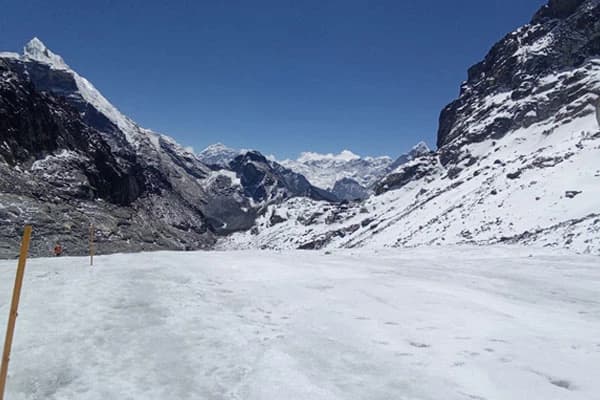
Spring and Autumn are the best seasons to cross the pass, where the skies are brighter, the skies are clearer, and the chances of precipitation are significantly lower, making the crossings much easier. However, at the pass of Kongma La, the temperature may fall to -10 degrees Celsius, so carrying essential warm gear, and even crampons or microspikes, is the best thing to do. Winter brings more harsh conditions, with snowy, icy trails going upto 2 feet and stronger winds, making the route more challenging. The monsoon and summer are the least favourable months, due to continuous rain and snowfall, cloud cover, slippery trails, and high possibility of delays and Lukla flight and route issues, making it least approachable.
Kongma La Pass Difficulty
Kongma La Pass Trek is considered one of the most challenging adventures and the most strenuous pass in the Everest region, demanding strong physical fitness and preparation as well. Daily, the journey entails 5-7 hours of walking, covering 8-12 kms, depending on a day-to-day basis; however, rather than the long distance, what makes the trip quite hard is that the trek covers wide route variations. The walking terrain is quite intense, where trekkers have to face high altitude, steep ascents, rocky and rugged terrains, and some glacial crossings as well. As the trek takes place at high altitude, the air gets thinner, and oxygen drops every single day, requiring prior acclimatization planning and a personalized itinerary.
However, the trek is not technically demanding; it is not compulsory to have prior trekking experience, but proper training and guidance are required, as the climb includes steep walking through multiple ascents and descents, with loose stones, glacier and moraine crossings. Unlike other Everest treks or when compared to Everest Base Camp itself, this pass falls under a challenging trek; meanwhile, an expert guide and comprehensive planning make the trip successful and enjoyable.
Kongma La Pass vs Cho La vs Renjo La: Comparison Table
| Feature |
Kongma La Pass |
Cho La Pass |
Renjo La Pass |
| Elevation |
5535 m |
5420 m |
5360 m |
| Difficulty Level |
Most difficult pass |
Moderately challenging |
Easiest one |
| Main strenuous Factor |
High altitude, rugged, steep climb, continuous ascent and descent |
Involves more slippery, icy, and glacier crossings |
Frequent uphill and downhill walking, no steep or technical hurdles |
| Terrain Type |
Rocky, dry, and rugged |
Icy and sloppy pathway (require microspikes and crampons) |
Rocky but stable to pass by |
| Technical Challenges |
Low to Moderate |
More challenging technically due to icy, slippery pathway |
Low or None |
| Famous as |
Toughest and demanding pass in the Everest region, or among three pinnacles |
Most technical crossing |
Best panorama mountain views and glacier insights with a vista of Gokyo Lake as well |
| Trekker Experience |
Physically demanding |
Requires proper caution and guidance |
Manageable for beginner hikers |
| Risk Factor |
Altitude fatigue/ AMS (Acute Mountain Sickness) risk |
Slippery and glacier sections |
Long walking day |
| Route |
Remote, adventurous and challenging |
Cold, technical and extra gear required |
Scenic Views |
| Best For |
Best for strong, experienced trekkers |
Best for prior hiking experience trekkers |
Suits every kind of hiker, beginners to any age group |
Permits Required
The permits that are required for the Kongma La Pass are the same as the ones required for the other passes of everest trek, as the pass is located in the Everest Circuit; the passes required are the same primary ones as the ones needed for the Everest Circuit trek.
Sagarmatha National Park Permit
The Sagarmatha National Park Permit is one of the primary permits you need to attempt the Kongma La Pass trek; you can obtain the permit at TAAN in Kathmandu. The permit costs around NPR 3000.
Khumbu Pasang Lhamu Rural Municipality Permit
The Khumbu Pasang Lhamu Rural Municipality Permit is the permit that is issued by the local government body of the area that the pass is situated in; the local government collects the money received through the permit purchase and uses it to improve the trails and improve the circuit overall. You can obtain the permit in Lukla, and it costs NPR 3000.
Packing Lists
When trekking through the pass of Kongma La, you need to make sure that you are well equipped with essentials for this sort of trek. Here a list of some things that we think are essential for you to pack.
- Trekking boots that can help you navigate through rough terrain with great ankle support
- Layers of clothing through which moisture can not pass
- Windproof trekking jacket
- Warm hats and warm insulated gloves
- Gaiters to prevent you from facing problems
- Sunscreen which is SPF 50+ to prevent getting sunburned
- Headlamp or a wide-range flashlight
- A pair of trekking poles
- Sleeping bags for extra warmth
- Essential documents (Permits, Photocopy of travel insurance, passport-sized photos, passport photocopy, local entry tickets)
Altitude sickness and Acclimatization Tips
The main issue for any trekker when crossing passes like these is the fear of getting AMS, so here are the ways to identify AMS, the different ways to prevent it, and the emergency procedures you will have to follow after getting AMS.
Symptoms of AMS
The main symptoms of a trekker about to get AMS are getting extremely nauseous, feeling highly dizzy, improper digestion, and high fatigue.
Prevention tips
As we have discussed the symptoms of it, the main way to prevent it is through these ways: making sure that your body is properly hydrated along the trek and making sure that your body is used to the pass by acclimatizing properly throughout the trek of crossing the pass. Taking one or two extra days to properly acclimatize is also important, as it helps with getting your body used to the changing temperature drop.
Emergency Procedures
The immediate and emergency procedures that you can take if you end up getting AMS or altitude sickness are mainly descending immediately and getting medical attention at lower points, or not ascending for some time and getting proper rest before starting the trek again.
Accommodation Availability
Getting proper accommodation and food along the trail is easy, as the teahouses and food you get along the trail are basic but abundant. It is usually fueled by the teahouses in Chhukung (4, 730m) and the teahouses available in Lobuche ( 4,940m).
Teahouses in Chhukung
Chhukung is the final stop before attempting the Kongma La Pass; even though it covers a small area, it has an abundance of teahouses where you get accommodation of basic twin beds, shared toilets, heated dining rooms, limited Wi-Fi, which you might have to end up paying extra for, and hot showers depending on their availability.
Teahouses in Lobuche
Lobuche is the first stop that trekkers make after completing the pass, and while descending, you can expect to get the same type of basic facilities as the stop in Chhukung and the facilities of the Wi-FI and facilities of electricity is very similar to the ones in Chhukung as well.
Useful Tips for Crossing Kongma La Pass
- Make sure that you acclimatize properly to avoid getting altitude sickness or end up getting AMS. Proper acclimatization is very important when crossing passes like these; you should spend ample time in points like Dingboche before attempting to pass the Kongma La Pass.
- Make sure that you start before sunrise, as the weather of the pass is more stable around this time. Starting the trek day during an earlier time of the day helps avoid the strong winds that will occur later in the afternoon.
- Look out for symptoms of AMS: nausea, dizziness, headaches, and major fatigue are some of the symptoms of AMS. If you do end up getting these symptoms, make sure that you start descending immediately to lower the risk of it becoming worse or to avoid it from worsening.
- Make sure to check the weather on multiple occasions before starting the trek; if the weather is much more foggy, it becomes hazardous and difficult to walk along the trek route. If the conditions turn out to be not so good, make sure that you delay the crossing of the pass.
- Travel through the suggested and marked routes; the Kongma La Pass is marked with monuments, so make sure you walk along following those monuments.
- Use the help of trekking poles, which will provide you with extra stability to navigate through the rough terrain of the Kongma La Pass.
- Make sure you have appropriate insurance for situations where emergencies might occur, which can include coverages for helicopter rescue during an emergency if it were to occur.
FAQs
How Difficult Is Kongma La Pass?
Kongma La Pass is one of the most rewarding pass treks available, but it is considered to be moderate to difficult, as the Kongma La Pass is considered to be the hardest among the other pass treks of the Everest Circuit.
How high is the Kongma La Pass?
The Kongma La Pass is situated at a high elevation of 5,535 m, making it a challenging trail for many trekkers.
How long does it take to cross Kongma La Pass?
The Kongma La Pass usually takes around 6 - 9 hours to cross, depending on the pace of the trekkers.
What is the best season to cross Kongma La Pass?
Spring and Autumn are the seasons that are widely regarded as the best seasons to cross the Kongma La Pass, as the weather is very stable around these seasons.
Conclusion
To conclude, Kongma La Pass (5535 m) is a pass located in the Everest Circuit and goes through the famous three passes of Everest. The trek usually takes around 7 - 10 hours, depending on how the trekkers walk throughout the trekking days. The Kongma La Pass is considered to be a harder pass in comparison to the other passes of the Everest Circuit. The difficulty of crossing this pass is said to be moderate to difficult depending on the season the person is trekking in. The pass consists of steep ascents and crossing of glacial rocks. The views are extremely spectacular and offer 360-degree views of the mountains around the region.
We here at Destination Himalayan Treks have 15 years of experience, and we are affiliated with the Nepal Mountaineering Association (NMA) and Trekking Agency Association of Nepal (TAAN), so choosing to book your next trek with us is a really good decision. To trek with us, you can do so by booking it and paying 10% to 20% upfront, and the rest of the amount can be paid after you arrive in person. For further inquiries, you can contact us via WhatsApp on +977 9851016814 and talk to our expert, or contact us via email at [email protected]. Our services are available at every hour, so feel free to contact us for further inquiries and questions.