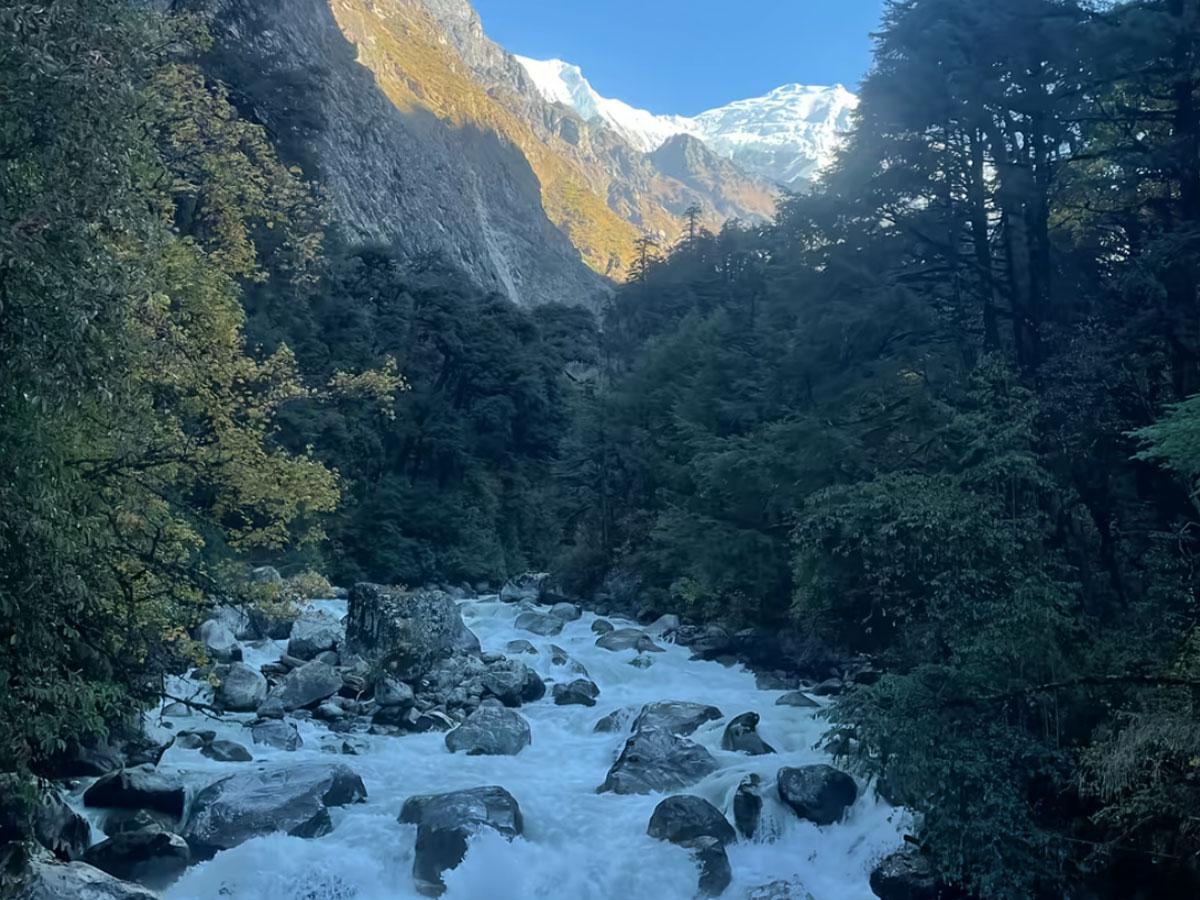
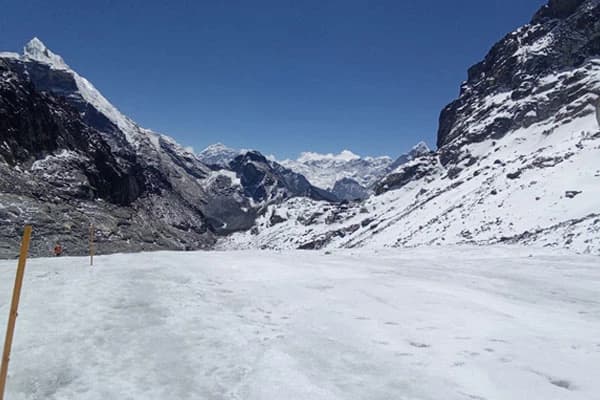
Nestled at the heart of the Langtang region, the Langtang village stands out as a motivational resilience, natural wonders, that boasts a varied ecosystem, cultures, traditions, and breathtaking glaciers, alpine valleys, and highly towering peaks. Located within Langtang National Park, it resides in Rasuwa district, just 80 kilometers north of Kathmandu, near the Tibetan border, where the sparkling glaciers, diverse trailheads, and untamed beauty thrive. From subtropical forest woodland covered with blooming red and pink rhododendrons, pines, and orchids, the trail covers almost 30% of the forested area, which is marked as a haven paradise for enthusiastic hikers and nature lovers, having the possibility of catching the glimpse, of rare species, such as red panda, snow leopard, musked spotted deers, and himalayan birds, as over 250 bird species, are recorderd here, with many elusive animals.
The valley's name, Langtang, is derived from the yak-herding cultures of the Tibetans, where "Lang" denotes "yak" and "Tang" means "pasture." That is why it is also referred to as "Valley of Yaks, especially by locals. What makes the Langtang village the most visited destination in the Himalayas is that it acts as a key trekking point, the route of the Langtang Valley Trekking, which is ranked as one of the top 3 trekking trails in Nepal, famous for the rich culture of the Tamang ethnic groups, Tibetan heritages, where the customs of ancient Tibetans are still preserved. Today, it also acts as a motivational resilience, due to the rebuilding of the valley, after the massive earthquake that happened in 2015 A.D. One can embark on the side trips to Kyanjin Gompa and the highest vantage points of Tserko Ri, or Kyanjin Ri, offering the 360 degrees panorama of the Langtang Lirung, glaciers, where the route is bloomed with red rhododendrons, pines, orchids, and the colorful housing at Kyanjin Gompa.
Besides, just being a himalayan trekking route, Langtang village is a resilient haven, reborn stronger after disaster, embodying Nepal's spirit, inviting adventurers to connect with nature, wildlife, and people in one of the Himalayas' most accessible yet wild pockets.
Where is Langtang Village located?
Situated at 3430 meters, Langtang village sits in a remote and isolated location, within the heart of Langtang Valley, in Rasuwa district, marking it as a prominent tourism hub, inhabited by the Tibetan ethnic group of Tamang communities, and surrounded by the stunning glaciers and peaks. Located just 148 kilometers from the northern side of the capital city, Kathmandu, near the Tibetan border, it stands out as an easily accessible trekking route in the Himalayas, which can be reached by all-around hikers.
The village is surrounded by the range of Langtang Lirung, perched at a height of 7227 meters, along the bank of the roaring Langtang River, and resides near the Langtang glacier, a glacial landform. The village resides within the iconic Langtang National Park, 1,710 square kilometers across three distinct districts of Nepal: Nuwakot, Rasuwa, and Sindhupalchok, with a buffer zone of 420 km². Langtang consists of diverse topography, forested areas, with the blooming red and pink rhododendrons, known also as the nepal's national flower, Tibetan monasteries, alpine valleys, meadows, rugged and remote terrains ascending a bit higher, and dry Tibetan plateau landscapes. Situated above 3000 meters, it connects the lower trail of Langtang and the highest point at Kyanjin Gompa (3870 meters), which is marked as one of the prominent trekking trails in Nepal.
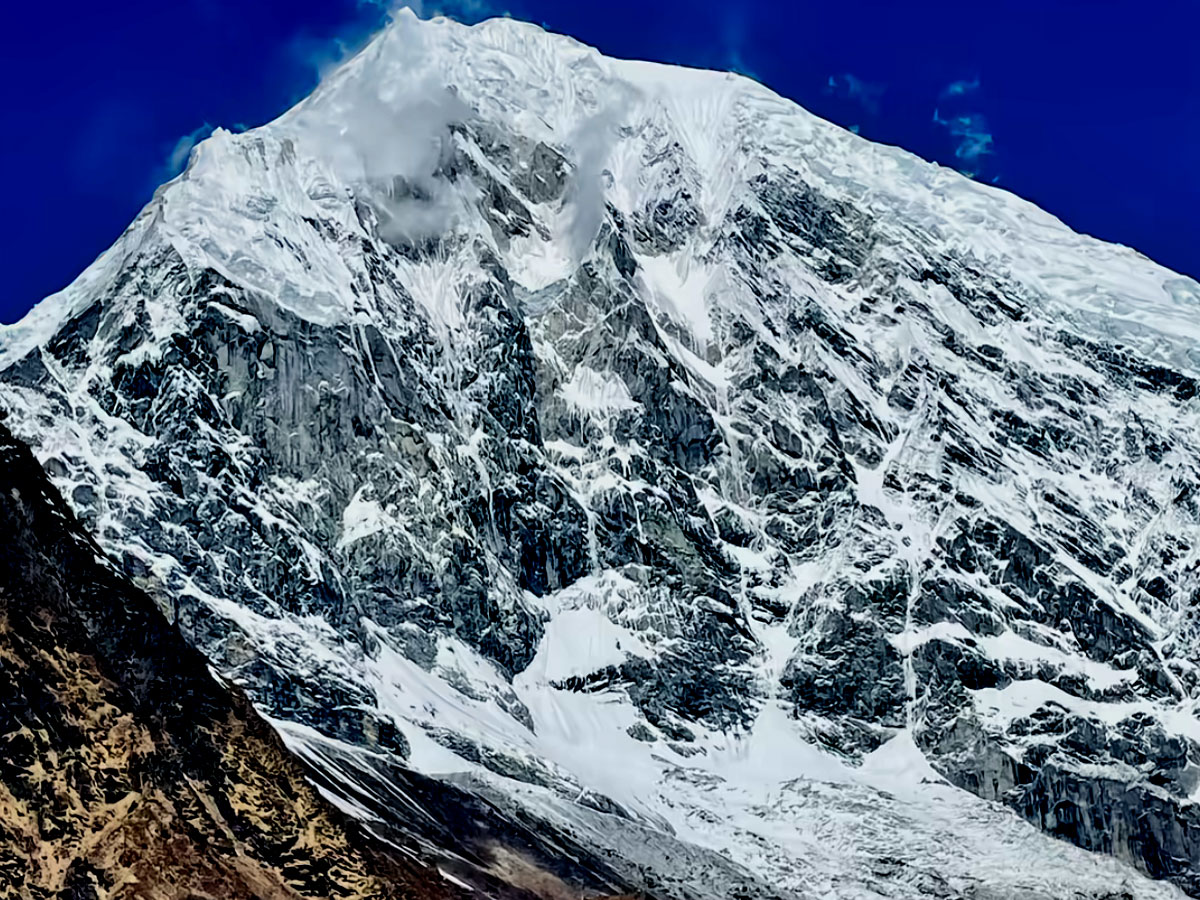
View of Langtang Lirung from Tserko Ri
How to Reach Langtang Valley from Kathmandu?
To get to Langtang Valley, the first and foremost thing that you have to do is start the roadway navigation, from Kathmandu to Syabrubesi, followed by the road transportation, to get to the starting point of the walking trail - Syabrubesi, from where the hiking route begins.
Kathmandu to Sybarubesi: Getting to the Starting Point
To reach Syabrubesu, you have two road transportation options: either via local bus, jeep, or car, whichever is feasible to you, with the driving lasting for 7 to 8 hours, covering 148 kilometers of distance. The bus stop is at Gongabu, or Macchapokhari, where you can buy the tickets from there, for the local bus, which takes, almost USD 8 to USD 9, or hire a jeep (private ones), for USD 150 to USD 180 per 4WD Jeep, with the pricing of the vehicle depending on the seasonal time. The local bus usually departs at 6-8 AM, in the morning, so make sure to reach before 6 AM, to get the tickets at the comfortable seating spot. However, if you hire a private jeep, then the departure time depends on you completely, but surely costly when compared.
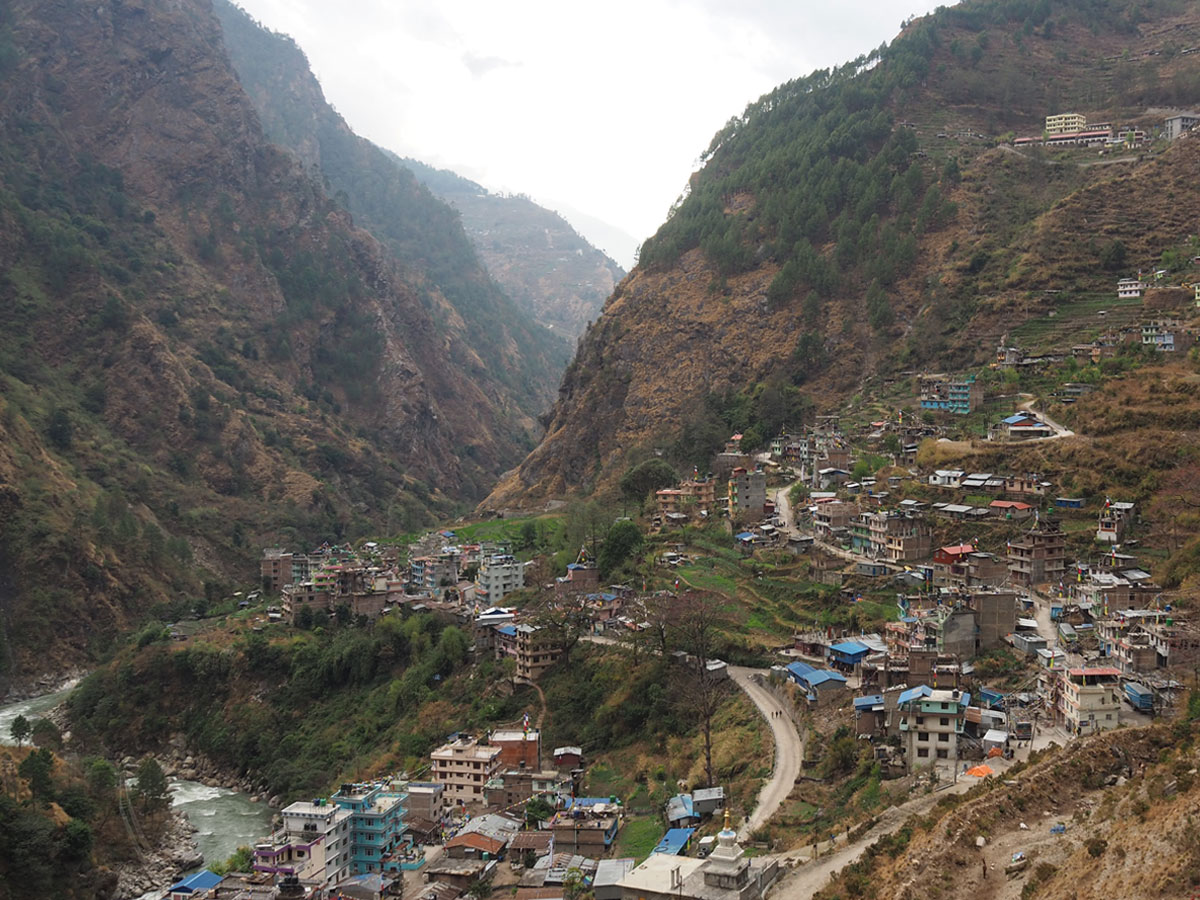
Syabrubesi, the starting point of the trek to Langtang village
Trekking Route Overview: Walking Trailhead
After getting your permits checked at the stopping point, the hike begins, from Syabrubesi, towards Lama Hotel (2500 m), and then proceeds to the Langtang village (3430 meters, on the very second day), following the forested area of rhododendrons, pines, and orchids, along with the Langtang River. Then, the route navigates towards Kyanjin Gompa (3870 meters), which is marked as the last tea house point along the route, and also an acclimatization point that takes you to the highest elevation at Kyanjin Ri, or Tserko Ri, above 4000 meters, the highest elevation of the Langtang Trek.
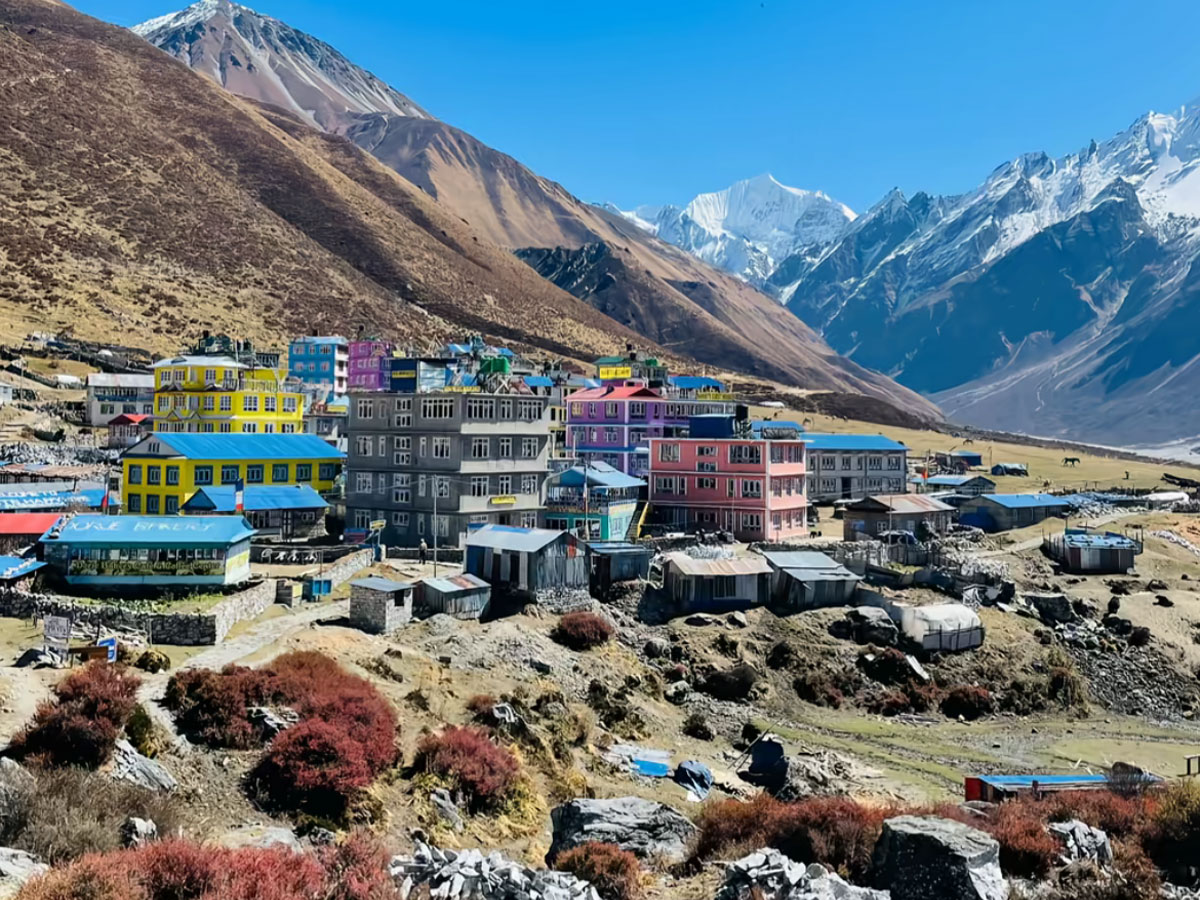
Kyanjin Gompa, the last stopping tea house during Langtang Trek
If you are not rooting for a hiking adventure, then you can consider a direct helicopter ride to Langtang Valley, as well. Meanwhile, the best thing is to opt for a hiking trekking trail, with a gradual ascent to reach such a high altitude and avoid mountain sickness.
Alternative Access Routes to Langtang Village: Possible Ways
Apart from just following the standard trekking trail, or itinerary, to enhance the overall experience, combining it with other possible routes is the best way to unravel the challenges, mountain and glacier views, remote cultures, traditions, and get deeper into the valley. Here are the top 3 handpicked alternative access routes that you can choose.
Tamang Heritage Trail Extension
Langtang Tamang Heritage Trekking stands out as one of the authentic trekking routes that anyone can undertake, combining Langtang Valley and Tamang Heritage in one single adventure, unraveling the authentic lives, cultures, and traditions of the Tamang people, with the ancient stone-bricked houses, monasteries, wand hite chortens, more focused on experiencing the authentic lives of the Tamang locals. While extending the route to this trailhead, it navigates through the ancient villages of Tatopani, Briddim, Goljung, and Tatopani villages, before reaching Langtang valley, adding an extra 18 to 20 days, and a coverage of an additional 22 kilometers.
Ganja La Pass High Route
For the experienced hikers, who are seeking a higher altitude than just getting to Kyanjin Gompa, or Kyanjin Ri, can opt for a higher route to Ganja La Pass, that locates at a height of 5130 meters, connecting the route to Tarke Gyang in Helambu. The total duration of the trek takes almost 12-14 days, depending on the route and itinerary that has been crafted.
Full Langtang Helambu Circuit Link
This Langtang Circuit Helambu trek connects the main trekking trail of the Langtang region, Langtang Valley - Gosaikunda - Helambu, all in one, touching both Langtang National Park and Shivapuri National Park, in one single adventure, for 18 to 20 days, which starts from Sundarijal.
Note: For those willing to commence on the odyssey to Langtang village, within a short period of time, can opt for the Langtang Short Trekking, which can be completed within just 5 days of timeframe.
What permits are required to visit the Langtang region, and how much does it cost?
To get access to Langtang, a permit must be attained via a travel agency or with the help of a licensed trekking guide if you are traveling independently. where the costs are non-refundable, and checked at the entry points of Sybarubesi or Dhunche. It can be obtained at the Nepal Tourism Board office at Thamel, or also, the Army checkpoint, at Ghodatabela, or Sybarubesi as well. Only one permit, the Langtang National Park Permit, is required as TIMS Cards are not needed since 2023; however, the navigation along the trekking guide is compuslorily required in 2026, as the new rule initiated in 2025.
The costing, on the other hand, varies on a nationality basis, while the foreigners have to pay NPR 3000 (USD 23 per head), whereas, for the SAARC nationalities, it costs only USD 13 (NPR 1500), and costs only NPR 100 (USD 0.8) for Nepalese trekkers.
A Brief History: The 2015 Earthquake in Langtang Village
Settled by the Tibetan locals, who migrated back then along the ancient Nepal-Tibet trade route, Langtang village faced a huge, tremendous disaster due to the 7.8 magnitude earthquake on April 25, 2015 A.D. Surrounded by the massive glaciers, himalayan peaks, also known as the valley of Glacier, when the earthquake happened in Nepal, Langtang was hugely affected especially, due to the avalanches triggered by the earthquake, which buried the village under 22 meters of snow, washing away all the valley, where one one small local house left, apart from that, all were destroyed completely. Almost 300 locals, 41 foreigners, along with guides and porters, died. After the Barpak village, in Gorkha district, the main epicenter, this village was mostly affected, and the main reason behind this was the towering rocks, ice, glaciers from Langtang Lirung at 7227 meters, fueling an avalanche down to 3430 meters, at the village of Langtang.
Immediate Aftermath: What happened after the earthquake?
After the devastation, many rescue operations were conducted by APF, Nepal Police, Nepalese armies, and helicopter companies for the rescue, on the very day, within a few hours, of the earthquake, which saved the lives of 12 locals and 2 foreigners initially. Many hikers, themselves, helped each other, to descend slowly to lower terrains, to Lama Hotel, or Syabrubesi, Ghoda Tabela, and were helicopter-rescued. After the rescue operations happened, survivors were immediately admitted to the hospitals and home, whereas the locals set up tents (temporary housing) to accommodate, as there were no houses, until the rebuilding of the village, except for one small house of a local.
Reconstruction Efforts: Building from Scratch, Support and Unity
Reconstruction efforts were started so soon after the earthquake and avalanches, with the support of national and international volunteers, as well as INGOs, NGOs, and the local community group, where the unity denotes a new array of hope, to the people and nature as well. New structures, like houses, lodges, monasteries, small herds for domestic animals, and schools, were built under the earthquake-resistant methods, where the government also distributed food, a certain amount of cash, and temporary houses (tents), to run the daily needs without any problems.
The popular side trekking spots, such as swiss yak cheese factory, Kyanjin Gompa, were fully built, and then, the trekking spots were reopened, quickly to continue to boost the local economy of the village. While the buildings were built under earthquake-resistant standards, the main focus was only to meet the design of the local community to preserve their cultures, heritages, and traditions, which blends the modern fusioned amenities, and a crisp Tibetan heritage, making the village more special, and a motivational insight to people.
In the present, Langtang is a prominent trekking spot, which boasts 20+ lodges, 200+ visitors, that empowers the local economy, through tourism, where locals are engaged in guiding as trekking guides, porters, and hosting local tea houses, for the comfort of the trekkers and still preserving their rich cultures and traditions, just as in ancient days. The buildings were rebuilt to focus on natural disaster protection, and built 100 meters uphill, reviving the tea houses and lodges with more standard amenities, health care spots (posts) in between run by security forces, nurses, or doctors, for immediate emergency cases. The rebirth of the valley symbolizes strength, power, unity, resilience, attracting hikers, all across the world, for safety navigation, an easily accessible trekking spot, a rich Tibetan cultural setting, and the iconic surrounding himalayan peaks and landscapes.
Best Seasons to Visit Langtang: Weather and Temperature
The Langtang Trek can be best experienced at the peak seasons of Spring and Autumn, where the weather and climatic conditions are expected to remain stable, with a very low chance of precipitation, resulting in clear views of mountains and landscapes. Whereas winter (December, January, and February) and monsoon (June to August) are not highly recommended, as during this span of the year, high levels of rainfall and snowfall are expected, hiding the views, making the trailhead slippery to navigate, and making the journey more challenging than it actually is.
During the spring season (March to May), the temperature usually ranges from 5 to 12 degrees Celsius, with the trailhead thriving with the blooming rhododendrons, pines, orchids, where the day hour also lasts for la onger time, offering a chance to explore more of the region without worrying about the darkness. The main festival of the Tamang locals, i.e., Sonam Lhosar, also falls under this timeframe, where you can experience how such celebrations and traditions are celebrated in the Himalayas.
Compared to the spring, the autumn (September to November), as this season comes after the conclusion of the monsoon time, the chance of a cloud burst is very low, minimal, making the terrains dry, with the crystal clear vista of the himalayan range, and a moderate humidity, making it a peak season. The temperature ranges from 5 to 18 degrees Celsius during the day and might drop to 0 to -5 degrees Celsius at nighttime, which marks the perfect time to hike and cover the long distance comfortably, and stay overnight, at such a high altitude above 3000 meters.
Meanwhile, the season of monsoon is not highly suggested, as during this timeframe, there is a high level of rainfall and snowfall, all the time, which makes the forested route muddy and slippery, and the access to higher altitudes slippery and snowy, hiding the vista of mountains and surrounding views at the same time, ruining the whole trip completely.
Besides, the possibility of the nature hazards such as landslides, floods, is always, there, as just in 2025 monsoon, 4-5 were found dead, due to massive flood, and landslides, happened, also, without the assistance of the trekking guide, hence, a proper track of weather, temperature, and navigation along with experienced licensed trekking guide remains cruvial.
During the winter season, the temperature reaches as low as 0 to -15 degrees Celsius, with heavy snowfall, blocking the pathway to higher trails, due to which the route also gets closed. disrupting the trek in between and also challenges, due to icy slippery sections; however, if you are an experienced hiker, then you are good to go.
Tea Houses and Accommodation Facilities: Where Comfort, Warm Hospitality, and Standard Amenities Blend
The accommodations in Langtang village are on a tea house or lodge basis, which are run by the locals themselves, so expect to be more on the simpler side; however, are well equipped, facilitated, and hygienically maintained. Most of the tea houses have the basic standard amenities, with wifi, charging accessibility, warm showers, and laundry facilities at an extra cost, charged by the tea house itself. It costs approximately USD 5 to USD 7 per room, with a shared washroom, whereas with an attached washroom, the room cost can exceed the pricing above USD 15 as well, at the peak seasonal time.
Whereas, the medical facilities are quite scarce, at higher altitude, for severe medical isuues, however, small health post run by armies, or apf, are always available, at many points to buy medicines, and minor injuries, other than, that, if there is a serious case, then, the only option is the helicopter evacuation covered by the travel insurance. In simple words, even though the facilities are not as luxurious as expected, it caters to the basic needs and preferences, to comfortably rest, sleep, and warm up after such a long, hectic trek.
Besides, the tea houses, features, a wide variety of meals, from vegan to vegetarian to non-vegetarian meals, for the three standard foods, breakfast, lunch, and dinner, along with that, for the drinking beverages, from hot ones such as tea, coffee, milk, any kind of soups, and cold drinks, such as coke, fantas, sodas, and so on. Whereas, for drinking water, you can either use tap water, or also, buy bottled water at the shops, costing USD 1-2 per bottle; however, keeping sustainability, eco-friendly, and budget-friendly, it is best to fill water at a tea house, using water purification tablets.
Major Things to do in Langtang Village: What not to miss out
Visit the Spiritual Hub of Kyanjin Gompa
Located at such a high elevation of 3870 meters, the Kyanjin Gompa marks the spiritual hub of the Langtang region, and also, as the spiritual heart of the locals, reflecting the ancient cultures and traditions of the locals. Every morning and evening, the gomba hosts a Tibetan prayer that echoes throughout the valley, making the hikers more connected with the Tibetan heritage. Apart from that, festivals, such as Sonam Lhosar, are hosted here, where the Tibetan Tamang ethnic group comes together to celebrate the rich tradition, which you can witness if the itinerary coincides with the festival season.
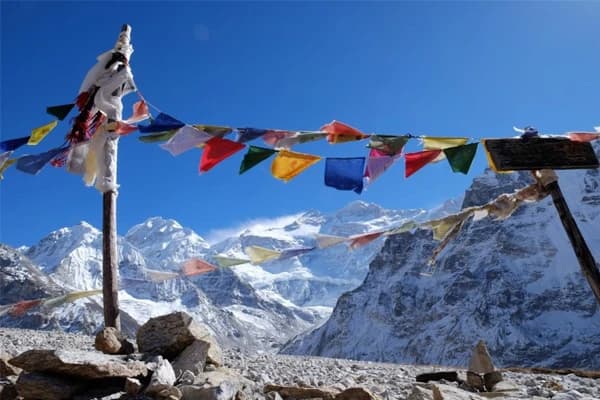
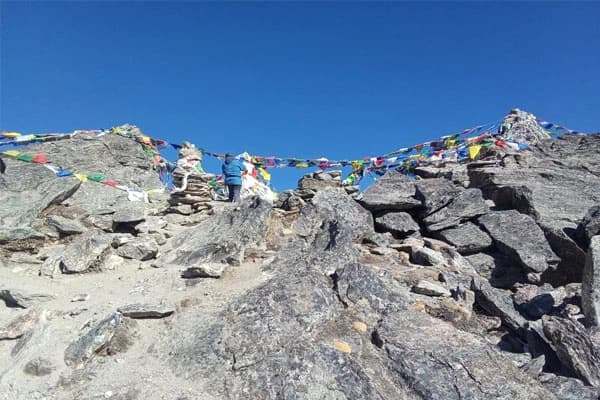
Decorated with the colorful Tibetan Buddhist flags, flapping in the winds, that carry thousands of prayers of the locals, visiting Kyanjin Gompa is an once in a once-in-a-lifetime spiritual moment for sure.
Ascend to Kyanjin Ri and Tserko Ri
The viewpoints of the Langtang are something you shouldn't miss out, offering the panoramic views of the Himalayan range and landscapes with the insight of the villages, as well, making the challenging uphill walk one hundred percent worth it. The famous and the highest viewpoint, which you can ascend to, is marked by the Kyanjin Ri and Tserko Ri above 4000 meters, offering a sense of accomplishment, breathtaking sunrise and sunset views for photography.
Exploring Tamang Culture in depth
Almost 80% of the Tamang locals reside here in Langtang, which makes it a cultural hub. Those who want to experience the ancient Tamang cultures, heritages, and traditions. While staying here at Langtang village, or at the main key points, you can enhance your cultural insights by setting yourself at the homestay, or tea houses, interacting with locals, knowing their stories, hearing their mountain climbing experiences, and also participitating at their festivals and celebrations. Besides, engage in the monasteries' prayers, learning local languages, making food, wearing their jewels and attire, engaging in thangka paintings, or yak herding for a deeper connection, on how locals reside at such remote and high altitude spots.
Taste Yak Cheese at the Swiss Factory
Established in 1952 A.D, also known as Nepal's first cheese factory, made with swiss techincal aid, the factory, at Kyanjin Gompa, offers a unique taste of cheese, of yaks, which boasts almost 80% of the local economy as well. While visiting the yak cheese factory, you can gain insight into the process, curding, and aging in cellars, amdde with fresh butter, milk, that supports the income source of the Tamang herders.
Spot Wildlife
Varied flora, such as rhododendrons, pines, and bamboos, bloom within the trail, making the journey truly intriguing. Besides that, the region boasts several wild, elusive endangered species such as red panda, snow leopard, himalayan tahr - a perfect opportunity for enthusiastic hikers and bird watchers as well.
Most Asked Questions (FAQs)
Did Langtang village get rebuilt after the 2015?
Almost 388 people were recorded in the total death rate, while 176 were locals, and 80 were foreigners, with no traces of houses, except for one small local tea house. The Langtang village was destroyed by the massive earthquake happend in 2015 A.D, with a magnitude of 7.8, where the whole valley was washed out; however, later rebuilt with international support and the local community, and now presents as a thriving trekking hub, with newly built earthquake-resistant structures.
How high is Langtang Village?
Perched at an elevation of 3430 meters, the village of Langtang is positioned after Lama Hotel (2,470 meters), before attaining Kyanjin Gompa, which is the last tea house stopping point and marked as an acclimatization stop, for higher viewpoints like Kyanjin Ri (4,773 m), or Tserko Ri at 4984 m.
How long does the Langtang trek take?
The total duration to trek to Langtang varies depending on the starting point, side trips included, itinerary, chosen route, and other factors. However, following the standard trekking trail, it takes almost 7 to 14 days to complete this himalayan adventure.
What is the major cultural highlight of Langtang village?
The major cultural highlights of the village stand out to be the locals themselves, following the Tibetan Buddhism culture, by the wide Tamang ethnic group, who speak the Tamang Tibetan language, being highly influenced by the Tibetan cultures, surrounded by monasteries, prayer flags, stone houses, and local tea houses. Major festivals such as Sonam Lhosar, Dashain, and many others are celebrated by the locals, where you can witness the prayers, pujas, and host rituals at the gompas (stupas), making it a more culturally affluent spot.
How long does it take to get to Langtang village from Kathmandu?
Starting from the capital city, Kathmandu, it takes approximately 8-9 hours to get to the starting point, Syabrubesi, via jeep or local bus ride. Whereas, to get to Langtang village, from the starting walking trail, it takes only a day, or even on this day, depending on your pace and itinerary, which is the most easily accessible destination.
How cold does it get at the Langtang village in Nepal?
Standing at such a high altitude above 3000 meters, surrounded by the Langtang range, the temperature ranges from -5 to -12 degrees Celsius at nighttime during the winter season, from December to February. Whereas, at the peak seasons, in the spring / autum time, the humidity ranges between 0 and 5 degrees Celsius. On the other hand, in the summer and monsoon season of the year, it ranges from 5 to 10 degrees Celsius at night, but experiences a high level of precipitation (snowfall and rainfall).
How difficult is it to get to Langtang village?
To get to the village of Langtang, it is considered an easy to moderate odyssey, which can be attained from Syabrubesi, to Lama Hotel, and on the other day, the route lasts for 5-6 hours from the Lama Hotel, to get to the Langtang village, via a marked pathway. However, if you are commencing this adventure as a trek, then a basic fitness level is required to reach Kyanjing Gompa - the last stopping point, and to ascend to the highest viewpoint at Kyanjin Ri or Tserko Ri.
Is a trekking guide mandatory to be hired to reach Langtang?
Yes, a licensed, experienced trekking guide is mandatory to go to the Langtang region, as the Government of Nepal has made the regualtion of compuslorily to hire a guide to obtain permits, safe navigation, preserve the cultures and traditions, and interact with local communities and boost the economy of locals.
Conclusion: Final Saying
Langtang Village, Nepal, stands out as one of the best prominent trekking destinations, which marks a motivational, culturally affluent tourism hub, surrounding the 360 degree panorama himalayan range, and landscapes. Standing at an elevation of 3430 meters, this village acts as a diverse tibetan ethinc group, of Tamang communities, where the Buddhist monasteries, whitely washed shrines, stupas, mani walls, and flanked by the colorful Buddhist prayer flags. After the massive disaster that happened in Nepal in 2015 AD, the Langtang village was highly affected, where more than 300 people died, with only one house left, followed by the deadly avalanche, landslides, due to which, there were no traces of any houses, or even the people who died here, while, many were rescued as well via helcopter.
Even after such a tremendous disaster, the Langtang village, today, is marked as the best tourist hub, having rebuilt after the earthquake, with the help of the INGOs, NGOs, the Nepal Government, and most of all the unity and strength of the locals. Even many survivors came together to build the shelters, local tea houses, building cattle herds for animals, due to which in the present day, many trekkers, especially tourists, take it as a motivational resilience showcasing to rise above all odds, after such destruction.
Standing at 3,430 meters, this village stands as a base of the Langtang valley, with earthquake-resistant tea houses, fully equipped accommodations, amenities, monasteries, and the trekking route to Kyanjin Gompa or Tserko Ri, surrounded by the snowcapped himalayan peaks, Langtang glacier, and the famous cheese factory. Today, Langtang village is one of the best trekking trails and spots, welcoming hikers from all across the globe, and it is an all-around adventure for beginners, families, and even experienced ones.
If you want to undertake this journey to the Langtang region, proper preparedness, planning, and comprehensive trekking itinerary planning must be done, where we at Destination Himalaya Treks and Expedition are all ready to set you for this year 2026 and the upcoming year 2027. Feel free to contact us at WhatsApp +977 9851016814, direct call, or just email at [email protected], anytime.
Here are the top 5 handpicked treks within the Langtang that you can check out, to opt for this year: