Best Time for Mardi Himal Trek
The ideal seasons for the Mardi Himal Trek are Spring and Autumn, as during this span of the year, the temperature is generally mild, and the weather is clear, offering an optimal season to venture out for a long expedition with the undisturbed views of the mountains and landscapes at the same time.
Meanwhile, this trek can also be done in the other two seasons of monsoon and winter, if the seasonal times don't fit your holiday duration. However, there are ample preparations that are compulsory to do beforehand, and appropriately packing the gear, while it might sound a bit challenging to complete the odyssey, with proper guidance, it can be successfully done.
Every season has something distinct and captivating to offer you; hence, no matter what season you are heading to this journey for, it will surely reward you with a breathtaking panorama of highlands and a unique perspective of landscapes.
Why choose the Spring season (March to May)?
Spring stands out as one of the finest seasons for Mardi Himal, as the temperature doesn't go beyond 12 degrees Celsius, so you can expect mild climatic conditions with a spark of cold weather, making the hike easy to begin with. As this season comes after just the end of winter, if you are a snow lover and want to build a snowman in Mardi Himal View Point, then from the beginning to mid-May, one can still feel the crispness of winter, but yes, with clear trailheads.
Well! But this is not the end yet! One of the enchantments about making our way to this enchanting journey is that, as this trek comprises several forested sections, the whole pathway is covered with red, pink rhododendrons and white orchids that bloom just right in front of the clear views of mountains and landscapes, making it one of the most loved sections amongst all.
- From the very beginning, you get to witness the colourful Himalayan flora, all thriving, welcoming the peak time, which only blooms at this particular time.
- The day is humid, the air is fresh, whereas at night, it does not fall below 5 or 0 degrees Celsius, making the day hike smoother, without being physically drained and at night, all cosy.
- The day sunlight lasts for a longer time, helping in forest navigation, especially at the beginning time, when you can take a hike at your own pace, without speeding the itinerary, worrying about the darkness.
- Possibility to encounter migrated rare faunas, Himalayan tahr, elusive red panda, langur monkeys, including Nepal's national bird, the Himalayan monal.
Why choose the Autumn (September to November)?
Autumn tends to be another season for the Mardi Himal Trekking, perfect for cultural enthusiasts and for someone who loves to thrive with other fellow hikers, cracking jokes and boasting at festivals. As this season comes after the end of the high precipitation monsoon, the weather gets clear with a high chance of no rainfall throughout the Annapurna region, offering safe ascent. Besides, the major festivals - Dashain and Tihar fall in this timeframe - Sep to Oct, so you have a perfect opportunity to gain a cultural insight with the undisturbed view of the Himalayas and six climatic zones here.
- The possibility of rain and snowfall is almost zero, which entails the pathway to remain dry, non-slippery and smoothly doable by every kind of hiker.
- The daytime temperature stands out as moderate, ranging between 5 and 12 degrees Celsius, whereas the nighttime humidity can be a bit chill and cold, but manageable with a heated communal dining area and a warm blanket.
- Clear mountain views, green valleys, with dry leaves(unique experience) and an opportunity to be a part of festival celebrations, with locals.
What to expect in winter and monsoon?
To be honest, the trail of Mardi during the monsoon is not highly suggested, as, due to the rainfall, the simple route becomes completely a nightmare to complete due to the slippery sections. As this trek begins right after a drive through a forest camp, dense forested section, in monsoon, the trails are muddy, slippery, and completely hazardous to navigate with disturbing leeches en route.
Whereas, you can complete the Mardi Trekkling in winter if you are prepared well enough and have some experience of high-altitude treks. Just be mindful of booking the rooms before 1 month, as many areas remain closed due to snow blockage. Even though trekking in winter might sound like a hassle, the peaks covered with snow and the forest decorated with snowflakes will surely reward your efforts, giving a sense of accomplishment.
Nonetheless, despite the season of the year, making sure you explore the best out of this trek, we arrange treks at any time of the year!
Mardi Himal Trekking Difficulty
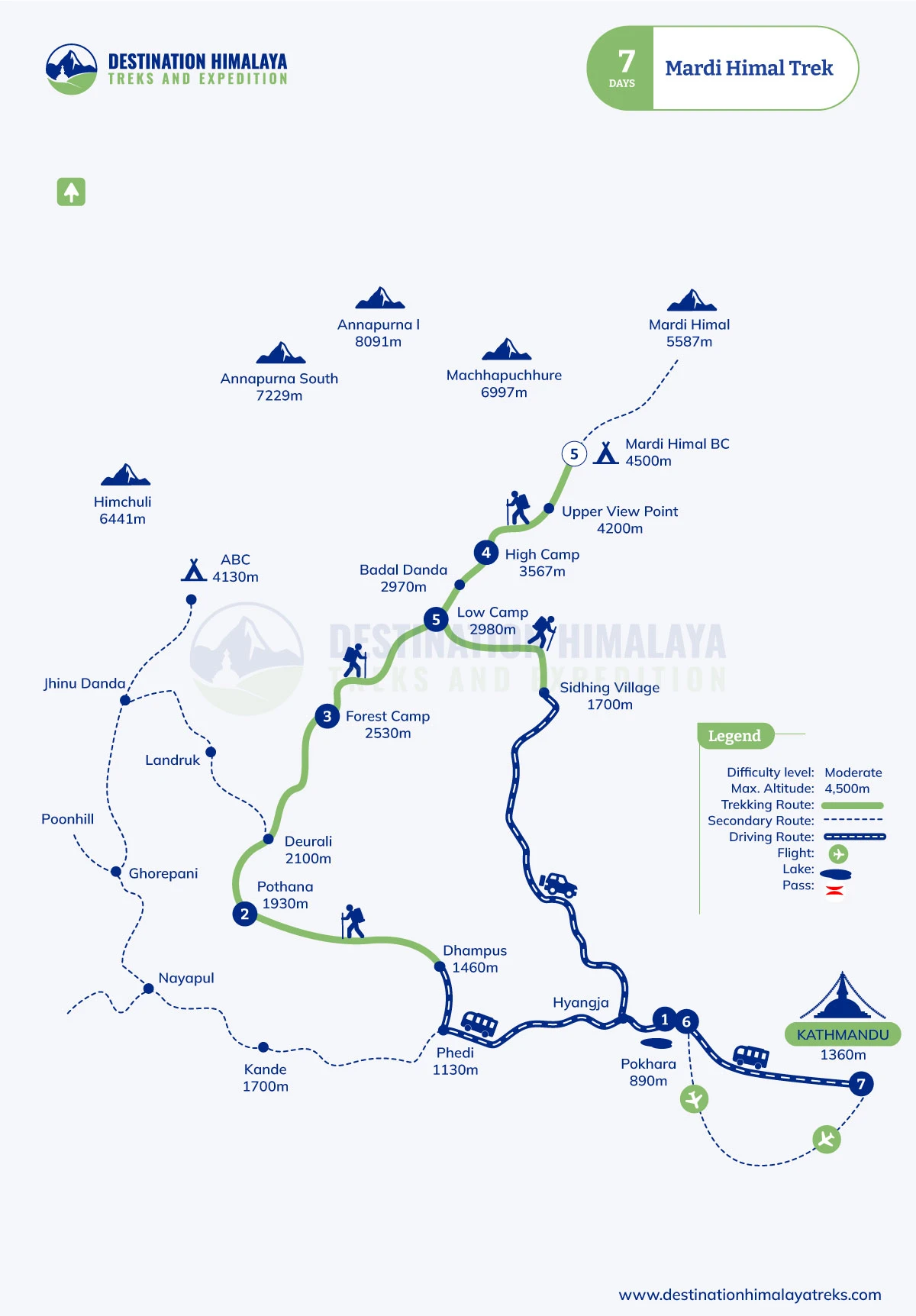
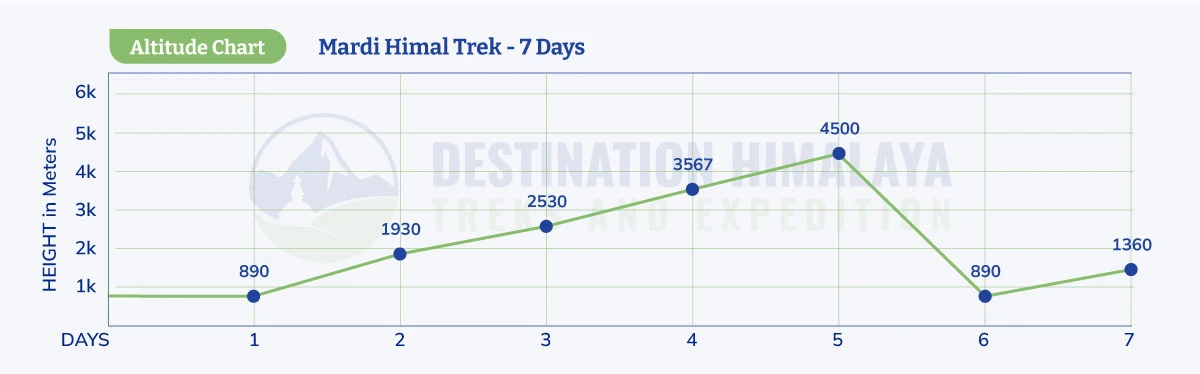
Even though this trek reaches an altitude of 4500 meters, the Mardi Himal Trek falls under easy to moderate treks in Nepal that open the gate to any age group, beginners, and pro hikers. Trekking the entire route spans 40-45 kilometres over 5-7 actual days of hiking. The daily hiking duration lasts between four and seven hours throughout the trek, while elevation gains increase from 500 to 900 meters on the toughest days.
The challenging level rises from Low Camp to Base Camp due to its steep and rocky terrain. Meanwhile, while making our way through Forest Camp to High Camp, the trail passes by thin ridge sections along the side of the landscape. But, there's nothing to worry about as it has poles set to walk by carefully for an uphill ascent.
Nonetheless, the trek is one of the easiest and safest trails, which doesn't demand any long-duration hike or highly rugged sections. Just make sure to trail carefully while navigating to Mardi Himal Base Camp as it contains slippery terrain en route, and acclimatise properly without rushing. Other than that, it is good to go!
In conclusion, even if you are a first-time traveller, you may easily finish this journey without worrying about altitude sickness since our 7-day Mardi Himal Trek itinerary is well-designed. Acute mountain sickness (AMS) is unlikely on our adventure as we ascend gradually, gaining 400–500 meters every day. On top of that, our trekking guides are always there to assist you throughout this odyssey, making sure that you are doing okay and safely ascending without experiencing AMS effects.
Is it a beginner-friendly trip?
Soaring at an elevation of 4500 meters, the highest point, a trip to Mardi Himal Base Camp can be easily completed by a newbie or beginner, no matter whether you have prior experience or not. The route is simply well-maintained and facilitated with ample tea houses, hence you won't find any difficulties in adjusting while settling down for the key stop.
Even though some trailheads do include rugged terrain, especially while ascending from Forest Camp - Low Camp to High Camp, it has sidebars and is marked with signboards in the forested section as well. Apart from that, it doesn't include several ascents and descents, and is considered easy as the route has only a few steep sections, so anyone with basic physical fitness can easily make it through.
Preparations Required
Before you head on any kind of Himalayan odyssey, being well prepared beforehand makes the journey hassle-free and successful as well, as, in the end, rather than your experiences, what matters is how well-trained, prepared, and mentally ready the hikers are. Usually, when it comes to preparedness, many misunderstand it as " oh, to be physically strong, getting yourself all out in packing, and so on, but there's more to it. Here are the preparations required and some useful tips for you to consider before starting the journey:
- Discuss with the pro expert team of the agency, regarding your experiences, health issues (if you have) and hiking pace level, along with your preferences, so the itinerary is tailored accordingly.
- Do a full body medical check-up with the doctor, and ensure that the body is doing all okay to handle the high altitude and increasing elevation, especially check the lungs and heart. If you have any, take the preventive guidance and medications from the doctor.
- Engage in the prior cardiovascular exercises, such as jogging, completing 10k steps daily, or if you have a gym membership, then you can do stairmasters, incline treadmill walks, cycling, and slowly strengthen the body, with shoulders, legs, and core workouts, to handle distinct terrains and uphill and downhill sections.
- Before venturing on this trip, do proper research regarding the tea houses, navigation route, remoteness, local people and their culture and set the mindset accordingly.
- Please leave your contact number, share your itinerary details, and the agency details with your family members, close ones, and friends, for emergency communication and reach out. Sometimes, the mobile network does fluctuate a lot at higher altitudes, especially from the Low camp, so they do not panic if you are out of reach for a day, or pass the information by agency to the guide, and to you, while on the trail.
- Ensure that your insurance policy covers all the must-haves, such as trip delays, cancellations, theft, medical expenses, and most importantly, the helicopter evacuation up to 5000 meters.
- While packing, enlist every essential, according to seasonal variations, and do not miss out on a basic first-aid kit, monsoon gear, like a raincoat, a backpack cover, as the chances of precipitation are always there in the mountain areas.
Is the trek to Mardi Himal family and kid-friendly?
If you are willing to head over to the Mardi Himal Trek with family, including the kids, and want to introduce yourself to the world of the Himalayas, then you are absolutely in the right place! It is a once-in-a-lifetime opportunity for enthusiastic hikers like you who want a quick escape with their loved ones, without feeling any hassle of prior preparations, as the route is comfortable enough, demanding just 3-5 hours of hiking per day. With the perfect blend of cultural encounter, mystic vista of mountains and landscapes, and cosy tea house, Mardi Himal Trekking falls under one of the family adventure trails in the Himalayas.
On the other hand, if you are wondering about the possibility of altitude sickness during this trek, then do not panic, as already mentioned, this Mardi Himal Trek itinerary is carefully crafted, keeping in mind that anyone can easily succeed in this trip - that is why, we've created for straight 9 days from Kathmandu, so you take an gradual ascend with families and kids enjoying the view.
As this trek also meets the Pokhara - the city of lakes, and also the starting point of any Annapurna region treks, you can engage in some kind of extra activities like boating, kayaking, canoeing, which create everlasting memories. From the bustling city of Kathmandu, to the wetlands of Pokhara, to the varied landscapes and highlands, this trek is more than just an expedition, but boosts your love for mountains and cherishing people.
Food and Accommodation
Local Nepalese dishes join various international food options available throughout the route. High-calorie breakfasts like Tibetan bread, chapati, porridge, pancakes, and eggs energise us before each day of trekking. Lunch and dinner consist of Dal Bhat, momos, soups, noodles, pasta, and fried rice. We highly recommend you have "Dal Bhat", which is served with 5 other side dishes such as veg/ non-veg curry, lentil soups, pickles, and rice that can be refilled as much as you can.
The Mardi Himal Trail offers basic lodging, which features simple, cosy rooms with basic amenities. You will find two types of rooms that consist of single or twin rooms with minimal furnishings, with thin mattresses, pillows, and blankets. It is recommended to bring your sleeping bags for additional warmth at higher altitudes.
Most tea houses have shared bathrooms, with some providing hot shower facilities for an additional charge, except at Higher camps because of limited water. For other amenities such as hot showers, laundry, charging, and WiFi, there's nothing to worry about. With the best views, this Mardi Trek caters to everyone's preferences, serving well-maintained facilities. Here are the key details regarding the variations in accommodation to expect along the trail, so you can get prepared accordingly.
Communication, Charging Facility, and Internet Services
Throughout the hike, communication facilities won't be a problem, as the trailhead is well facilitated with telephones in every tea house along the WIFI Facilities by paying some pennies. However, it is highly suggested to buy an NTC SIM card in either Kathmandu or Pokhara with identification validation from the shops, so that, in case of an emergency on the route, you can use it immediately. Just buy 1 SIM card and insert it in a phone, and get a data pack for 1 week, which costs only NRS 120/- and works amazingly in the lower section. Meanwhile, in tea houses, the wifi can only be connected at the dining area after crossing Low Cap via Forest Camp, so make sure to buy a SIM.
Also, take note that electric sockets aren't attached in the room itself, and are only available in the dining area, waiting for a queue to recharge your gadgets, so please bring at least 1 power bank to quickly recharge your phones and cameras when needed. Nonetheless, the communication accessibility won't be a hassle on this trip.
Guides and Porters
During the Mardi Himal Trekking, right from the very beginning, you will be assisted by an experienced, top-notch guide who has served hundreds of hikers in this Annapurna region. They aren't only licensed but also medically guided to respond promptly, in case any uncertainties occur. Hiking with a guide means that you are not just gazing at the mountains and the local lifestyle, but also looking thoroughly at the historical and meaningful significance they carry.
Our guides are free-minded and know how to provide safety and maintain privacy as well. While finding tea houses is quite hectic in peak seasons, they will accommodate you with the best lodging possible. Being on the route every day, they know every highlighted corner and safe route, avoiding avalanches and staying safe at the same time. Our package also covers an experienced guide, with all his meals, salary, lodgings, insurance, and gear, hence you do not have to pay extra.
Whereas our trekking packages do not include porter services, as it is a moderate trailhead, having a porter to take care of your gear is always a great idea, as you can ascend the uphill with ease without any draining journey. So, if you want one, then we can include 1 strong porter at an additional cost that can be shared between 2 hikers with a maximum weight of 22 kgs in total.
Mardi Himal Trek Permits
Two permits are needed to do this trek to Mardi Himal, which must be obtained from the authorised local trekking agency. Don't worry! As soon as the booking is confirmed with us, we at Destination Himalaya Treks and Expedition will arrange all the permits required for the trek, which are included in our package. Here are the permits and it's fess required to trail along this route, which must be considered beforehand
- Annapurna Conservation Area Permit (ACAP): NPR 3,000 (approximately $27) for foreigners. NPR 2000 (approximately $18)for SAARC countries.
- Trekkers’ Information Management System (TIMS) Card: NPR 2,000 (approximately $18) for foreigners. For SAARC nationals, NPR costs 300 TIMS Permits (through an agency), and NPR costs 600 per person without an agency.
Travel Insurance
Although the trail of Mardi Himal represents a moderate-pace level easy hike, the Himalayan journey remains an uncertain adventure. High elevation, uncertain weather, dense forests, and steep rocky terrain can cause unexpected events or accidents. Travel insurance comes into action to support you during unexpected situations on your trip and also helps us to arrange immediate rescue on short notice.
Travel insurance is a safety net that comes to your rescue in case of medical emergencies, the cost of lost gear, and most crucially, emergency evacuation. It makes sure that your budget does not go over the expected amount. Sometimes you may not be able to make it to the trip, or flights may be cancelled; at such a time, your travel insurance can reimburse your expenses too! You may rest easy knowing that the bothersome aspect of planning has been handled, and concentrate on other fun parts of the journey.
Packing Lists
Even though this adventure simply falls under one of the easy treks within the Annapurna region, when it comes to some tips and tricks to tackle the challenges, the first and foremost thing that obviously comes to mind is the packing essentials to consider during any trek in the Himalayas. For sure, you do not have to go head over heels for packing, but there are some considerations that you must include in your packing list before undertaking this trip; hence, here is the suggested gear list.
Clothing Essentials
- Dry Fit T-shirts and Breathable Hiking Pants or shorts - that can easily soak up the sweat and are lightweight to wear
- 3 to 4 pairs of light t-shirts - to wear on alternate days, maintaining hygiene
- Windproof jackets and a Down Jacket or 2 if it's winter
- Fleece jackets and T-shirts
- A wide, wide-brimmed hat or just a normal cap
- Touch screen gloves and thermal socks
- Comfortable hiking shoes or just normal shoes
- Scarf or wool knitted mufflers
Footwear
- Flip-flops or Slippers - to wear while staying at the tea houses
- Hiking Boots - having a strong grip for ascent and avoiding slippery terrains
- Woollen socks and cotton socks (both)
Miscellaneous Items
- Travel Documents, including passports, permits, and travel insurance photocopy (if you have one)
- 1 waist bag to fit the important gadgets
- Powerbank, Charger, and Batteries
- Basic First Aid Kit and Sleeping Bag - if required, it will be provided by us
- Backpack (60 litres) and Day backpack - 15 to 25 L
Note: These are the only suggested packing gear lists that we highly suggest estimating the weather and the trailheads; however, it is totally up to you what to include and exclude. Just do not go overboard while packing; just pack something that's required, as packing tons of loads can be strenuous to take an ascent if you are opting for the porter option.
Travel Tips
- Make sure to bring filtered water bottles and water purification tablets to enjoy safe drinking water in the mountains without creating plastic waste.
- Start preparing your body 6-8 weeks before the trip with stair climbing, hiking nearby hills, swimming, and cycling to increase your strength and endurance.
- En route, try to consume hot fluids like sherpa stew or garlic soup that help you to warm up the body and avoid the coldness that could potentially lead to altitude sickness.
- The daily intake of 3-4 litres of water maintains proper hydration because it enables better adaptation to altitude changes and prevents headaches that may occur at higher elevations.
- Withdraw sufficient Nepali rupees from banks in Kathmandu or Pokhara ahead of your trek because ATMs are not available during the trek.
- Get a local SIM card from Ncell or NTC in Kathmandu or Pokhara to use during emergencies, as these providers supply sufficient network coverage throughout the trek.
- Use a power bank to recharge your devices because electricity is minimal at higher elevations. The teahouses will charge you extra for electricity usage.
- It is highly suggested not to overpack the bag, even if you hire a porter, as the ascent section might be too strenuous for beginners with 10-12 kgs of backpacks. So, pack smartly but in the right way! That becomes useful along the trail and also makes the trip easy.
Booking Procedure
Do not delay any longer if you wish to book a spot with us so that we can fully support you for your adventure to the iconic Annapurna region! To make things easy, we provide everything you need for the trip, including food, lodging, transportation, permits, and expert guides (all of their permits, food, insurance, and so on), which are included in our package itself.
You can email us at [email protected] for the booking confirmation, or you can phone or message us on WhatsApp at +977 9851016814 with any questions. To manage everything, we just deduct 20% of the entire fee; the remaining sum may be paid after you get to Kathmandu. Please do not hesitate to contact us, as we are here to assist you at all times.