mera peak climbing
summit to Mera peak
mera peak climbing guide
More Photos

Mera Peak Climbing - 18 days

314 reviews in TripAdvisor
27 reviews in Google Reviews
Recommended by 99% of travelers
Duration18 Days
Trip GradeStrenuous
Maximum AltitudeMera Peak (6476m/ 21,247 ft)
ActivitiesTrekking and Peak Climbing
Group SizeAny
StartsKathmandu
EndsKathmandu
Best TimeSpring and Autumn

In our childhood, all of us might have dreamt of climbing some of the tallest mountains, right? But you must be sitting back as it’s full of roller coaster rides with heart-wrenching challenges that only pro climbers can conquer. Well, what if we say it’s possible, and you do not even need technical skills to summit Nepal’s highest trekking peak, Mera Peak, within just 18 days?  

Venture out on our best Mera Peak Climbing itinerary, a 18 days adveture, where the trekking route in the first half covers the less crowded trail, ancient Sherpa villages, and diverse terrains within the Khumbu region, ascending to the summit point above 6,000 meters, safely with the assistant by the experienced Sherpa climbing guides.

Detailed Overview:

Mera Peak Climbing is a beginner-friendly expedition that takes you to the summit point of 6476 meters, with no technical sections included. Located within the Everest region, this once-in-a-lifetime thrilling adventure provides you with afront-row ticket to see 5 out of the 8 highest mountains in the world that sit here in Nepal.

Going a little backwards in time, there was no record of the ascent of the Mera Peak until 1950. A game changer for climbing Mera Peak began when Jimmy Robert and Sherpa Tenzing finally summited the peak. After this success, it has been rated as a hot trending climbing destination among enthusiastic climbers who seek to push their limits.

Located in the Solukhumbu district, south of Mt. Everest. It has three summits, i.e., Mera Central, Mera South (6065m.), and Mera North (6476m.). Our goal is to conquer the highest one, the northern part of the peak. 

Although the Mera Peak summit, the name itself sounds like a challenging expedition, the best part is that it is beginner-friendly climbing due to its straightforward route without any technical sections. However, some technical sections are quite expected, but if you are prepared well enough, then you are good to go. On top of that, our guides will be there to assist you in every step, ensuring safety, so you are safe back home with a smile on your face.

The journey is, of course, not like a walk in the park; it is not the easiest journey. As being said, “ To achieve something rewarding we must let go the comfortability and embrace challenge.s” Just like that, reaching the summit, you will be rewarded with some of the glorious views of Kanchenjunga, Cho Oyu, Makalu, Lhotse, and Everest itself, exceeding the height of 8000 meters along the shining glaciers.

While we may think that this journey is all about climbing one of the trekking peaks in Nepal, it is more than that. Wondering why? Right after we land in Lukla from Kathmandu, the Mera Peak climbing route begins from Paiya and traverses through many settlements such as Panggom, Ningsow, Chhatra Khola, Kothe, Khare, Thuli Kharka within the Hinku Valley- home of sherpas. Thus, you will get a lively experience of the Sherpa culture and also get to hear their fascinating stories of conquering many mountains and laughable jokes that make your trip even more meaningful. 

This trail also enters the Makalu Barun National Park, where you will pass by several waterfalls, rivers, blooming flower forests, and suspension bridges. Not only that, but you will also get to encounter pristine wildlife such as elusive Red pandas, musk deer, red foxes, black bears, and many others. 

Thinking about signing up for this expedition? Follow this 18-day Mera Peak climbing itinerary that trails through famous villages, allowing you to explore the heavenly beauty of the Himalayas and reach the summit safely at the same time by joining our hands. The great Himalayas await to welcome you wholeheartedly! 

Major Highlights of Mera Peak Climbing 

  • Get a chance to get a lively experience of Sherpa culture every single day
  • Walk on the less crowded trail of the Khumbu region, peacefully exploring the wildlife, nature, and landscapes
  • Surround yourself with eight-thousanders such as Cho Oyu, Kanchenjunga, Lhotse, Makalu, and Everest itself
  • Get an amazing insight into Hongu and Hinku Valley, showing their raw beauty at its best
  • Reach the summit of Nepal's highest trekking peak and scream your heart out joyfully
  • A trail through the Makalu Barun National Park, exploring the unspoiled vegetation and rare animals such as the elusive red panda
  • Pass across cascading waterfalls, rivers, suspension bridges, dense forests, and terraced fields with views of snowcapped peaks and landscapes throughout the trail
  • Cross one of the highest mountain passes of the Himalayas- Zatrwa La Pass

Why summit Mera Peak with us?

With the experience of serving for more than two decades, we are well-known for the techniques we apply and how to tackle the unseen situations that may arise in high-altitude areas.

We are fully determined to be the shadow in your every step to the mountains; our sherpa guides are well-trained and medically equipped, helping you to overcome any emergency if it occurs in the expedition. Every year, we successfully lead many climbers like you to the summit of Mera Peak without any hassle with the help of our course sherpa guides and porters. 

We believe that "your safety is our greatest treasure,and our DHT team ensures that you are acclimatized properly, due to which our 18-day package itinerary is well crafted by professionals. So, we have set 2 days of acclimatization at Khare, one day to rest and another for a training session to memorize and practice the climbing once again. From the beginning to the top of the summit and till the end, you can trust that you are in safe hands.

Furthermore, we are also well known how uncertainty mountains can bring up to you, due to which our summits may get delayed by bad weather. 1 Contingency Day is scheduled in our Mera Peak Trekking itinerary, so such delays can never stop you from conquering your dreams without compromising your tight schedule and flights.

On top of that, our cost is shown in the package itself:"whatever you see, you get it. There's nothing like hidden charges that can burn your pockets. We believe in 3 three thingsyour safety, your comfort, and your satisfaction, so that every penny you have spent on an expedition becomes worth it. 

If you have any queries, simply email us at info(a)destinationhimalayatreks.com or dhimalayatreks@gmail.com. We are available 24/7 for your assistance.

Willing to shake hands with us for your thrilling expedition? Do not wait any longer, unchain your backpack and dust off the climbing boots that have been in your wardrobe for a long time. Destination Himalaya Treks welcomes you wholeheartedly, and our sherpa guide and porters are all geared up to befriend you at every step of the mountains.

Mera Peak Climbing Difficulty 

Well, every climber dreams of conquering the summit of Nepal’s highest trekking peak, Mount Mera. There’s no doubt that the breathtaking glaciers and mountains reward you with amazing views along the trail till the end of reaching the top after long hours of expedition.

However, just like every rewardable endeavour comes with some challenges. Reaching Mera Peak is not an easy task, with some notable challenges in certain sections of the climb. While the route is not technically difficult, it does require pre-preparation. Usually, novice climbers commence on this expedition to gain technical knowledge and experience before the higher climbs they plan for next. So, you can guess how one can climb Mera Peak without any issues.

Walking on the trails with some rugged, steep terrains with limited amenities is not a journey in the blink of an eye, especially for those who haven’t had such expeditions before.

Firstly, please note that we are navigating through some icy and snowy terrains as soon as we reach the Mera Peak Base Camp. Secondly, we will be accommodated at basic tea houses in remote areas and spend one night in a tent a day before the summit, which might be mentally daunting for some. Hence, you must create a positive mindset and be prepared accordingly.

Meanwhile, with some training sessions, a planned itinerary that includes proper acclimatization days, and the right gear, anyone can complete the Mera Peak Climbing successfully, even if you are a new climber.

What preparation and training are required for the Mera Peak Climb?

As we are aware of how unfortunate situations are always circulating in the mountains, it is compulsory to be prepared beforehand to avoid any kind of adverse situations and make the Mera Peak climbing a completely hassle-free expedition. Hence, we have mentioned some of the tips, guidance, and advice that will help every climber conquer Mount Mera for sure:

Gradual Ascent with Proper Acclimatization Days

Having said that, “ taking time is better than always rushing and failing”, just like this statement a slow, steady, and continuous ascent are two major keys to success in the expedition.

Simply, considering this thing in our mind, we have created the itinerary accordingly so we can get a gradual ascend without any rush that is the main reason why our Mera Peak itinerary has touched 18 days and avoids the summit of Mera Peak until and unless we are done with adopting the changing high elevations.

First and foremost, we have set the acclimatization Day at Khare for 3 straight nights where we will do a proper pre-training session of what can be done if something happens and memorize to use the ice axe, and crampons again. Secondly, we will set up a tent in the High Camp of Mera to be familiar with the altitude. Lastly, we have planned a contingency day so if some uncertainty occurs such as bad weather conditions, or delays of the Mera Peak summit then it gets covered without lengthening the days.

Prior High Altitude Trekking Experience

Spending 14 days straight at a high altitude is not a joke, especially when you are thinking about climbing Nepal’s highest trekking expedition Mera Peak which stands at an elevation of 6476 meters. 

Do not neglect thinking about achieving this summit if you haven’t had a single trekking experience at an altitude above 4500 meters. It doesn’t require any professional experience in technical climbing but it is also necessary to note that we are spending many days exceeding weeks in the wilderness of Khumbu region. 

Hence, make sure to do some trekking/ expedition before starting the Mera Peak Climbing in your own home country or here in Nepal such as the Mardi Himal Trek and the lap of Everest Base Camp that is budget friendly and reaches the base camp exceeding the height of 5000 meters as well. Well! Thinking about one? Then talk to us before joining our Mera Peak Expedition. 

Maximize your fitness level: Build stamina and calves strength

While we mention leveling up the stamina, we don’t mean bulking up the muscle and building some abs. In simple language, we want you to engage in some kind of physical activity like cardio, pilates training, or even a short hike that includes several up and downhills. Some of the tips that are highly followed by many climbers and turn out to be effective are mentioned below.

Firstly, please remember that you are not hiking on the roads of streets but on heading to scale one of the highest peaks. So, make sure to get involved in some sort of physical strengthening activity like walking, or running on the treadmills or fields if the time fits ranging from 3.5 km to 10 km per day, or alternative days.

Secondly, note to carry some loads in the bags of 5-6 kgs while hiking or walking at some distance. This will help you to know the pressure the bag holds while ascending/climbing while carrying your own trekking gear. 

Lastly, try to build up the strength of your legs and calves by doing some rope skipping, and stretching for 15 minutes daily at home or even you can do several ups and downs by a staircase that helps you to tighten up the core and boost up your stamina.

Creating a positive mindset

While we always keep in mind that being physically prepared is generally necessary for any climbing. We somehow unknowingly neglect being mentally prepared before embarking on a voyage for Mera Peak Climbing. But do you know what? It is much more important than being all geared up and getting prepared by building some strengths.

Spending days that exceed the weeks in remote and mountain areas is not a piece of cake. It can be mentally daunting and tiring for some who are not used to being in a limited infrastructure. On top of that, while making your way to the summit of Mera mountain in Nepal, you might feel a hinge of doubt on whether you can succeed or not.

For that, you must be prepared and create a positive mindset before starting the expedition and say to yourself " This is everything that I got and my only goal for now is to reach the tip of the peak". Keeping this thing within yourself will for sure make the climbing journey 99% easier.

Choosing the right gears and equipment

Make sure to tick off the packing list just before you start the journey of the Mera Peak. The expedition can be miserably terrible if you haven't carried a proper gears and equipment. We simply want to avoid such critical conditions, don't we? So, the best thing you can do is try to check your gears at every stopping point while staying at the tea house. 

Besides that, bring yourself warm fastly drying clothing items such as dry t-fit, pants, and jackets that are easy to carry and warm at the same time. 

Select a knowledgeable guide and reliable company

Selecting an experienced sherpa guide might be a hassle for you as there are many guides available. But, if you are opting for a registered local company of Nepal like us, Destination Himalaya Treks then we not only provide an experienced guide but also equip the ropes safely, and manage the training sessions in Khare and Mera Peak Base Camp.

On top of that, we also provide you with some gear and equipment such as oximeters, sleeping bags, 1 t-shirt, 1 jacket (complimentary), a satellite phone, a trekking cap and not to forget one sherpa guide and assistant sherpa guide as well that had accompanied climbers to the Mera Peak Climbing since many years.

We firmly believe in the idea that "safety is the greatest treasure in the mountains".

Altitude Sickness

In general AMS (Altitude Mountain Sickness) can occur to someone who hasn't had any trekking prior experience in higher altitudes or if the proper acclimatization days aren't scheduled accordingly. As mentioned earlier, this trekking to Mera Peak elevation starts from 2000 meters and reaches over 6000 meters at the summit which is honestly a huge deal for a novice trekker/climber. So, the basic effect of altitude sickness is quite expected not only for beginners to pro hikers. 

So, how can we know if such a thing happens? Well! Firstly, If you feel any symptoms like dizziness, fatigue, tiredness, nausea (feeling like vomiting) difficulty in breathing, and severe headache then, please inform the sherpa guide.

Secondly, check your oxygen level with an oximeter given by us at every stopping point. Lastly, if you feel tiredness or some sort of the mentioned symptoms then, take a day leisure day at Khare and Base Camp and opt for the summit attempt on the contingency day that we have saved in this planned 18-day itinerary for Mera Peak Climbing.

Here are some preventive guidelines that you must consider:

  • Walk at your pace along the guide, do not panic! please remember that a gradual ascent is the key to succeeding at the summit. Do not overspeed yourself that can be both mentally and physically tiring.
  • Hydrate yourself right from the start of the trip as it increases your stamina level and avoids dryness in your mouth that could sometimes lead to increased headaches and fatigue leading to altitude sickness.
  • Drink hot ginger soups or dry gingers that are available in every tea house along the route of the Mera Peak trip that boost up the energy and increase the warmness of the body
  •  Avoid smoking and drinking hard drinks that significantly cause rapid feelings of increasing heartbeat and lead to dehydration and dryness
  • Inform the guide and lodges beforehand if you are allergic to some foods like lactose intolerance or vegan they might not know your health condition. So, it is always the best thing to remind the guide as well.
Itinerary
Trip PlanExpand all

Let us know your arrival date and time here in Nepal. One of our Destination Himalaya representatives will be there waiting for you at the TIA airport. He'll be carrying a dashboard with the name of the company and your name. So you won’t feel confused about finding him. 

Wave hello to each other and he will greet you with a flower garland (a Nepali way of showing respect and gratitude toward valuable newcomers in the country). Then, he’ll transfer you to the 3-star hotel that has been already booked for you of course. After your check-in at the hotel, get some rest and be fresh. In the evening time, we will have dinner together and also get a short briefing from the expedition guide and the company representative. 


Max Altitude: 1350 m/4428 ft Meals: DinnerAccommodation: 3 star hotel

Well, being in the country's cultural hub and not visiting the historical sites would be a complete waste. So, this day has been set as a cultural trip to some of the amazing sites within the Kathmandu Valley.

First thing first, our tour guide will come to meet you up at your hotel/hostel. Then, we make our excursion trip towards the 5 major sites; durbar squares of Kathmandu and Patan, the Buddhist temples of Boudhanath and Swayambhunath, and lastly we will pay our visit to the biggest Hindu temple of Shiva, Pashupatinath Temple.

Reaching Thamel (maybe at 5 pm) we’ll have a short meeting at the DHT office regarding how the trip will be managed and also a detailed brief of the Mera Peak Climbing. We’ll get an introduction to the porter and guide as well. DHT company representative will give you a short checklist of the packing list for the climbing. Make sure to tick it up correctly.

Note: If you have missed out on some climbing gear. Please do not Panic! Here on the streets at the Thamel, we can get gears at a reasonable price. Our team will assist you at the shops. 


Max Altitude: 1350 m/4428 ft Meals: Buffet BreakfastAccommodation: 3 star hotel

Today is the day that we all have been waiting for as we catch a flight to Lukla- the flight that leads us towards our thrilling expedition. Reaching Lukla, our trekking adventure begins as soon as we land. Taking our backpacks and gear we make our way by the forested area and cross the Handi Khola that will lead us to Surke and Pakhapani. 

Making our way by the tiny villages ahead we’ll cross the Chutok La Pass. Making our ascends towards Paiya (Chutok) several mountains such as Khatnag, Kongde Ri, and other snowy peaks exceeding the heights of 7000 meters tend to befriend us making our first hike truly breathtaking.


Max Altitude: 2937 m/ 9636 ft Meals: Breakfast, Lunch and DinnerAccommodation: Tea hoursDuration: 3-4hrsDistance: 4.7km

After a short and fulfilling breakfast, the adventure begins as we descend from Paiya and arrive at a tiny bridge made out of woods. Crossing the bridge leads us toward a slipper path until we cross the Kari La Pass. So, please note to take a gradual step and do not panic on the slippery route. 

Shortly after, we will enter a forested area of bamboo and of course rhododendrons from where we enter the narrow mountain trails. After walking by the narrow trails, we’ll fortunately get to see the stunning Dudhkoshi River (Milky River) and its valley. Take some time to get this rewarding view within your beautiful memorable list. After a short stop here, we continue making our steps towards our next destination, Panggom. 

Upon arriving at Panggom, we can witness how they are living their daily lives as we can see the locals engaging in some kind of farming activities like harvesting crops in terraced fields and also yaks grazing here stunningly. Make sure to interact with them as they tell you some of the fascinating stories, myths, and also their life and hardships in the Himalayas around this village.  


Max Altitude: 2846 m/ 9338 ft Meals: Breakfast, Lunch and DinnerAccommodation: Tea houseDuration: 5-6 hoursDistance: 6.7km

After taking local breakfast at Pangom we start our day walking to Nagindingma traverses through adventurere lush forests, traditional villages, and rugged path trails in the distant Hinku Valley region. The trekking trail begins with a gradual ascent although few decent, meanwhile we enjoy the dense rhododendron and bamboo forests. During the day we might encounter some local who greet trekkers to scenic views of distant snow-capped peaks and the soothing sounds of mountain streams.

Mera Peak trekking route traverses several small settlements where locals welcome visitors with warm hospitality. As we are closer at Nagindingma, the landscape becomes more rugged, with steeper inclines and narrow trails winding along forested ridges and terraced hillsides. The village of Nagindingma itself is a quiet, picturesque stopover, surrounded by greenery and offering a glimpse into the traditional mountain lifestyle.


Max Altitude: 2650m/8,692ft Meals: Breakfast, Lunch and DinnerAccommodation: Tea houseDuration: 5-6 hoursDistance: 10km

Have a fulfilling breakfast today as we are hiking to one of the most challenging sections through several steep ups and downs. But, do not panic! The paths are still in a manageable (good) condition with a rewardable view. First and foremost we will make our way by ascending towards Ramailo Dada known as an exciting hill in English as we can see the glorious views of Mera Peak at its best or you can say the first clear glimpse of it.

Entering the Makalu Barun National Park, we will navigate by the forested area where we can see several rivers, suspension bridges made out of woods, and stunning streams. Not to forget! We may also get to catch wildlife insights of the Himalaya animals such as langur monkeys, eagles, and the endangered red panda. 

Making our way within the Hinku valley, we will finally reach the Chhaktra Khola where we will be staying for tonight. 


Max Altitude: 2800 m/ 9187 ft Meals: Breakfast, Lunch and DinnerAccommodation: Tea houseDuration: 7-8 hoursDistance: 10km

Today, we begin our trek by ascending some of the rocky sections that lead us to the forested trail of pines, bamboo, and rhododendrons. Following the route of the Mera Peak, we will cross several rivers such as Hinku Khola, Majhang Khola, and Sanu Khola through wooden bridges. 

En route, we can see locals engaging in some kind of agricultural activities such as harvesting crops on the terraced fields. And also yaks, and blue sheep grazing beautifully on the hills just adding medicine to our tiring long hike. 

Reaching the village of Kothe, make sure to interact with the kind-hearted locals where we can also get a lively experience of their livelihood. Have a great noon enjoying the surroundings of this valley as tomorrow the hike is quite short so we don’t have to worry about a long tiring walk. Make the best out of it while staying here. 


Max Altitude: 3691 m/ 12111 ft Meals: Breakfast, Lunch and DinnerAccommodation: Tea houseDuration: 6-7 hoursDistance: 15km

Today, our trail begins through some narrow sections navigating toward the banks of Hinku Khola. The path leads us to one of the famous and old Buddhist gompas of Lungsumgba. 

Here, we will explore this cultural site located in the middle of the landscape and after a while, we make our step toward the tiny summer village of Gondishung. 

Just like yesterday, we will get an amazing chance to have some conversations with heartwarming locals residing here before reaching our destination for today, Thagnak. 


Max Altitude: 4358 m/ 14299 ft Meals: Breakfast, Lunch and DinnerAccommodation: Tea houseDuration: 5-6hrsDistance: 7km

A short challenging yet rewarding hike is just ahead of us. Leaving the village of Thagnak behind, we make our step towards the Dig Kharka by crossing the moraine of Dig Glacier. The path might be a little daunting for some but the heavenly views of Charpate Himal and Hinku Glacier just on our north side befriend us making us forget our challenges for sure.

Ascending from here through another moraine of Shar Glacier. We will pass through Hinku Nup and finally reach Khare. Upon arriving at Khare, the clear views of the north side of none other than Mera Peak rising gloriously can be seen. Soaking this captivating view of heavenly mountains and glaciers, we will stay here overnight. 


Max Altitude: 5045 m/ 16553 Meals: Breakfast, lunch and DinnerAccommodation: Tea houseDuration: 4-5hrsDistance: 6.1km

Get yourself a little hype up today as a climbing session is set for today. It is required for us to get an instruction on how to use gears/types of equipment to climb Mera Peak.

Our Destination Himalaya climbing guide will give you a detailed brief on how to use some of the technical gear such as ice axe, and crampons, techniques on how to use the ropes, and a demo of rope climbing methods. Although it has been already mentioned right at the beginning of this trip it still acts as a safety net reminding everything step by step that also helps to our confidence level one hundred percent.

The day is also set as a rest day so make sure to explore this valley thoroughly and get an amazing rewardful cultural insight of the Khare village. One more overnight stay at Khare. 


Max Altitude: 5045 m/ 16553 Meals: Breakfast, Lunch and DinnerAccommodation: Tea house

Today, we will make our step towards none other than Mera Khare High Camp where we will be setting our tent before the summit. Following the steep rough section, the trail leads us to the Mera La Pass. Please note to walk slowly by wearing helmets as it is a high landslide-prone area. 

Make sure to wear crampons before crossing the large glacier. We will then gradually descend by passing through the moraine and glacier on the northern side that eventually takes us toward Mera Base Camp. Leaving the lap of the highest trekking peak, we will start ascending towards high camp. We retrace our step back to the glacier and follow the easy snow slopes. 

Now, we will make our ascend toward the High camp by following the stone-littered site. We might feel mentally fatigued but please remember that “Consistency is the Key” and this is the day that we have been waiting for. 

Well, while ascending do not miss out on turning back at least one time no matter how tired you may feel during the ascend as several snowy mountains such as Everest, Lhotse, Nuptshe, and many others are aligned to welcome us with their awe-struck views. 

Arriving at the Khare High Camp, we will set up our tent (our cozy home for today in the middle of the mountains). Staying here we might feel freezing cold but the heavenly peaks of Makalu, Chamlang, Lhotse, and Mera Peak will remind us that we are just one step/day behind to reach the summit. 

After taking a good rest for an hour, we will start our training with the climbing guide once again so we can get a reminder of how exactly to use the gears and what to do if something uncertain occurs. Although it is rare to have uncertainty it is also a good idea to take a brief training session with a guide for approx 3 hours. After a short training session, enjoy the stunning views of glaciers and mountains surrounding you.


Max Altitude: 5780 m/ 18964 ft Meals: Breakfast, Lunch and DinnerAccommodation: Tent CampDuration: 5-7hrsDistance: 3km

The day has finally arrived and we all have been waiting patiently. Waking up early in the morning, take time for 5 minutes of meditation to freshen up the mind first. We will start climbing gradually between 2 to 3 am, we must leave the high camp within this timeframe as the starting time plays a crucial thing while summiting as the weather might get windy while descending. So, we will leave as soon as possible depending on what current weather situation the area is holding. 

The first and foremost thing we do is set up the fixed ropes and crampons. Then, we will start climbing carefully with the help of our expedition guide by the steep terrains. Although the climb might be mentally tiring, do not panic! And remember that what you are here for, is to reach the summit right?  Make your heads high and focus on the 3 P’s- Perseverance, Persistence, and Patience level, keeping in mind the climb becomes much easier.

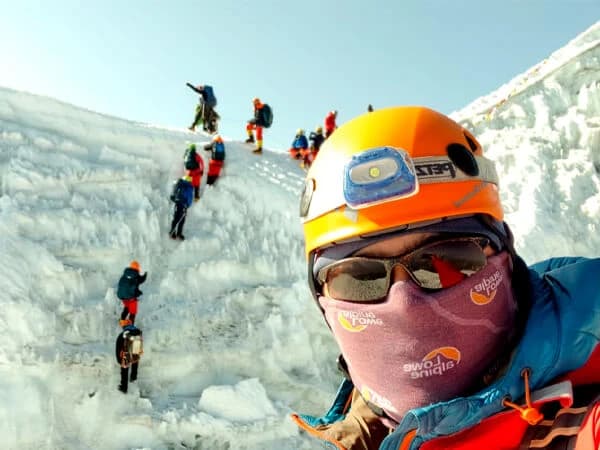
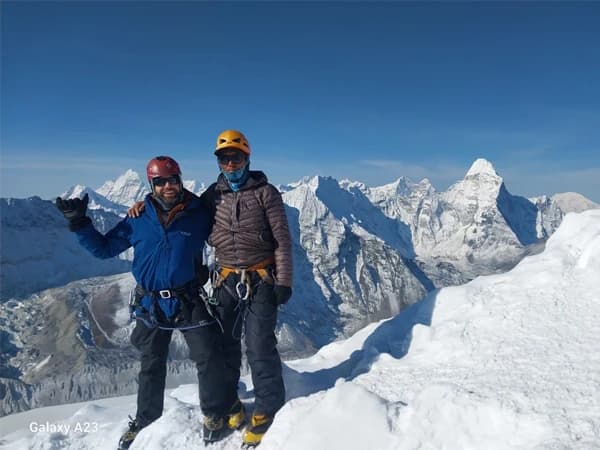
After a while, we can see 3 summits, however, our major goal is to reach the highest one among the three. So, keep hustling your feet through the steep and snowy slopes that lead us toward our ultimate goal- the summit of Mera Peak. Although the climb is quite a hassle, upon reaching here you will for sure enjoy the heavenly beauty of several snowcapped peaks of Mt Kanchenjunga, Everest, Makalu, Cho Oyu, Ama Dablam, and many others adding fuel to our low energized body.

We will retrace back our steps towards Khaire by descending from High Camp making once-in-a-lifetime memories of stepping our foot to the peak. 

Reaching the tea house of Khaire, get a proper rest as your legs may be a little trembling, and also you might feel a little effect of altitude sickness. Have some ginger soup or a dry ginger whatever is available in the tea house to ease you down. 


Max Altitude: 6461 m/ 21199 ft Meals: Breakfast, Lunch and DinnerAccommodation: Tea houseDuration: 9 hours

Well, this day has been properly set by us as the weather is truly unfortunate in the mountain areas. If anything happens like the delay of the summit on the planned/ scheduled date due to bad weather conditions, then we must hold back a day here before we climb the peak.

If such conditions do not occur then and everything goes well according to the plan then, this day is not required. 


Max Altitude: 5045 m/ 16554 ft Meals: Breakfast, Lunch and DinnerAccommodation: Tea house

We will retrace our step back to Kothe, which is quite a long and physically tiring journey as we walk past rocky sections descending all the way. We might feel leg tremble due to continuous downhill, so stretch your body beforehand.

Traversing through several tiny villages, including Thagnak, glaciers, and moraine; we will finally reach Kothe after 6 to 7 hours of downhill walking. 

Max Altitude: 3691 m/ 12111 ft Meals: Breakfast, Lunch and DinnerAccommodation: Tea houseDuration: 6-7 hours

Today, we hike to the Thuli Kharka from Kothe following the bank of the Hinku River side by side. We traverse several ups and downs sections with rocky trails passing by several river valleys, dense forests, and vistas of mesmerizing cascading waterfalls.

The best part is! We might even get a chance to see the insight of rare wild animals such as musk deer, elusive red panda, and many others. So, make your cameras and phones ready to get a snap out of it. Walking continuously for 5 hours approx. we will finally reach Thuli Kharka where we will stay for tonight. 


Max Altitude: 4300m/ 14107 ft Meals: Breakfast, Lunch and DinnerAccommodation: Tea houseDuration: 5-6 hours

After having our drooling breakfast, we make our way toward Lukla by stepping on the uneven terrains with rocky trails.

So, make sure to please pay attention while navigating this trail that takes us towards Zatrwa La Pass at an altitude of 4600 meters. This particular section might be a little slippery so ensure that you are gradually making your steps. After crossing Zatrwa La Pass, the pass leads us toward Lukla passing by some of the amazing valleys, rivers, and forests. 


Max Altitude: 4600m/ 15093 ft Meals: Breakfast, Lunch and DinnerAccommodation: Tea houseDuration: 6-7 hours

Abiding a heartfelt goodbye to the Everest region after spending more than 2 weeks, we catch a flight to Kathmandu. 

The flight gradually shows the transformation of white snowy peaks to landscapes and green hills depicting how our trip went from the start that for sure will leave us speechless. 

Upon reaching Kathmandu, the guide will transfer you to the hotel that we stayed in before as well as where our luggage is stored. In the evening, we will have a little gratitude/ dinner session with the company representative where he will distribute you the completion certificate of summitting the peak.

The evening is yours! Make sure to make the best out of it by exploring the street of Thamel as much as you can. 

Max Altitude: 1350 m/4428 ft Meals: Breakfast and farewell dinnerAccommodation: 3 star hotelDuration: 30 minutes

Let us know your departure date back to your home country, and one of our DHT Team will drop you off at the airport from the hotel. 

If you have anything then, let us know we are happy to assist you again wholeheartedly with some amazing offers/deals as well. Thank you for trusting our company to become your shadow of your thrilling adventure in the mountains. 

Route Map
Mera Peak Climbing Route Map
Altitude Chart
Mera Peak Climbing Altitude Chart
Cost Details
Includes
  • Airport pickup and drop-off service on a private vehicle 
  • 3-star hotel accommodation in Kathmandu with buffet breakfast
  • 3 standard meals with one cup of hot beverages throughout the trip
  • Accommodation throughout the trip - 1 night at tent camp
  • Registered English-speaking professional trekking guide, climbing sherpa, and climbing crew with all their salary, food, equipment, and insurance
  • Seasonal fruits every single day after lunch/dinner
  • 1 experienced strong sherpa porter (must be shared between 2)
  • All required climbing permits and National Park Permit 
  • Domestic flight; Kathmandu - Lukla - Kathmandu
  • Destination Himalaya Treks Tshirt, duffle bag, sleeping bag, jackets, hats with climbing ropes and tents
  • Oximeter- to check your pulse and heartbeat
  • 1 assistant sherpa to the group that exceeds the number of 6
  • Climbing completion certificate after the summit
  • Farewell dinner in Kathmandu with Nepali cultural programs
Excludes
  • International flight tickets
  • All the Beverage bills and personal expenses (Hot water, Hot shower, Wifi charge, battery recharge, bottled water, Laundry charge, etc)
  • Lunch and Dinner in Kathmandu 
  • Nepal entry visa
  • Personal trekking gear and equipment
Dates & Availability
Select your preferred date
Jan 2026
Feb 2026
Mar 2026
Apr 2026
May 2026
Jun 2026
Jul 2026
Aug 2026
Sep 2026
Oct 2026
Nov 2026
Dec 2026
Date and Days
Price
Status
Date & Days
Jan 11, 2026 - Jan 28, 202618 Days
Price
US$1799US$2499
Save US$700
Status
Guaranteed
Date & Days
Jan 13, 2026 - Jan 30, 202618 Days
Price
US$1799US$2499
Save US$700
Status
Guaranteed
Date & Days
Jan 15, 2026 - Feb 01, 202618 Days
Price
US$1799US$2499
Save US$700
Status
Guaranteed
Date & Days
Jan 17, 2026 - Feb 03, 202618 Days
Price
US$1799US$2499
Save US$700
Status
Guaranteed
Date & Days
Jan 19, 2026 - Feb 05, 202618 Days
Price
US$1799US$2499
Save US$700
Status
Guaranteed
Date & Days
Jan 21, 2026 - Feb 07, 202618 Days
Price
US$1799US$2499
Save US$700
Status
Guaranteed
Date & Days
Jan 26, 2026 - Feb 12, 202618 Days
Price
US$1799US$2499
Save US$700
Status
Guaranteed
Date & Days
Jan 29, 2026 - Feb 15, 202618 Days
Price
US$1799US$2499
Save US$700
Status
Guaranteed
Essential Information

Best time to climb Mera Peak 

The first and foremost priority every climber must think of is choosing the right seasons for any peak expedition that not only offers clear views of mountains and glaciers but also ensures safety at the same time.

If you are a dreamer who is manifesting the Mera Peak Summit, then the ideal time for this expedition in Nepal would be during Spring and Autumn. You might be wondering why. Well! There are several good reasons attached to it. The first and foremost important reason is that these two seasons offer perfect stable weather with balanced climate conditions.

However, climbers who have summited many other challenging peaks before can opt for the Winter season as well. Meanwhile, it is highly not recommended as the temperature drops significantly during this time, which can cause several issues due to harsh weather conditions. 

Here are some details to make you understand what the Spring, Autumn, and Winter seasons of the year have to offer climbers/trekkers with their perks.

Spring (March, April and May)

We are all familiar with how the spring brings the best out of nature, whether it’s blooming flowers or the unobstructed views of mountains due to less fogginess; it has everything that enthusiastic climbers usually seek.

As spring falls right after the winter season the weather generally remains stable. So, you can easily trail along the route and start the Mera Peak climbing with ease. In the lower regions, temperature generally falls around 10 degrees Celsius in the daytime and drops up to -10 degrees Celsius at night time which is quite a good deal to warm your body in the sunny golden hours.

At the summit of Mera Peak, it can drop to -20 degrees, which is bearable in the mountains as we are prepared accordingly. Hence, the Spring season is one of the most preferable times to commence on this expedition in Nepal.

  • Unobstructed views of mountains, glaciers, and landscapes
  • Blooming wildflowers and greenery forests add a vibrant tone to the trails
  • Perfect climatic conditions blending with the weather
  • Long duration of sunny golden hour daylight
  • No heavy rainfall or snowfall throughout the journey

Autumn (September, October and November)

Another best peak season for Mera Peak Climbing is the months of September, October, and November, which fall under Autumn. If you are craving to ace the expedition by experiencing the great, valuable cultural encounters in the Himalayas, then it would be the perfect time for you.

During this season, we can highly expect good weather conditions to perfectly blend with climatic situations. That means we can trail and start the expedition without worrying much about avalanches and snowy/slippery sections. Generally, the temperature is approximately 12 degrees and drops to 5 degrees Celsius at the chill nighttime. 

Reaching the Mera Peak summit, the temperature can drop to 5 degrees Celsius, which is bearable in the mountains, as we will be well prepared considering these facts. 

  • Great cultural insights into the greatest festival of Dashain- Tihar along the route of remote villages
  • No chance of fogginess due to no rainfall or snowfall
  • Glimpse of the harvests of crops by the locals in the terraced fields
  • No chance of avalanches 
  • Perfect climatic conditions blending with the weather

Winter (December, January and February)

Well, if your time doesn't fit the peak seasons of Autumn and Spring, then gearing up for the expedition to Mera Mountain in Nepal would not be a complete waste. In fact, you can get the best views of mountains and landscapes covered with white sparkling snow. However, we must consider some challenges that the winter brings as the temperature drops to - 5 degrees during daytime hours and 10 degrees Celsius at nighttime, which can be cold, causing some dizziness, fatigue, and blistering to the feet as well.

In the higher Everest region from Khare to the summit, it drops to -20 degrees Celsius, which can be mentally daunting due to the low temperature if not geared up properly. However, if you are a pro climber who has done some amazing expeditions before and wants to push off the limits in the wintertime, it is truly a great idea. Reaching the Mera Peak unfolds a new reflection that lies within you, and on top of that, the heavenly views of the surrounding mountains from the top are to die for!

Thus, you can successfully do the Mera Peak Climbing in early December and February with proper preparation, gear, and, of course! with great willingness to conquer the summit with a prepared mindset. 

  • Less crowded with peaceful trails and routes
  • No chance of delay/cancellation of the flight
  • Dry weather with some amazing unhindered vista of mountains

Accommodation Facilities 

Throughout our thrilling adventure right from the start till the very end of our journey, you will be settled at 3 categories of hotels. In the beginning point that means Kathmandu, you will be placed at a 3-star hotel. Right after you enter the Everest region your accommodation in the tea houses gets started and lastly, before the summit point of base camp, the sherpa guide will set up a tent for you after we get there.

3-star hotel in Kathmandu: As soon as you reach here in Kathmandu, you will be accommodated at the 3-star hotel of your choice (if you have any) with a buffet breakfast. The tea houses' accommodation begins from Paiya, the first lodge in the Khumbu region or you can say after Kathmandu Valley.

Tea houses: As expected, the lodges along the route within the Khumbu region are quite basic with limited amenities as it is run by none other than the Sherpas. Although it sounds basic it has got all the amenities such as single cozy beds, an attached washroom, a hot shower, a laundry facility, and even wifi. Moving to upper parts, don't expect lavish tea houses like the lower sections, as you ascend higher. You must share washrooms as there are only finger-countable tea houses in the higher sections. Blankets, pillows, and comfortable mattresses will be provided by the lodges.

Tent Camps: We will fit our tent camp in the Mera Peak Base Camp before submitting one of the highest trekking peaks in Nepal, Mera Peak as lodges aren't available from the base camp. So, it is the only option left with us to reach the summit as soon as possible before it gets too windy and dark. 

Meals and Drinking facilities availability

The best part about this Mera Peak Trek is you do not have to compromise your favorite foods and diets as the tea houses serve the best diversity of foods from local to western cuisines. Don't panic about how hygienic the foods are up there as it is well tracked by our guides and only get prepared after you order them.

3 standard meals with beverages will be provided to you, just check out the menu and give your order to the guides or tea houses. Also please inform us beforehand, if you are allergic to some food items. 

For drinking water, you can get every tap water facility in tea houses. However, if you are willing to buy bottled water then, it can cost you approximately less than $1. So, the best thing to do is carry a water purification tablet that is provided by us before the trip starts. 

Is Travel Insurance required for the Mera Peak expedition?

When it comes to any trekking peaks in Nepal or any trekking/hiking journey that exceeds the elevation of 4000 meters, then travel insurance is highly suggested. Especially, when you are opting for Mera Peak, you must get travel insurance. Although this climbing is not so technically difficult and also known for its training ground of climbers who are looking to achieve high mountain summits.

Whether you are an experienced climber or just a beginner there's nothing guaranteed in the Himalayas, who knows what's coming tomorrow? So, it is always the best idea to get insurance so that if any uncertainty happens in the mountains then, it will help us to rescue you as soon as possible in one go. Also, please note that it covers the following things:

  • Emergency evacuation and medical treatment: Well, we all are familiar with how risky mountaineering is or any kind of expedition or you can say a simple hiking as well. There's nothing such as estimating/scaling our future health condition when we are in mountainous areas in such high altitudes. So, it is always better to get an insurance policy that covers our emergency helicopter evacuation, coverage of medical bills, emergency medical care, and hospitalization. As we are in the upper section of remote areas, there is limited or no hospitalization so we must go to the lower areas by helicopter. Emergency evacuation not only acts as a safety net but also costs you much cheaper as it might be too expensive here in Nepal. 
  • Trip delays and disruption: Please make sure that your insurance policy covers any kind of Trip cancellation policy that is non-refundable to you. In case of any unforeseen events such as political interference, natural disasters, or any other uncertain situations that cause delays or cancellation of the trip. It helps to protect your money and allows you to reschedule the trip without burning your money.

Tips for Mera Peak Climbing in Nepal (Gears, ATM, wifi, acclimatization, food, personal expenses)

Well, after giving our service to many climbers/hikers/trekkers, we've learned how some small suggestions act like a big deal in the field. Although now it doesn't seem like important tips, it is always great to know basic yet useful suggestions if you are planning this thrilling adventure. Thus, here are some of the finger-countable top 10 tips that we would like to tell you before embarking on this incredible adventure:

  1. Please make sure to check all the trekking gear at every stop point, i.e. accommodation and look out if something is missing or lost, so we can buy it beforehand before reaching the territory of the summit. Inform the guide immediately if such a situation arises by any chance.
  2. It is highly suggested to wear climbing shoes beforehand, many times just for practice if it's new. Also, please avoid wearing/buying too tight if possible, buy 1 size bigger, but not too loose shoes. That would be perfect after we wear thick climbing socks.
  3. Make sure to carry a power bank or solar charger to charge your gadgets. You can get electric sockets in the lower Everest region, but in most of the sections, the electric sockets are in the dining area, which will cost you approximately $2-$5, depending on an hourly basis, to charge your devices.
  4. There are zero ATM services or card services in the Mera Peak climbing route; please exchange your cash or withdraw it in Kathmandu or Lukla. If you have USD, then it's fine, most of the tea houses accept dollars.
  5. Do not forget to carry dry garlic (which helps warm up the body), granola, and bars of protein (protein bars) for a quick snack time. As, someday you are hiking for even 7 hours straight with no sign of tea houses in between.
  6. Carry a small backpack with you that fits all your basic and important items, even though you are hiring a porter. If possible, carry your daily medicines, chargers, water bottle, and phones by yourself.
  7. This package covers all your meals and accommodation, or you can say all the expenses required for the expedition, except the tips. Our Mera Peak climbing cost doesn't include your tips. It's not necessary, but if you are satisfied with their hardworking service,s then it would be a great gesture.
  8. We highly suggest you inform the guide or us before the trip if you are allergic to some kind of food. So, we can inform the lodges to prepare it accordingly.

Mera Peak Climbing Cost in 2026 and 2027

Our 18-day Mera Peak package cost starts from USD 1799 to USD 2499, and it includes all your permit fees, accommodation, meals, guide insurance, guide, and porter expenses. To sum up, it covers all the necessities for the trip, so you can do your expedition in a relaxed and peaceful mind without worrying much about the cost in the mountains. If you have a group of climbers with you, then the cost will be cheaper.

Also, note that you must bear all your expenses, such as bar bills, laundry services, and the hot shower facility. So, please note to carry some extra cash, estimating $5 to $10 per day. 

Booking procedure

The booking procedure is quite simple; just go through our payment section, and you can pay for the trip in just a few seconds. If you are wondering about the safety of your penny for booking, then please note that Destination Himalaya Treks is a locally registered company, and we are associated with many national tourist organizations, such as TAAN, NTB, NMA (Nepal Mountaineering Association), which itself acts as a huge commitment towards our valuable clients. Feel free to make a booking with us, and we just require 10% of the total cost of the booking for confirmation. 

For further details, please email us at info(a)destinationhimalayatreks.com or WhatsApp us at +977 9851016814 and +977 9851146814. 

Last Minute Booking 

To book our Mera Peak Trekking/climbing package, 100% payment must be made for the last-minute booking, as the logistics, accommodations, flight tickets, supporting crews, guides, and porters must be arranged immediately, and also, costs are higher as well. However, we only charge the cost that has been quoted in the cost details; other than that, we do not charge any extra cost. It's just that 100% of the total cost is required

100% of the Mera peak climbing cost needs to be paid for a last-minute booking. It will help us make necessary accommodation reservations in Kathmandu and along the trekking route. To know more, feel free to reach out to us anytime of the day, as we are available 24 hours a day, via WhatsApp, direct call, or email, at the given information.

FAQs

Standing tall at an elevation of 6467 m above sea level, Mera Peak tends to be the highest trekking peak in the country, Nepal which is globally renowned as a home where the highest mountains reside. It has three summits, however our goal is to conquer the northern face- the highest one.


Mera Peak sits at the Mahalangur section within the Solukhumbu district where the world’s highest mountain resides as well. 


The Mera Peak climbing difficulty level is considered moderately challenging, graded as Alpine PD, which is suitable for beginners with basic mountain climbing skills. The ascending route doesn't require mountaineering or technical skills, consisting of straightforward snow walking. However, a strong fitness and proper preparedness are expected due to the high altitude and glacier travel, so make sure to engage in any kind of strength-building exercises, and be properly prepared for any kind of unexpected situations, like climatic conditions, such as opting for gearsm equipments, set a buffer day (in case of delay of the summit), plan the itinerary that comprehensively matches your fitness and experiences.

No, supplemental oxygen is not required for the climb; however, proper acclimatization over 14 to 16 days is compulsory, with an acclimatization or rest day at Khare (5,045 meters) and at base camp at 5,350 meters. No matter how fit, experienced, or if you're just a beginner, taking a gradual ascent is a must, with proper preparedness and planning. Besides, for any uncertain, unexpected situation at the high elevation, the sherpa guides carry emergency oxygen bottles; however, summitting without an oxygen tank is a standard for such a peak, which doesn't touch the height of 7000 meters, or until and unless, 8000 meters, of elevation. Just follow preventive measures, ascend slowly, follow the navigation along with the trekking guide, and hydrate properly, have nutritious meals and drinks, which keep you warm and cozy, and you are good to go.


If you have already arrived in Nepal, then you can buy the gear or rent it at Thamel. However, if the the Mera Peak trek has already been started then, you can simply buy from Khare where we will be staying 3 nights for acclimatization.

Known as the nepal's highest trekking peak, Mera Peak stands tall at an elevation of 6,476 meters, which is 21,249 feet above sea level on the northern side summit, while the central one stands at 6,461 meters, and the southern one is perched at 6,065 meters.

Yes, you can surely take an insight into the world's tallest peak, Mount Everst from Mera Peak, along with other himalayan peaks such as Lhotse, Makalu, Kanchenjunga, Cho Oyu, Ama Dablam, Tharmseku, along with many other peaks, considered as eight-thousandeers.

Compared to Kilimanjaro, the summit of Mera Peak is quite challenging to ascend, due to the higher altitude, having a huge gap difference of 5,895 m vs 6,476 m, with some technical sections involved. It demands crampons and ice axes, and a longer duration trek, of 14-18 hours, while covering the trekking trail of Mera; however, Kilimanjaro is a non-technical walk, with 4-6 days, and consists of rapid AMS (Acute Mountain Sickness), due to quick elevation gain, infact, the success rate of this peak is only 45 to 70% where as, the Mera boasts the success rate above 80% to 96%, if proper preparations and trainings are done beforehand.

The climb to Mera Peak summit follows a non-technical route that demands no prior technical or mountaineering skills. However, navigating 82 kilometers of rugged terrain, crossing the challenging Zatra La Pass at 4,600 meters, and spending 14-16 days in the Himalayas can be physically demanding and frustrating for beginners.

Additionally, reaching the elevation of 6,476 meters at Mera North, with thin air, may challenge first-time climbers. It is recommended to carry A-rated oxygen and proper gear. While no technical skills are required, the final 50-degree snow dome involves gear like ice axes, crampons, harnesses, and fixed ropes, all assisted by experienced climbing Sherpa guides, so there is nothing to worry about.

For beginners, our guides conduct training sessions along the trail and at Khare, where we acclimatize with a dedicated training day. This allows you to review gear usage and snow ascent navigation.

This expedition only requires 2-3 nights at the tent camp, basically, two, while staying at high camp and base camp above 5000 meters, whereas, as in the present days, the tea house has been facilitated at Khare, where we will spend 2 nights, one has an acclimatization day, and another as a contingency day (extra day), at Khare, jutst in case, if bad weather conditions, difficulty in ascend, or extra training session is required.

To climb this peak, you will require 2 major permits: Sagarmatha National Park permits- to enter the conservation area and NMA (Nepal Mountaineering Association) permits for the summit of Mera Peak. These can be provided by locally registered trekking agencies like us. 

Although, Mera Peak is located within the Khumbu region where Everest resides. But, you won’t even touch the route of EBC as it diverges right from Lukla. If you are seeking one, then you must visit the base camp first and go climbing but that would cost more dollars and many additional days for sure. 

Although conquering this highest peak sounds quite strenuous. But, it is much easier than it sounds as it doesn’t demand some technical mountaineering skills and pro-experienced knowledge. In fact, many beginners try to conquer the summit of Mera Peak if they are beginners and want to do some training session or you can say learn some mountaineering skills.

It totally varies on how your itinerary is planned with acclimatization and leisure days. Generally, it ranges from 12 days to 25 days. Our itinerary is in between the short and long climbs so, you can gradually adapt to the changing altitude conditions without gaining any effect of altitude sickness. during your expedition to Mera Peak climbing.

No, the Mera Peak climb is not possible without a guide, which must be hired via governmnet registered trekking and travel company, as obtaining the required climbing permits isn't possible without a guide.


To climb the Mera Peak, you'll be provided a top-notch local sherpa guide by us who possesses in-depth knowledge and who has become a shadow of many other highest peaks to climbers including the Mera for many years. They are registered Sherpa guides, medically trained, technically equipped, and professionalized. So, do not panic! They provide you safety from the beginning till the end of this expedition.

Well, many people assume that it might be quite risky to summit the Mera Peak. However, it is one of the trekking peaks that can be successfully completed without any technical and uncertain avalanche issues. 

The delay of the Lukla Flight is quite expected during the peak season, due to the heavy traffic congestion and sudden weather changes. For your own safety, your flight will be rescheduled for the very next day. Whereas, if it lasts for fewer days, then the helicopter flight will be arranged for you, with an extra USD 500, shareable with other passengers.

If you have to disrupt the expedition, in between, due to an emergency, or any unexpected situations like accidents, injuries, or altitude mountain sickness, then you will be evacuated immediately, via helicopter charter, as it is the only possible way to get you back to Kathmandu or hospitals quickly. Make sure that your insurance policy does cover the essentials, such as theft, medical bills coverage, injuries, and most of all, the helicopter evacuation upto 6500 meters, to avoid extra costly bills after being evacuated. Please, take note that once you start the expedition, the amount that you paid is non-refundable, as the logistics fare, sherpa guides, porter costs, airfare flight costs, and other service charges have already paid.


Well! The communication is quite stable and good within the Everest region. However, from the base camp to the summit of Mera Peak you can use the satellite phone to communicate that will be carried by our guide. 

No, you do not have to join a group for this climbing adventure, and can surely commence on a solo summit expedition odyssey, as we are always flexible to craft the itinerary and packages as per your needs. To date, there are no such regulations by the Government of Nepal regarding group joining being compulsory, where one can undertake this climbing journey privately, solo, crafting the itinerary as per one's experience, hiking pace, and so on, with proper private guidance by the climbing sherpa guide as well. Whereas, climbing with a group minimizes the overall cost, expenses, and has a huge group to ascend along with, building confidence, and a keen minded hikers like you matching your interests, meeting new people, and creating memories, by joining our fixed departures, where the climbers are all set to trek along with other hikers.


Need Help? Talk to Expert!
min gurung
Min Gurung
+977 9851016814
What Our Guests Say?
You May Also Like
mera peak climbing with amphu lapcha pass trek
Starting from
US$2149US$3295
mera and island peak climbing via amphu lapcha pass
Starting from
US$3250US$4999
summit 2 legendary peaks
island peak climbing
Starting from
US$1799US$2280
Need Help? Call Us+977 9851016814